
Norco: The Welding Gas Distributor Employees Actually Own
Norco made MDM's 2026 top gas and welding distributors list. The sharper story is how a Kissler family business became 35% employee-owned in 2015.
Part of Distributor Playbooks — strategy teardowns of every company on the MDM Top Distributors lists.
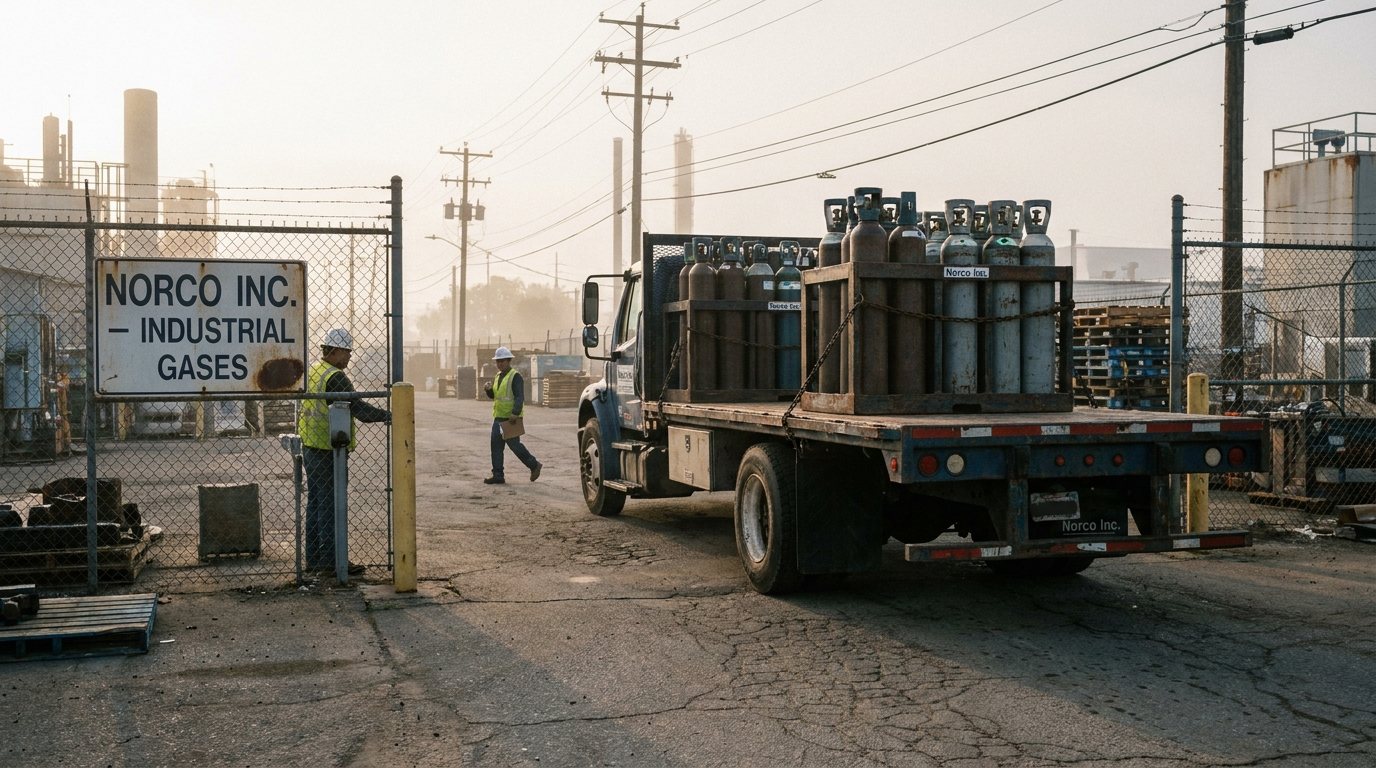
Norco Inc. shows up on Modern Distribution Management's 2026 Top Distributors list in the Gases & Welding Supplies category, one of the roughly 20 verticals MDM ranks each year across North America. The company doesn't disclose revenue, which fits its whole personality: Norco has spent close to six decades growing a regional industrial and medical gas business out of Boise, Idaho, without ever going public or selling to a strategic buyer. The more interesting fact isn't the ranking. It's that Norco is simultaneously a family business and one of the largest ESOPs in its sector, and it has run that way for over a decade.
From an auto parts counter to a seven-state footprint
Norco's origin traces to 1948, when it started as the welding supply division of Nordling Auto Parts in Boise. In 1968, Larry Kissler bought that division and struck out on his own. According to Norco's company history, Kissler arrived with his wife Fran and four kids to find just two locations, Boise and Twin Falls, and 15 employees. He brought in Dan Steele as general manager, and the two spent the next two decades doing what small regional gas distributors have always done to survive: buying up neighboring welding supply distributorships across the Intermountain West.
The gas side of the business grew almost by accident. Norco started calling on hospitals to sell medical oxygen, then built out a durable medical equipment line under Neil Emerizy. That split, industrial gas on one side and medical gas and equipment on the other, is still the company's structure today: Norco Industrial and Norco Medical run as separate divisions under one parent, according to norco-inc.com.
A quiet handoff, then a much louder one
In 1985, Larry's son Jim Kissler bought the company from his father. That's a routine succession by industry standards, family distributors change hands within families all the time. What Jim did thirty years later is not routine.
In December 2015, Norco converted 35% of its stock into an Employee Stock Ownership Plan covering 1,200 employees across what was then 75 branches in seven states, according to the company's ESOP announcement. Norco's president at the time, Ned Pontious, framed it plainly: "The willingness of Jim Kissler to offer this benefit to our employees is critical for our ongoing success." The stated goals were retention, motivation, and recruitment, the same three reasons every ESOP gets built. What made it notable in Idaho specifically was scale: the move reportedly made Norco the state's second-largest private employer offering an ESOP, trailing only WinCo Foods, a grocery chain famous for the same structure.
The insight: family control and employee ownership, running at once
Here's the part worth naming directly. Norco didn't choose between staying a family company and becoming an employee-owned one. It became both, and it still is. Jim Kissler kept the company; his daughter Nicole Kissler became CEO in 2021 while Jim moved to chairman, per Norco's leadership history. The family didn't cash out to employees, the way many ESOP conversions work when a founder is looking for a succession path and an exit. They gave up a third of the equity while keeping operating control, and kept building.
That's an unusual structure for this industry specifically. Gases and welding supplies is a vertical where the biggest names, Airgas (now part of Air Liquide) and Linde among them, are public multinationals, and where private equity has spent two decades rolling up regional welding distributors into platform companies built for eventual sale. Norco sits outside both patterns. It isn't selling to a strategic. It isn't being flipped by a sponsor on a five-year clock. It's a fourth-generation-adjacent family business that gave a chunk of itself away to the people running the branches, then kept acquiring on its own terms, most recently reflected in a Petersen acquisition noted on the company's branch map as of November 2025.
The trade-off is real, and worth stating rather than glossing over. An ESOP inside a still-family-controlled company means slower access to outside growth capital than a PE-backed roll-up gets, and it caps how aggressively Norco can chase the multi-state consolidation its bigger competitors are running. What it buys instead is retention in a labor market where welding-gas route drivers and branch technicians are hard to replace, and a governance structure that doesn't have to answer to a sponsor's exit timeline. Norco has picked speed and independence over scale-at-any-cost, and it's been picking that for a decade.
Why this matters more than the ranking
MDM's list measures size. It doesn't measure why a company got that size, or whether it'll still be independent in another decade. Norco's answer to that second question is baked into its cap table: an ownership structure almost nobody else in gases and welding supplies runs, built by a family that decided the fastest way to keep the business was to stop owning all of it.
Distribution's biggest stories rarely live in the boardroom. They live in the branch network, the catalog behind it, and the data that decides who gets what SKU on which truck. This series looks at the companies making that unglamorous machinery work.