
Roberts Oxygen: The Last Family Firm in Industrial Gas
How Roberts Oxygen stayed family-owned for three generations while Airgas, Praxair, and Linde consolidated the rest of the industrial gas industry.
Part of Distributor Playbooks — strategy teardowns of every company on the MDM Top Distributors lists.
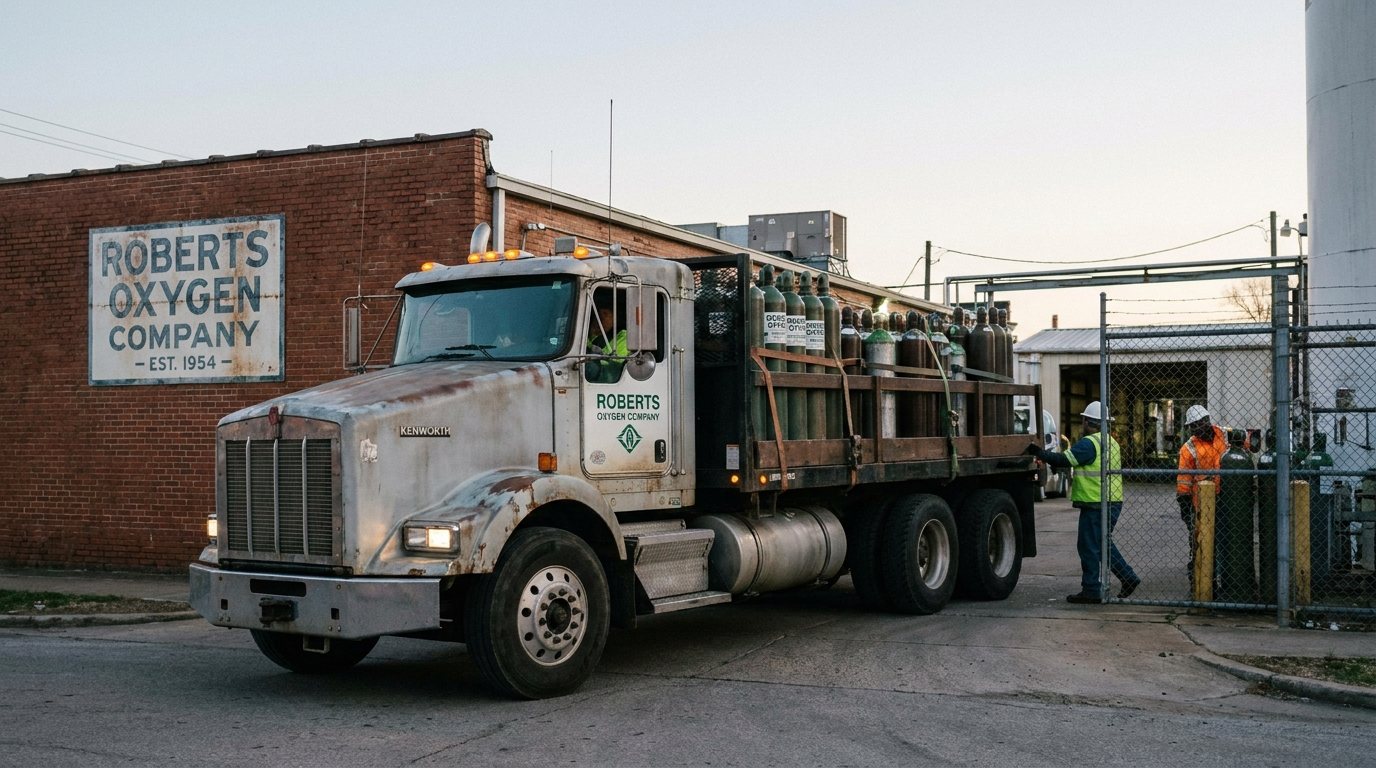
On July 1, 1966, Bill Roberts quit his job as Air Products' Southwest regional manager in Dallas and drove back to Washington, D.C. to start a compressed gas distributorship out of Rockville, Maryland. Sixty years later, that company shows up on Modern Distribution Management's 2026 Top Distributors list in the Gases & Welding Supplies category, one of a shrinking handful of independent, family-run names still competing against industrial-gas majors many times its size.
A founder who'd seen the trade from every angle
Bill Roberts wasn't a garage-startup outsider. His father had worked for National Cylinder Gas and Air Reduction, and Bill had already logged time at Southern Oxygen and Air Reduction before running Air Products' Southwest region out of Dallas. When he and his wife, Peg, launched Roberts Oxygen, he brought two things a new distributor rarely has on day one: supplier relationships and a working knowledge of how the gas business actually ran. Peg handled the office. Bill handled sales. Two early hires, Dick Owings and Mike Pinto, both poached from Southern Oxygen, gave the young company a sales and operations backbone from the start, according to GAWDA Media's account of the company's 55th anniversary.
The insight: family-owned in a sector that stopped being family-owned
Here is the part of the Roberts Oxygen story that matters more than any single branch count. Industrial gas distribution consolidated hard over the last decade. Air Liquide bought Airgas for $13.4 billion in 2016. Praxair and Linde merged in an $80 billion deal in 2018 to form the largest industrial gas supplier on earth. Matheson Tri-Gas has been owned by a Japanese parent, Taiyo Nippon Sanso, since the 1980s. Against that backdrop, a regional distributor still run by the family that founded it, now in its third generation, is not a quaint detail. It is a structural choice that shapes everything else: who Roberts Oxygen answers to, how patient its capital is, and why it can keep investing in branches and trucks on a multi-decade horizon instead of a quarterly one.
Three generations, one title at a time
The leadership sequence is unusually clean for a company this age, and it shows a family that treated succession as a planning problem rather than an inheritance.
| Generation | Name | Role transition |
|---|---|---|
| First | Bill Roberts | Founder, 1966; President until 1977 |
| Second | Bob Roberts | Joined as Controller, 1973; VP, 1976; President, 1977; later Chairman/CEO |
| Third | Will Roberts | Joined full-time, 2012; Corporate VP, 2015; President, February 2019 |
Bob Roberts didn't join the family firm straight out of school. He came in as a Controller after finishing his MBA, worked his way to Vice President, and only took the president title when Bill retired in 1977, per GAWDA's coverage of the 2019 presidential transition. Will Roberts followed a similarly earned path: a Cornell computer science degree, a stint as a software engineer at Raytheon Solipsys, and a company he co-founded (WonderProxy) before joining Roberts Oxygen full time in 2012 and taking the presidency seven years later. Bob stayed on as Chairman and CEO through the handoff, an overlap that let institutional knowledge transfer without the operation losing a generation's worth of supplier and customer relationships overnight.
That third-generation president's résumé is itself worth noting. A distributor whose incoming leader spent years writing code before running branches is a different kind of succession story than the classic "son inherits the truck keys" narrative. It suggests a family that let the next generation prove itself elsewhere first, then brought outside-world skills back into a business that, at its core, still runs on gas cylinders, cryogenic tanks, and delivery routes.
Growing the old-fashioned way: branch by branch
Roberts Oxygen's expansion has been almost entirely organic branch-building rather than acquisition-fueled roll-up, the opposite motion from the industry's majors. The company now operates dozens of locations stretching from the Mid-Atlantic into Florida. As recently as May 2025, it closed on a 17,000-square-foot facility on Donaldson Road in Piedmont, South Carolina, to serve as its base for Upstate South Carolina operations, delivering bulk and microbulk gases, dry ice, and technical services to industrial, research, and medical customers, according to Expansion Solutions Magazine's report on the purchase. That is the pattern: buy or build the real estate, plant a branch, extend the delivery radius, repeat. It is slower than buying a competitor's customer list, but it leaves Roberts Oxygen owning its own footprint outright in a business where owning the last mile of delivery is most of the moat.
What the tenure numbers say about the model
The company's own account of its history leans hard on employee longevity: staffers with 25, 33, even over 40 years at the company, and a stated philosophy that reads less like a mission statement and more like an operating rule: "The most important aspect of running a successful company is to have good employees and provide them with the tools and incentives to do their best work," per GAWDA's anniversary retrospective. Quarterly bonuses and annual profit-sharing are cited as the mechanics behind that retention. For a distributor whose product is largely commoditized gas, moving through a network of branches, the driver who's held the same route for two decades and the salesperson who knows every welding shop's account history are difficult for a larger, more centralized competitor to replicate quickly.
Roberts Oxygen's story is a reminder that distribution's real competitive terrain is rarely the product itself. It's the branch network, the delivery schedule, and the decades of account knowledge sitting behind the catalog, all of it built one generation, one branch, and one line-item at a time.