Albertsons: How a Boise Grocer Built a Banner Empire
Albertsons ranks #10 on NRF's Top 100 Retailers 2026 with $81.77B in U.S. sales. Here is how a 1939 Boise store survived private equity to get there.
Part of Retailer Playbooks — history-first profiles of every company on the NRF Top 100 Retailers list.
Albertsons ranks #10 on the NRF Top 100 Retailers 2026, with $81.77 billion in U.S. retail sales in 2025. Behind that number sits one of grocery's stranger survival stories: a company that got split in half by a leveraged buyout, operated as two separate businesses for seven years, then quietly stitched itself back together and came out bigger than before.
A district manager's side bet
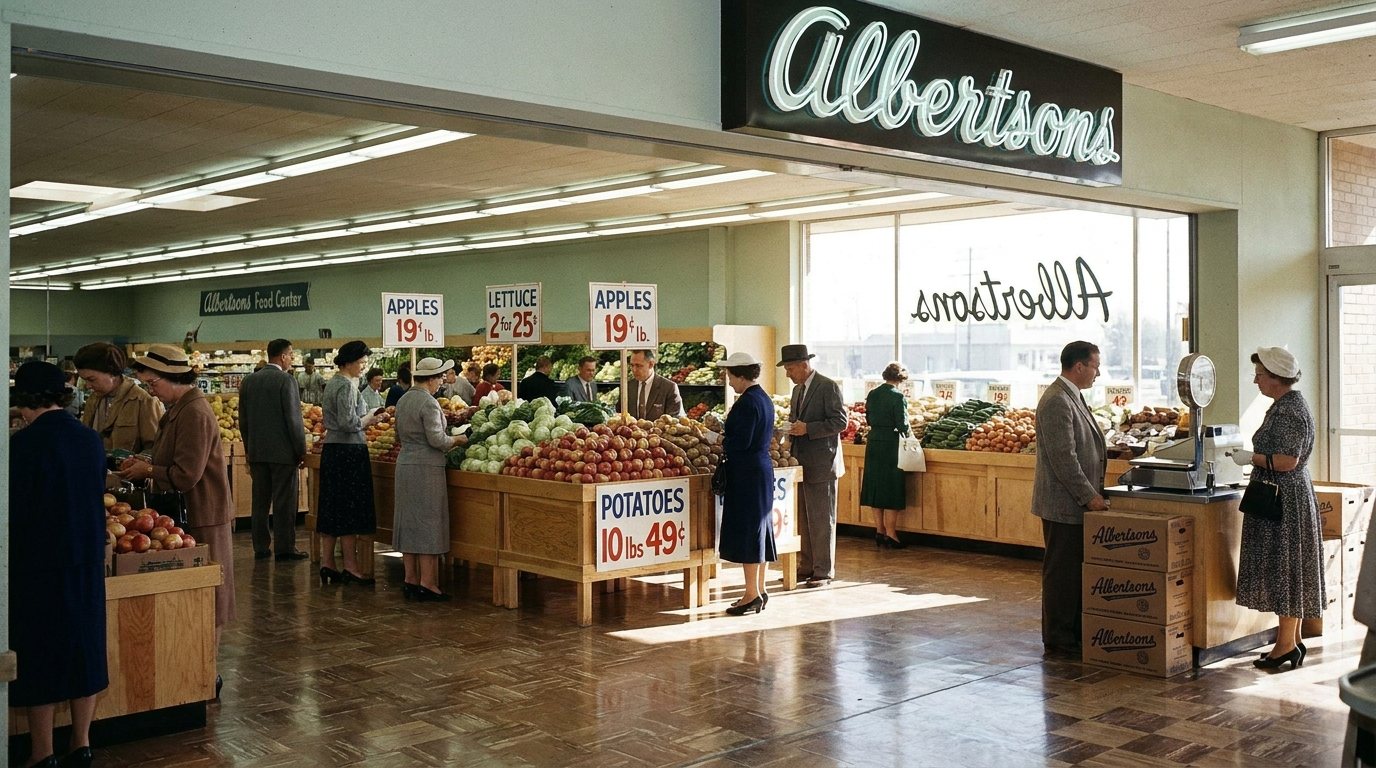
Joe Albertson spent the 1920s and 1930s climbing the ranks at Safeway, eventually running stores as a district manager. In 1939 he left, mortgaged his life insurance policy for $7,500, and partnered with L.S. Skaggs, whose family had helped build Safeway itself, and Tom Cuthbert to open a single store in Boise, Idaho. It was 10,000 square feet, roughly eight times the size of a typical 1930s grocery, and the opening ad promised "Idaho's largest and finest food store." It had an in-store bakery, homemade ice cream, and one of the first magazine racks in American retail. Sales topped $170,000 in year one against a $9,000 profit, according to FundingUniverse's company history.
The original three-way partnership dissolved in 1945, and Albertson incorporated the business on his own. By 1947 he had six Idaho stores and his own poultry-processing operation. The chain pushed into Washington, Utah, Oregon, and Montana through the 1950s and went public in 1959, twenty years after that first store opened.
The combination-store bet, twice
Albertson's most consequential early decision was a rerun of his own founding partnership. In 1969 the company teamed up again with Skaggs, this time Skaggs Drug Centers, to build combination food-and-drug stores as large as 55,000 square feet, nearly double the conventional supermarket of the day. The logic was margin: pharmacy and cosmetics carried better returns than groceries, and a bigger box meant more shelf for both. The Skaggs partnership ended amicably in 1977, but the format it proved out became the industry standard, and Albertson's kept building on it, adding electronic price scanners and superstores through the late 1970s and into the 1980s, per Wikipedia's account of the company's history.
Growth after that came almost entirely through acquisition. The 1998 purchase of American Stores Company was the biggest deal in company history at the time, bringing Acme, Jewel-Osco, Lucky, and Osco Drug under one roof. In 2004 Albertsons paid $2.5 billion for Shaw's and Star Market from Britain's Sainsbury's. Each deal added a regional name, and each time the company made the same choice: keep the local banner rather than repaint it.
Split in two, then sewn back together
That acquisition run stalled hard in 2006. A consortium led by Cerberus Capital Management and SuperValu bought the company and carved it apart: SuperValu took most of the store base and the Albertsons name for accounting purposes, while a Cerberus-controlled entity called Albertsons LLC kept roughly 661 stores across five divisions. For seven years, two separate companies operated stores that customers still walked into as "Albertsons."
The unwind came in March 2013, when SuperValu sold the "New Albertsons" stores back to Cerberus, reunifying ownership under one roof for the first time since the buyout. Cerberus wasn't finished shopping: a $385 million deal for United Supermarkets in 2013 was followed by the transformative one, a $9.2 billion merger with Safeway that closed in January 2015 and pushed the combined company past 2,200 stores. Albertsons finally went public again in June 2020, fourteen years after Cerberus took it private.
The company's next headline swing was an attempt to merge with Kroger, announced in October 2022 at $24.6 billion, with a divestiture package of stores earmarked for C&S Wholesale Grocers to satisfy regulators. Washington, Colorado, and the FTC all sued to block it during 2024, and a federal judge ruled against the deal that December, ending the largest supermarket merger ever attempted in the U.S., according to Wikipedia's coverage of Kroger. Albertsons kept operating as it had before the announcement.
The unique insight: Albertsons never wanted one name
The pattern across nine decades is not "grow the Albertsons brand." It's the opposite. Every major deal, American Stores in 1998, Shaw's in 2004, Safeway in 2015, added stores that kept their own names: Vons in Southern California, Jewel-Osco in Chicago, Acme in Philadelphia, Randalls and Tom Thumb in Texas, Carrs in Alaska. Most consolidators standardize signage to capture efficiency; Albertsons has spent decades doing the reverse, betting that a shopper's loyalty to "their" regional grocer is worth more than the marketing simplicity of one national name. That is arguably the real product of the company: not a supermarket format, but a portfolio of trusted local identities held together by shared buying power and supply chain, an approach that let it survive a leveraged breakup that would have killed a company built around a single brand.
| Year | Move |
|---|---|
| 1939 | First store opens in Boise |
| 1969 | Combination food-drug format launched with Skaggs |
| 1998 | American Stores deal adds Acme, Jewel-Osco, Lucky |
| 2006 | Cerberus/SuperValu buyout splits the company in two |
| 2013 | Ownership reunified under Cerberus |
| 2015 | Safeway merger closes, 2,200+ stores |
| 2020 | IPO after 14 years private |
| 2024 | Kroger merger blocked, terminated |
Every regional banner on an Albertsons receipt is a small monument to a company that got bought, split, and put back together, and decided the fastest way to be trusted everywhere was to never look the same anywhere.