
Aldi: The Grocery Chain Built by Splitting a Family in Two
Aldi is #14 on NRF's 2026 Top 100 Retailers list with $58.36B in 2025 U.S. sales. How a 1960 sibling split built two of America's grocery chains at once.
Part of Retailer Playbooks — history-first profiles of every company on the NRF Top 100 Retailers list.
Aldi ranks #14 on the NRF Top 100 Retailers 2026 list, with $58.36 billion in 2025 U.S. retail sales, per the National Retail Federation and Kantar. Most American shoppers know it as the store with the quarter-locked carts and the weekly aisle of power tools and kayaks. Fewer know that the company that owns Trader Joe's is, legally, Aldi's estranged twin.
A Widow's Shop in Essen
The story starts in 1913, when the mother of Karl and Theo Albrecht opened a small grocery store in Essen, Germany. Her sons took it over in 1946, rebuilding a business in a country still digging out from the war. By 1950 they ran 13 stores across the Ruhr Valley. By 1960 that number had grown to 300, built on a simple bet: strip out everything a grocery store did that didn't lower the price, and pass the savings straight through. Rather than run the loyalty-stamp promotions common in German retail at the time, the brothers simply cut prices by the legal maximum discount up front, according to Wikipedia's history of Aldi.
The Split That Made Two Aldis
In 1960, at the height of that growth, Karl and Theo divided the company between them. The official account says the brothers disagreed over whether to sell cigarettes at the checkout: Karl worried about shoplifting, Theo saw an easy margin. A journalist who later dug into the split, Martin Kuhna, argued the real cause was more mundane, that the two brothers simply ran their halves of the business differently and the arrangement formalized what had already split apart in practice. Whichever explanation is closer to true, the result was two independent companies, financially separated by 1966: Aldi Nord in the north, Aldi Süd in the south. In 1962 both adopted the shared name Aldi, short for Albrecht-Diskont.
That 1960 divorce is the reason Aldi's American footprint looks the way it does. Aldi Süd opened its first U.S. store in Iowa in 1976 and built the "Aldi" discount banner that now runs more than 2,400 stores across 39 states, with a 2024 plan to spend over $9 billion adding 800 more by 2028. Aldi Nord took a different path into the American market entirely: in 1979 it quietly bought a small Pasadena chain called Trader Joe's, according to Wikipedia. Trader Joe's still runs its own buyers, its own stores, its own culture, and most of its regulars have no idea their neighborhood-quirky grocery store and the discount warehouse across town descend from the same mother's shop in Essen. That's the detail an About page won't tell you: two of America's most distinct grocery formats are, on paper, cousins by way of a 1960 sibling dispute.
Why Theo Albrecht Disappeared
In 1971, Theo Albrecht was kidnapped and held for 17 days. His captors, a lawyer named Heinz-Joachim Ollenburg and an accomplice named Paul Kron, were paid a ransom of 7 million German marks, delivered by the Bishop of Essen, before police caught them and recovered only half the money, according to Wikipedia's entry on Theo Albrecht. Albrecht later tried, unsuccessfully, to write the ransom off as a business expense.
The kidnapping did more than make headlines. It hardened a family that was already private into one that essentially vanished. Theo began varying his commute and traveling in armored cars. Public photos of either brother became rare enough that Forbes once described the Albrechts as harder to spot than a yeti. That instinct toward invisibility, built in the 1970s, shows up today in a company that still discloses less than almost any retailer its size and lets the low prices, not the founders, do the talking.
Fewer Items, Faster Turns
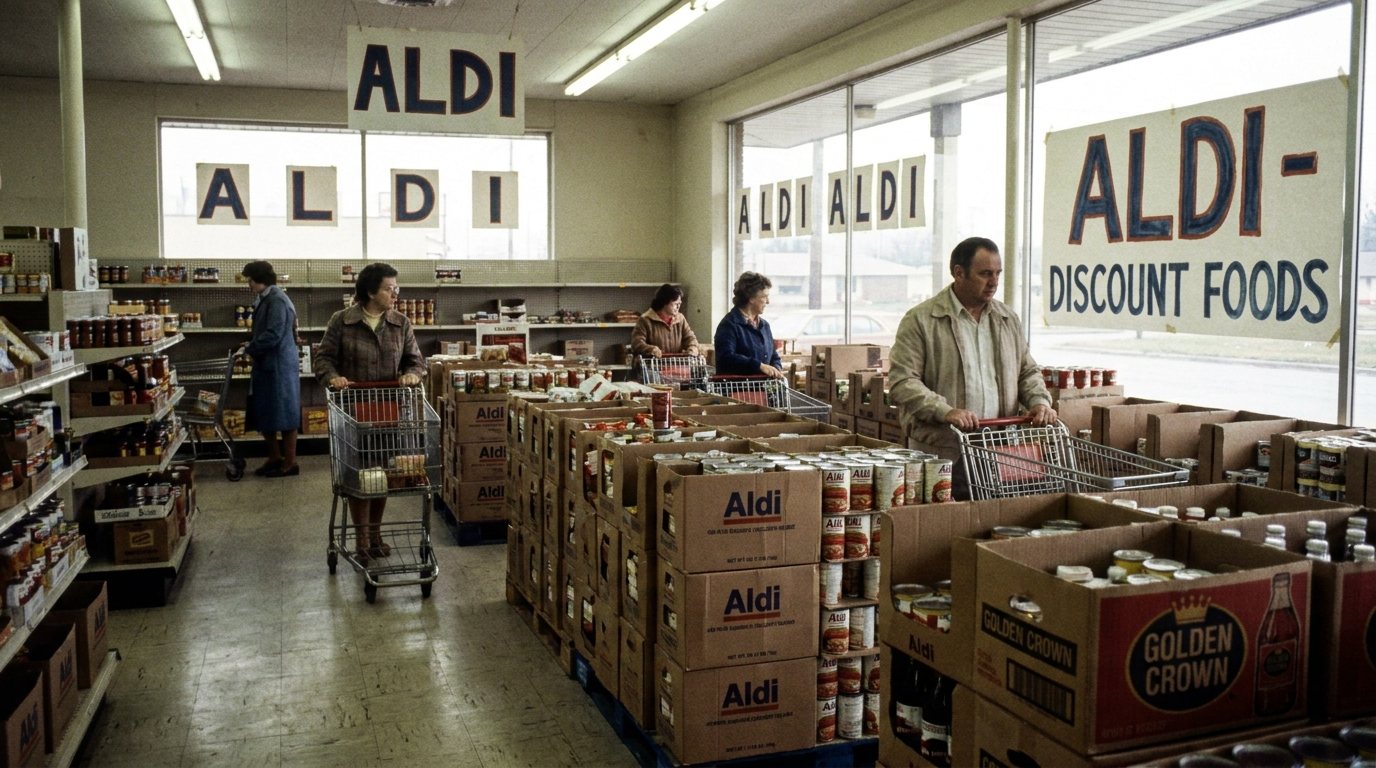
Aldi's operating math has stayed remarkably consistent across sixty years. Where a conventional supermarket might stock 30,000 to 40,000 SKUs, a typical Aldi store carries closer to 1,500 to 2,000, almost all of it private label. Fewer choices mean fewer suppliers to negotiate with, fewer shelf-tags to print, and stores small enough to run with a skeleton crew. A 1993 Forbes estimate cited by FundingUniverse put Aldi's U.S. labor costs at roughly 4% of sales against 10 to 12% for traditional grocers, and its net margin at nearly double the industry average despite gross margins far thinner than a full-service supermarket's. The company makes it back on velocity: cheaper carts, boxed-not-shelved inventory, and a captive audience that comes in for staples and leaves with whatever oddity is sitting in the center aisle that week.
The Model Everyone Else Copied
For decades, Aldi's format looked like an outlier next to America's supermarket chains, until the 2010s made hard discount the industry's biggest threat. Aldi Süd's U.S. arm has answered by doing what it rarely did in its first hundred years: spending aggressively, opening stores at a pace that puts it on track to be one of the three largest U.S. grocers by store count within a few years of 2028. It got there the same way it always has, by keeping the shelf count low and the receipt shorter than the next store over.
Grocery retail runs on the boring stuff nobody photographs: what's on the shelf, what's in the truck, and how fast the data behind both of them can be trusted. Aldi built an empire, twice, by treating that boring stuff as the whole business.