
AmeriGas: The Propane Giant That Had to Buy Itself Back
AmeriGas built America's largest propane network as a public partnership, then watched its own parent unwind that structure to save the business it created.
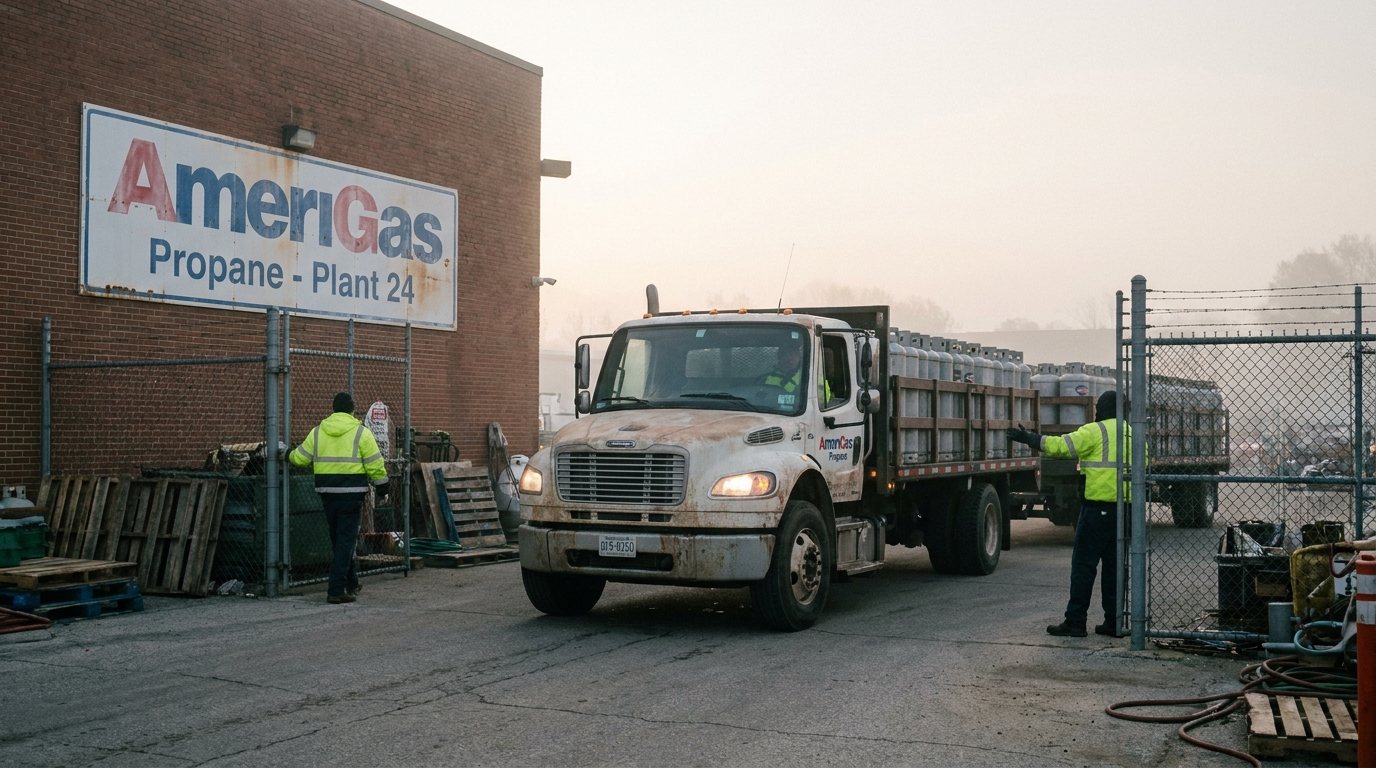
Part of Distributor Playbooks — strategy teardowns of every company on the MDM Top Distributors lists.
AmeriGas Propane landed on the 2026 MDM Top Distributors list in the Gases & Welding Supplies vertical, Modern Distribution Management's annual ranking of North America's largest distributors, with $2.28 billion in FY2025 revenue. That figure describes a company that fills tanks for more than a million homes, farms, restaurants, and job sites in all 50 states. The more interesting story is not how AmeriGas got that big. It is the financing structure it used to get there, and the fact that its own parent eventually had to unwind that structure to keep the business functioning.
A utility's unregulated side hustle
UGI Corporation, a Pennsylvania gas and electric utility dating to 1882, went looking for growth outside its regulated territory in the late 1950s. In 1959 a UGI subsidiary called Ugite Gas bought three small liquefied petroleum gas companies, according to a detailed corporate history. Propane distribution was attractive precisely because it was unregulated and cheap to enter: no utility commission, no fixed territory, just trucks, tanks, and a route sheet. Ugite expanded into eight states by 1977, and UGI created a new subsidiary named AmeriGas that same year to run the LP-gas business going forward.
The company took a detour in the 1970s and early 1980s, forming divisions to chase oil and gas exploration during the energy crisis. When oil prices collapsed, UGI absorbed a $45.7 million writedown in 1985 and refocused on the plain, unglamorous propane-delivery business it already understood.
Buying a bankrupt rival, then financing the combination as a public partnership
The real scale move came out of someone else's failure. Petrolane, a major propane competitor, went through bankruptcy reorganization in the early 1990s, and UGI began acquiring its debt and equity, building to a 35 percent stake by early 1994. In April 1995, UGI finished buying Petrolane and merged it with AmeriGas Propane into a single entity, AmeriGas Partners, L.P., taking the combined company public as a master limited partnership on the NYSE. The result, per the same corporate history, was immediately "the nation's largest retail propane marketing organization."
That MLP choice is the part worth sitting with. MLPs are the standard financing vehicle for pipelines and midstream energy infrastructure, assets with long, predictable cash flows and modest ongoing capital needs. AmeriGas used the same structure for a last-mile delivery business: thousands of trucks, tens of thousands of tanks, and a workforce that has to show up at a farm or a restaurant on a winter morning. An MLP is legally obligated to pass most of its cash flow to unitholders as quarterly distributions. A delivery network needs to plow cash back into fleet replacement, tank maintenance, and route technology. Those two obligations compete for the same dollar, and for two decades AmeriGas managed the tension by growing its way past it, buying propane companies faster than the payout drained the till: Penn Fuel Propane's assets for $32 million in 2008, then Heritage Propane from Energy Transfer Partners for roughly $1.46 billion in cash and $1.32 billion in common units in 2012, a deal that doubled the network overnight.
When the model cracked
Serial acquisition works until the pipeline of accretive targets thins out or the unit price stops rewarding it. By 2018 and into 2019, AmeriGas Partners' public units were struggling, and UGI's own quarterly earnings softened alongside them. In April 2019, UGI announced it would buy out every publicly held AmeriGas unit it didn't already own; the deal closed that August, with unitholders receiving 0.50 shares of UGI stock plus $7.63 in cash per unit, a package valued at roughly $2.44 billion for the 69.2 million public units. That ended a 24-year run as an independently traded partnership. The unique insight here is straightforward and rarely stated plainly: the exact financing mechanism that let AmeriGas out-acquire its way to national scale was the same mechanism its own parent had to dismantle to stop the company's public value from eroding. Growth-by-roll-up and a public-yield structure make uneasy long-term partners in a business this capital-hungry.
The reckoning wasn't finished
Full ownership didn't immediately fix the underlying strain. UGI's fiscal 2024 results were dragged down by a large impairment charge tied to the propane segment, and AmeriGas posted a loss for the year. In December 2024, UGI installed Michael Sharp, a 25-year energy-industry veteran who had previously overseen fleet operations at Talen Energy, as AmeriGas's new president and CEO, with an explicit mandate to stabilize service and cut costs before chasing growth again.
A rebound, and a very old trade trying something new
It worked, at least for one year. In its fiscal 2025 results reported November 20, 2025, UGI posted GAAP net income of $678 million against $269 million the prior year, crediting the absence of that earlier impairment along with improved margins across the AmeriGas segment. Six months later, AmeriGas took its most unconventional swing yet: on May 7, 2026, it began selling and exchanging pre-filled propane cylinders directly on Amazon, starting in Philadelphia, Washington, and Atlanta with 17 more markets queued behind them. "This is about challenging the status quo and utilizing modern digital platforms to make it as easy as possible for customers to get fueled propane cylinders delivered directly to their front door," said Shaun Hart, the company's VP of Sales & Marketing.
Whether that recovery holds is now entirely a UGI balance-sheet question, not a public-market one. There are no more units to buy back and no outside investors to reassure. The 66-year arc from a utility's side hustle to a public partnership to a fully absorbed subsidiary is a reminder that the financing wrapper around a distribution business matters as much as the trucks and the tanks inside it.
Every distributor in this series wins or struggles on the unglamorous stuff behind the branch signage: fleets, routes, tanks, catalogs, and the data that keeps all of it moving on schedule. AmeriGas's history is a case study in how the financing built on top of that infrastructure can end up mattering just as much.