
Amway: The Basement Startup That Wrote the Rules of Direct Selling
Amway ranks #61 on NRF's 2026 Top 100 Retailers with $7.35B in U.S. sales. The 1959 basement startup that built the legal template an entire industry still runs on.
Part of Retailer Playbooks — history-first profiles of every company on the NRF Top 100 Retailers list.
Amway lands at #61 on the National Retail Federation's Top 100 Retailers 2026 list, compiled with Kantar, with $7.35 billion in 2025 U.S. retail sales. It is an unusual name to find there. Amway owns no stores, runs no checkout lanes, and ships almost nothing directly to a stranger. Its entire retail footprint is a network of people, and that network was assembled in a basement in Ada, Michigan, by two friends who had already failed together once.
Two friends and a sailing schooner
Jay Van Andel and Rich DeVos met at Grand Rapids Christian High School in the 1930s, sons of Dutch immigrant families where entrepreneurship was practically a catechism. Van Andel served as a U.S. Army Air Force officer training bomber crews during World War II. After the war, the two went into business together, an early venture that included chartering a sailing schooner, before it folded.
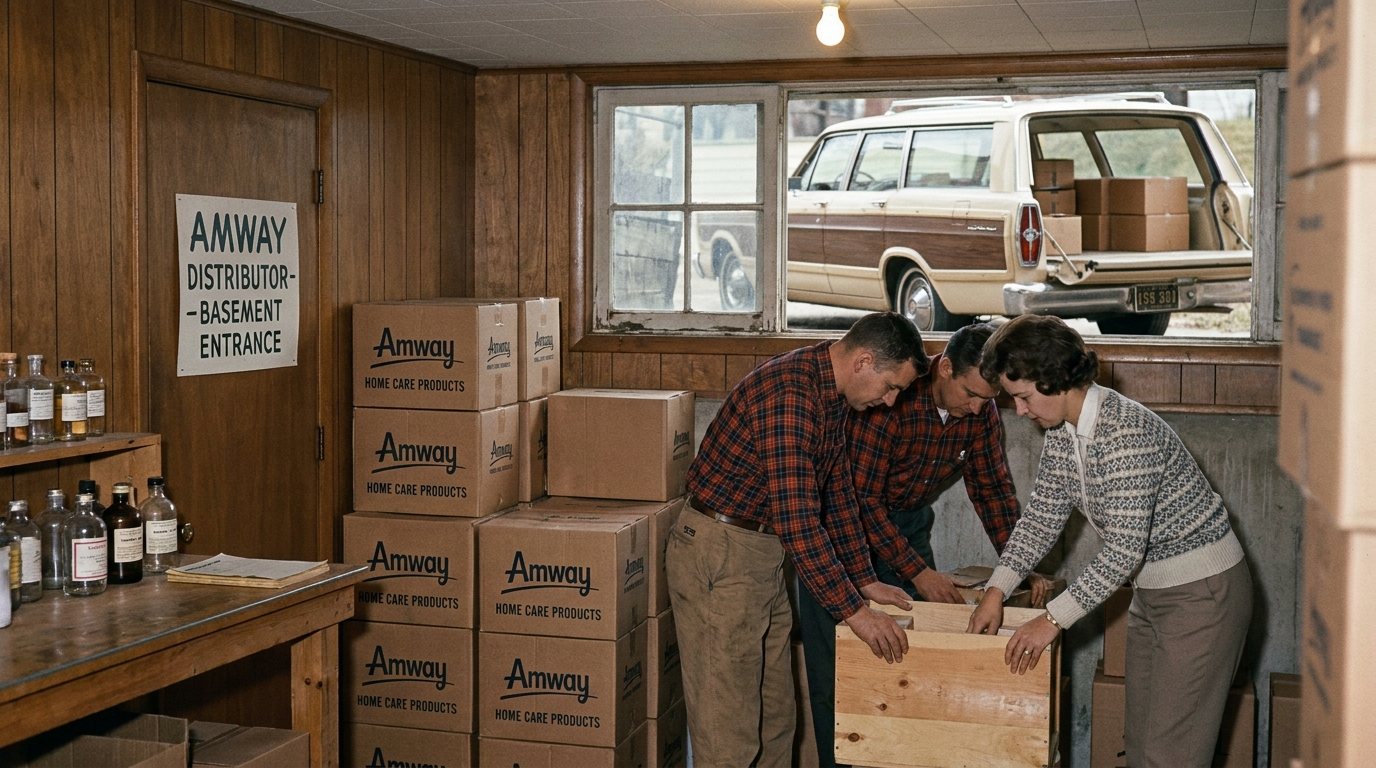
In 1949 they found their real opening: after attending a seminar in Chicago, they became distributors for Nutrilite, a California nutritional-supplement maker that sold through a multi-level structure, one distributor recruiting the next. Van Andel and DeVos were good at it. By 1958 they had built a downline of more than 5,000 distributors, and they had grown uneasy about how much of their business depended on a single supplier. So they hedged. They started sourcing and selling other products, including a biodegradable organic cleaner nicknamed Frisk, and in April 1959 they formalized the operation as the American Way Association, run out of their own basements. Amway incorporated as Amway Sales Corporation that same year and opened its first outside office in 1960, in a converted service station.
From service station to $10 million
The early growth curve is the part every direct-selling company since has tried to replicate. First-year sales in 1960 came in around $500,000. They roughly doubled annually through the early 1960s, hitting $10 million by 1964, the year Van Andel and DeVos merged their separate sales, services, and manufacturing entities into a single Amway Corporation. Van Andel took the chairman's title, DeVos became president, and the arrangement held for three decades.
The supply chain lesson from those early years is a good one: in 1969, an aerosol-manufacturing plant fire cost the company roughly $700,000. Amway rebuilt it within six months. By the mid-1970s the company had consolidated some 30 regional warehouses down to seven distribution centers, a structural bet on logistics discipline over retail sprawl that a traditional chain, worried about square footage and foot traffic, would not have made in the same order.
Amway also fixed its original supply-chain anxiety directly. It bought a controlling stake in Nutrilite in 1972 and full ownership by 1994, turning the company it once depended on into a captive brand. Nutrilite supplements alone reached nearly $4.7 billion in sales by 2011, with the Artistry beauty line close behind at $2.8 billion.
The case that built an industry's rulebook
Here is the part of Amway's history that most shapes American retail today, and it rarely makes the About page. In 1979, the Federal Trade Commission ruled on a multi-year investigation into whether Amway operated an illegal pyramid scheme. The FTC found Amway guilty of price-fixing and making exaggerated income claims to recruits, but it also found that Amway's business model, specifically its rules requiring distributors to sell a real volume of goods to actual retail customers and guaranteeing they could return unsold inventory, kept it on the legal side of the line between direct selling and a pyramid scheme.
That ruling did not just settle Amway's case. It produced a working legal definition, still cited today, of what separates a lawful direct-selling company from an illegal pyramid operation: verifiable retail sales to real customers, and a buy-back guarantee on inventory. Every multi-level marketing company that has operated legally in the United States since 1979 has built its compliance program around some version of the Amway Rules. That is the non-obvious throughline here: a Michigan cleaning-products company's federal court case became the load-bearing wall for an entire retail channel, the same way a building code shapes every house built after it, whether or not the builder knows the code's origin story.
The company was not untouchable after that. It made a serious run at buying Avon in 1989, offering $2.1 billion, and was turned down. Its 1998 revenue fell to $5.7 billion, its first decline in more than a decade, after a run that had carried it from $1 billion in 1990 to $7 billion in 1997. In 2010 it paid $56 million to resolve a separate set of pyramid-scheme allegations, a reminder that the model requires constant defending, not a one-time court win.
Handing off, and holding on
Van Andel and DeVos retired from day-to-day leadership in the early 1990s, handing the company to their children. Dick DeVos became president in 1992 and Steve Van Andel chairman, with the founders' combined net worth estimated near $9 billion by the mid-1990s. Rich DeVos went on to buy the NBA's Orlando Magic in 1991 and died in 2018 at 92. Jay Van Andel died in 2004 at 80, after founding the Van Andel Institute for disease research in 1996.
In 1999 the founding families restructured the business under a holding company, Alticor, with Amway as its flagship direct-selling brand. Today Steve Van Andel and Doug DeVos serve as co-chairs and Milind Pant as CEO, running a business that reported roughly $8.1 billion in global revenue in 2022 across more than 100 markets, still selling Nutrilite, Artistry, the eSpring water filtration system, and XS energy drinks through independent business owners rather than shelves.
Every company on the NRF's list moved product to a customer last year. Most of them did it through a door, a website, or a loading dock. Amway did it, at scale, through a stranger's living room, and the legal groundwork it laid to make that possible outlasted the cleaning products that started it.