
AVB BrandSource: How a Fishing Trip Built a National Co-op
AVB BrandSource ranks #64 on NRF's Top 100 Retailers with $7.02B in 2025 U.S. sales, the legacy of a 1969 fishing-trip pact among independent dealers.
Part of Retailer Playbooks — history-first profiles of every company on the NRF Top 100 Retailers list.
AVB BrandSource lands at #64 on the National Retail Federation's Top 100 Retailers 2026, compiled with Kantar, with $7.02 billion in 2025 U.S. retail sales. That single line item hides an unusual fact: no one owns AVB BrandSource. It is not a chain. It is a federation of several thousand independently owned appliance, electronics, home furnishings, and bedding stores that pool their purchasing so a family-run shop in Ohio can buy a refrigerator at close to the price a national chain pays.
Born on a fishing boat
The founding story, retold every year at the group's convention, is specific enough to trust. In the spring of 1969, a handful of appliance and electronics retailers from Southern California were out on a fishing boat when the conversation turned to a shared problem: manufacturers gave volume discounts to the big chains, and none of them alone could match that volume. By that summer they had formed Associated Volume Buyers, pooling purchase orders so independent dealers could buy at scale while keeping their stores and their names, according to Yelp's business listing for AVB Marketing, which recounts the origin story, and AVB's own site.
It was a modest premise: buy together, compete separately. Fifty-plus years later it is still the whole model. AVB is structured as a not-for-profit, member-owned cooperative, meaning the dealers who buy through it also govern it, and any margin the group captures on the buying side flows back to members rather than to outside shareholders, per avb.net.
From buying club to national brand
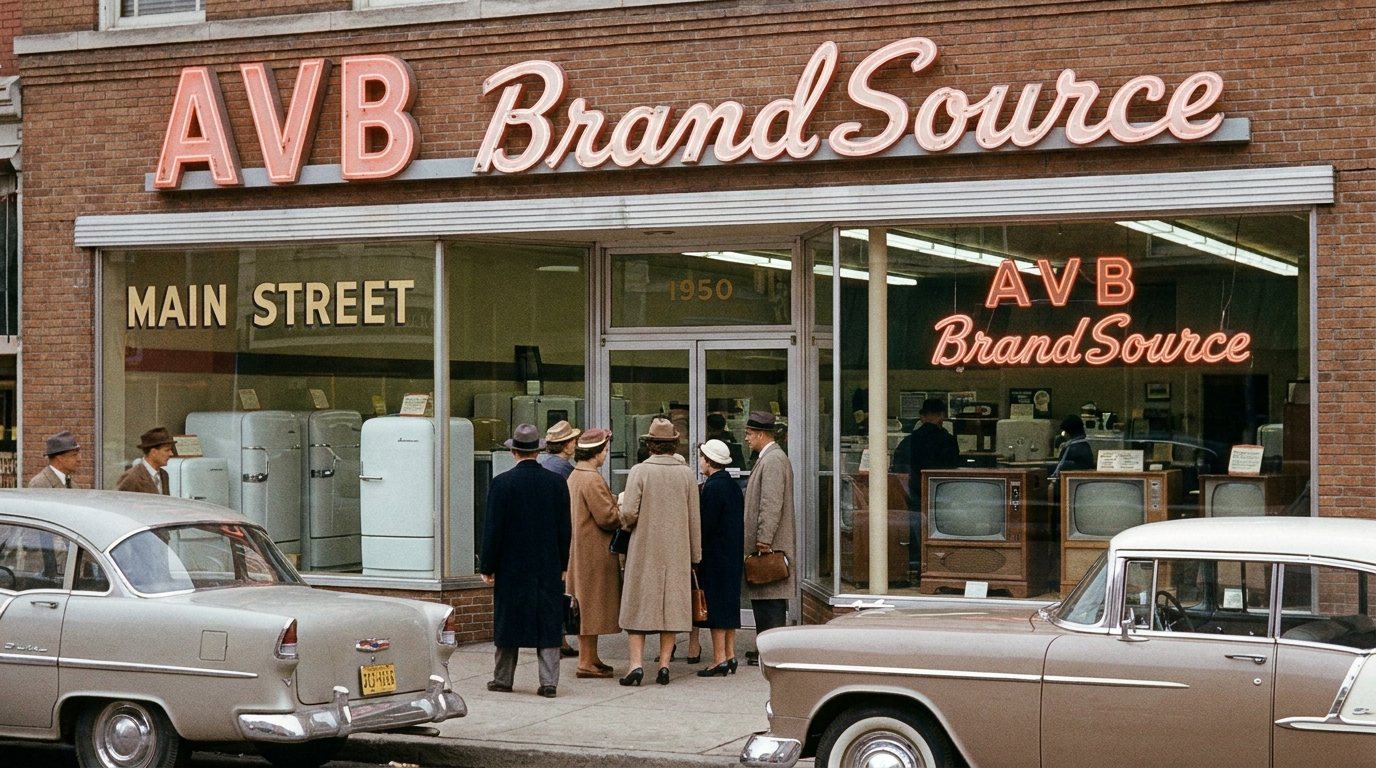
For its first three decades, AVB was purely a purchasing organization: it negotiated with Whirlpool, GE, and the rest, and members carried whatever brand names they chose above the door. That changed around 2000, when AVB rolled its member stores under a single consumer-facing identity, BrandSource, and began running national television and radio advertising on their behalf, a shift covered by industry trade press. The move mattered because it addressed a problem buying power alone couldn't fix: an independent dealer can match a big-box price, but it cannot match a national ad budget. A shared brand let thousands of separately owned stores advertise like one.
That single idea, borrow scale for buying and borrow scale for marketing but never for ownership, is the thread connecting AVB's founding to its current size. The organization now describes itself as the largest member-owned buying group of independent retailers in appliance, home furnishings, bedding, electronics, and custom integration in North America, employing more than 250 people across five countries in support of its members, according to avb.net. Its BrandSource division alone represents nearly 5,000 independent dealers across the U.S. and Canada, per joinbrandsource.com.
The decades that tested the model
| Era | What happened | Why it mattered |
|---|---|---|
| 1969 | Founding as Associated Volume Buyers | Independent dealers pool purchase orders to reach chain-level buying scale |
| Circa 2000 | BrandSource national brand launched | Adds shared advertising and marketing to shared buying, letting small stores look and sound national |
| 2000s-2010s | Big-box and e-commerce consolidation reshapes appliance retail | Co-op model becomes the main lifeline keeping independent dealers price-competitive |
| 2019 | 50th anniversary, membership near 5,000 dealers | Group frames itself as the largest member-owned buying organization in the country, per Your Source News |
The middle decades of that timeline were not gentle ones for independent appliance and electronics dealers. Category killers, then big-box chains, then online retail each arrived with pricing that a standalone storefront could not touch on its own. Buying groups like AVB were built for exactly this kind of pressure, and the fact that AVB's membership was still measured in the thousands at its 50th anniversary in 2019, per Your Source News, suggests the cooperative structure did what it was designed to do: let small operators survive waves of consolidation that killed plenty of unaffiliated competitors.
The unique wrinkle: a federation on a list of corporations
Here is the detail that separates AVB BrandSource from nearly everything else on the NRF Top 100: every other name on that list, from the department stores to the club warehouses, files one balance sheet and answers to one board. AVB BrandSource's $7.02 billion is the aggregated result of thousands of separately owned businesses, each with its own storefront, its own payroll, and its own name on the door in most cases. The co-op itself does not sell refrigerators or televisions to a single consumer. It negotiates, brands, and finances on behalf of people who do. That is a genuinely different animal from a corporate retailer, and it is the reason AVB BrandSource's presence on a list otherwise dominated by public and private chains is worth pausing on: it is proof that a cooperative structure, invented on a fishing boat by merchants who wanted to keep their independence, can still put up chain-scale numbers more than half a century later.
What holds the model together today
AVB's current structure extends the same logic into adjacent categories through partner organizations: ProSource for consumer tech and custom integration, TRIB Group for rent-to-own, Mega Group for the Canadian market, and HFA Buying Source for home furnishings dealers, according to joinbrandsource.com. Each extension follows the founding pattern: aggregate the parts of the business that benefit from scale, leave ownership and day-to-day operations with the independent dealer.
It is a model built for a specific kind of operator, the family business that wants to compete on price and marketing reach without selling the store. Fifty-seven years after that fishing trip, thousands of dealers are still betting that arrangement beats going it alone, or selling out entirely.
Every retailer on this list runs on some piece of unglamorous infrastructure, whether that is a supply chain, a store network, or in AVB BrandSource's case, the purchasing and marketing scaffolding that lets thousands of independent businesses look and buy like one.