
Avnet Runs Two Distribution Businesses Under One Roof
Avnet ranks #2 on MDM's 2026 Electronics distributor list. Its real edge is running a low-margin broadline arm and a high-margin design business as separate brands.
Part of Distributor Playbooks — strategy teardowns of every company on the MDM Top Distributors lists.
In fiscal 2025, semiconductors made up 78 percent of Avnet's sales. When that market cratered, net income fell 52 percent in a single year. A year later, quarterly sales were up 34 percent year over year and the stock hit an all-time high. That whiplash is not a flaw in Avnet's business. It is close to the whole point of how the business is built.
Avnet lands at #2 on Modern Distribution Management's 2026 Top Distributors list for electronic components, with $22.2 billion in FY2025 revenue by MDM's count. It has held a place near the top of that ranking for decades, through booms, gluts, and at least one near-total reinvention of what an electronics distributor is supposed to do.
The barbell nobody merges
Here is the pattern a reader would not get from Avnet's About page: this is really two distribution businesses stapled together, and Avnet has deliberately kept them from blending into one.
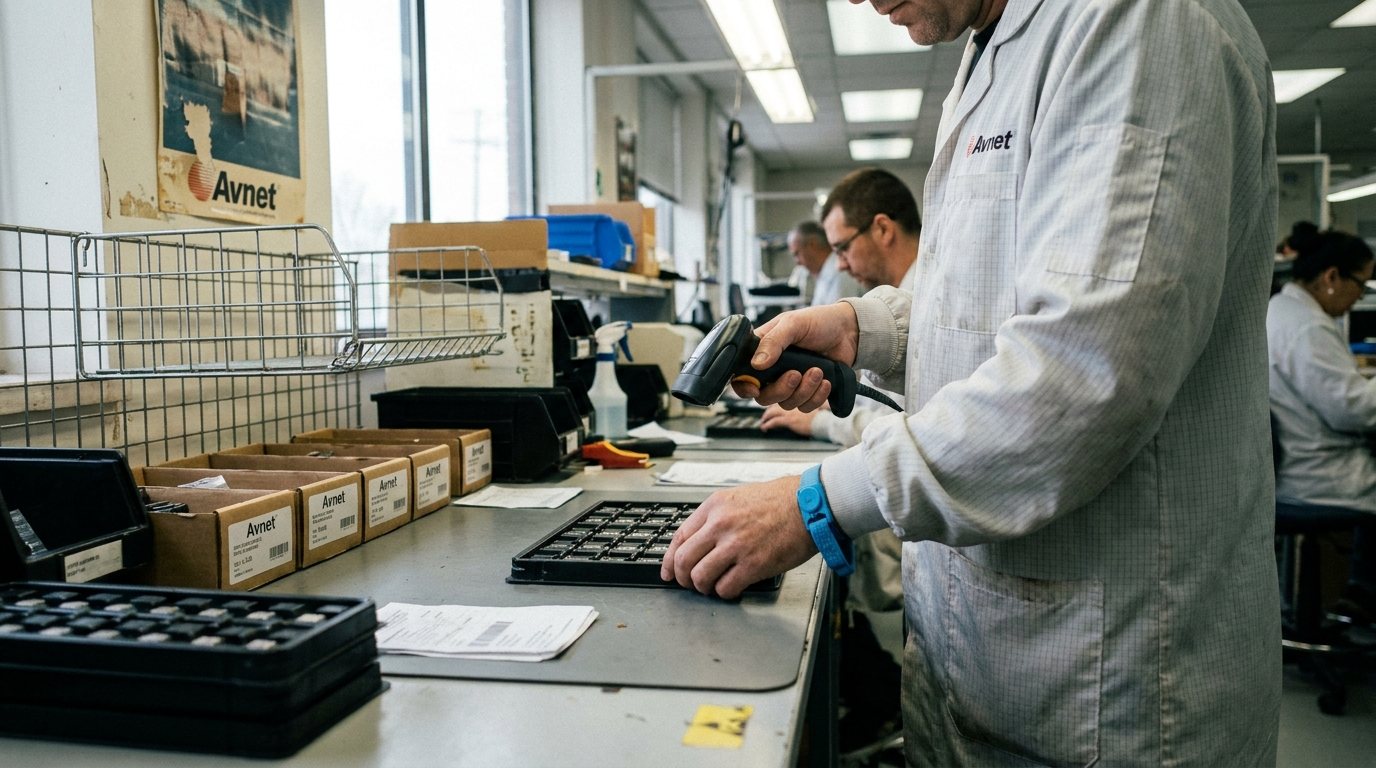
The first is broadline distribution under the Avnet name: massive volume, thin margins, and inventory turns measured in weeks, moving components from Texas Instruments, Analog Devices, and dozens of other manufacturers into the hands of contract manufacturers and OEMs building at scale. It is a working-capital business more than a sales business. Avnet expanded its receivables purchase facility from $500 million to $700 million in mid-2025, extending it through 2028, according to Investing.com's coverage of Avnet's filings, a housekeeping move but a telling one. Financing the float between paying suppliers and collecting from customers is a core competency here, not an afterthought.
The second business is Farnell, acquired as Premier Farnell for roughly £691 million in 2016 according to Avnet's company history on Wikipedia. Farnell sells in small quantities to engineers building prototypes, running a catalog-and-kit model with far higher margins and a much smaller average order. Avnet could have folded Farnell's brand and catalog into its own storefront after the acquisition. It did not. Nearly a decade later, Farnell still operates as a distinct brand serving a distinct customer, engineers designing the next product rather than manufacturers building the current one.
Running both under one holding company gives Avnet a rare piece of market intelligence: it sees demand at the design stage through Farnell, months or years before that same part shows up as a broadline order at volume. Keeping the brands separate protects each business's operating muscle. A high-touch, small-quantity, engineering-support model and a high-volume, low-touch, just-in-time logistics model reward opposite instincts, and Avnet has resisted the temptation to average them into something worse than either.
From Radio Row to Intel's first phone call
The company's origin is almost quaint next to the $24 billion machine it became. Charles Avnet, a Russian-Jewish immigrant in his early thirties, started out in 1921 buying surplus radio parts on Manhattan's Radio Row and reselling them, per Wikipedia's account of the company's founding. As radio manufacturing matured, he pivoted from selling to hobbyists to supplying component distribution for manufacturers, the shift that turned a Radio Row storefront into the template for the modern electronics distributor.
The pivotal validation came decades later: Avnet became Intel's first authorized distributor in 1973, a relationship that anchored its position at the center of the semiconductor supply chain as that industry exploded. The company moved its headquarters to Phoenix in 1998, migrated its listing from the NYSE to Nasdaq in 2018, and along the way absorbed Kent Electronics for roughly $600 million in 2001 and Bell Microelectronics for $631 million in 2010, each acquisition adding scale and geography rather than changing the underlying model.
The one acquisition that did change the model was Farnell in 2016, paired the same year with the sale of Avnet's Tech Data-adjacent technology solutions business for about $2.6 billion. That was the moment Avnet chose to go deeper into components and design services and step back from broader IT distribution, a bet that the barbell described above would out-earn a more generalist strategy.
Leadership that grew up inside it
Avnet's last two permanent CEOs both spent most of their careers at the company before running it. Rick Hamada joined as a technical specialist in 1983 and became CEO in 2011. Phil Gallagher, named CEO in November 2020, is described in company materials as a 40-plus-year Avnet veteran who ran the global broadline components business before taking the top job. For a public, Nasdaq-listed distributor operating in a sector that has consolidated hard around acquirers and private equity, promoting from three or four decades of internal tenure is a quieter kind of differentiation than any acquisition.
The tension worth naming
The same cyclicality that makes Avnet's numbers swing wildly is the reason the barbell model exists at all. Broadline distribution is a bet on the semiconductor cycle; Farnell's design-stage business is a partial hedge against it, since prototype and R&D spending does not collapse as fast as production orders when the market turns. But hedges are never free. Running two brands, two cost structures, and two working-capital profiles inside one company is organizationally harder than running one, and it means Avnet's overall margin will always look thinner than a pure design-services player's and its growth choppier than a pure broadline player's. Avnet is betting that owning both ends of the chain is worth the complexity. The FY2025 downturn and the FY2026 snapback both suggest the bet still pays, just not smoothly.
Distribution rewards the companies willing to do the unglamorous work well: keeping a catalog current, a branch network stocked, and a data pipeline clean enough that the next order ships correctly the first time. That is as true for a hundred-year-old components giant as it is for the smallest regional wholesaler.