
How DigiKey Built an Electronics Empire Without Branches
DigiKey ranks #6 in Electronics on MDM's 2026 Top Distributors list. How a family-owned company in rural Minnesota built a one-warehouse global moat.
Part of Distributor Playbooks — strategy teardowns of every company on the MDM Top Distributors lists.
DigiKey lands at #6 in the electronics vertical on Modern Distribution Management's 2026 Top Distributors list, the annual accounting of North America's largest distribution companies. What separates DigiKey from the distributors around it, and from most of the vertical, is what it refused to do to get there. No branch network, no public stock ticker, no relocation out of a town of roughly 8,000 people in northern Minnesota.
A Morse code side project with too much leftover inventory
DigiKey traces back to 1972, when Ronald Stordahl, an electrical engineer and amateur radio operator, started selling kits that helped ham operators generate cleaner Morse code signals. The kits sold slower than the parts inside them. Stordahl noticed customers wanted the components on their own, so he pivoted to mail-order electronic parts sales, according to Wikipedia's account of the company's history. That accidental pivot, selling the raw material instead of the finished kit, is the same logic that still runs the business more than fifty years later: DigiKey doesn't design anything. It stocks everything and gets it to the engineer's bench faster than the alternative.
The single-warehouse bet
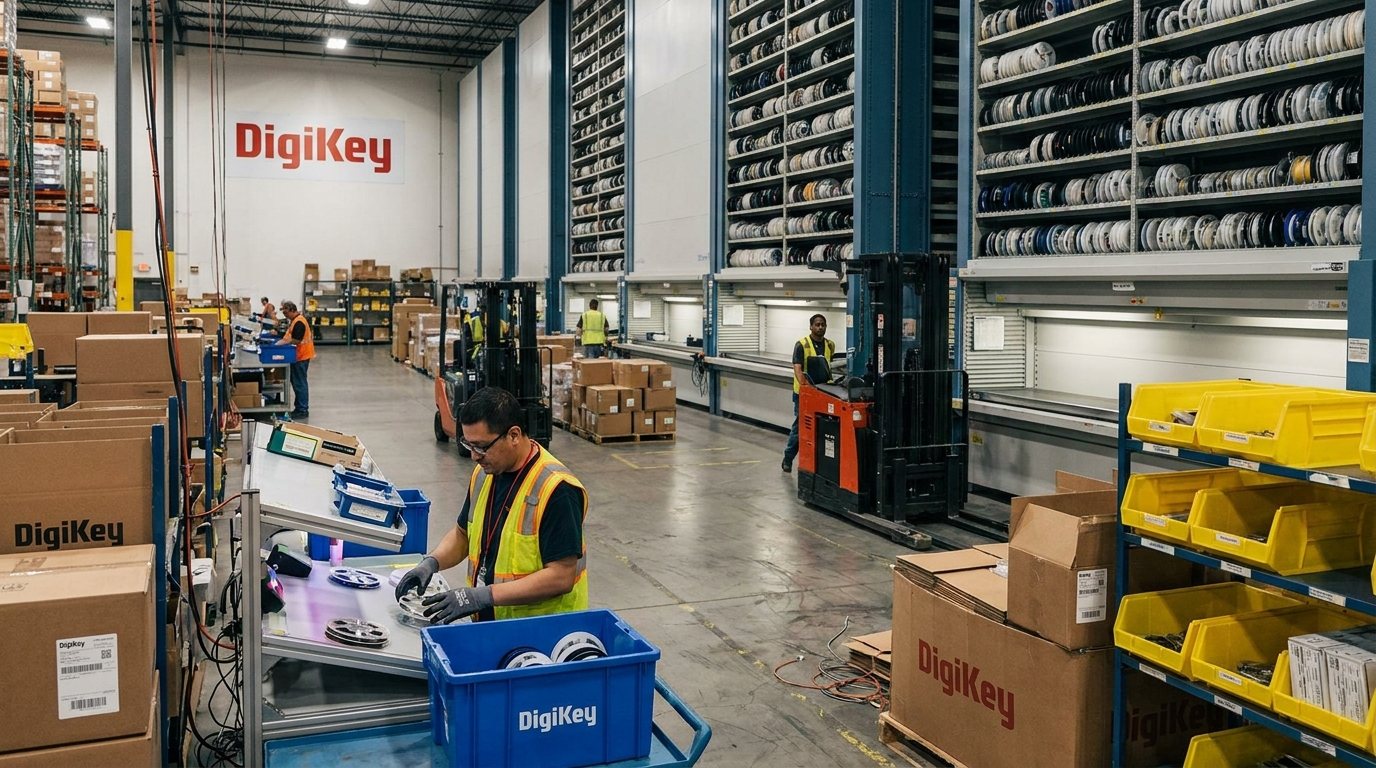
Most of the distribution channel wins through geography: branches near customers, regional hubs, trucks running short routes. DigiKey built the opposite model. Rather than open a chain of local stocking points, it kept doubling down on one location: Thief River Falls, a town far from any major interstate or airport hub. The company built what was, at the time, Minnesota's largest building there, then added a 2.2 million-square-foot expansion that opened in August 2022, bringing total facility space past 3 million square feet, according to DigiKey's own company facts page.
The bet only works if automation erases the distance penalty. DigiKey's pitch to customers isn't "we're close to you," it's "we can process your order, however small, in minutes and ship it same day from wherever we are." The company says it handles more than 6.5 million orders a year from a footprint that stocks upward of 17 million components from roughly 3,000 manufacturers. That's a company betting that a warehouse's processing speed matters more than its zip code, a wager most of the channel hasn't made because most distributors don't sell a catalog this deep to customers this fragmented.
Selling the long tail, one unit at a time
The other half of the model is who DigiKey sells to. Arrow and Avnet built their scale chasing large production runs and franchise agreements with OEMs buying in volume. DigiKey built its catalog for the opposite customer: an engineer who needs eleven of one resistor value for a prototype, wants it shipped tomorrow, and doesn't want to talk to a salesperson to get it. No minimum order, a search interface built for parametric filtering rather than account-rep relationships, and inventory breadth deep enough that the obscure part is usually in stock. That's a genuinely different business than the volume-production distributors ranked near it on MDM's list, even though all of them get counted in the same electronics category.
In 2020, DigiKey extended that catalog logic into a marketplace layer, letting vetted third-party sellers list industrial and automation products, from pneumatics to machine safety gear to MRO supplies, directly on digikey.com. DigiKey doesn't hold that inventory. It rents its search traffic and reputation to partners in exchange for expanding what a customer can buy in one session, without expanding what DigiKey itself has to warehouse.
Still privately held, in a sector that got rolled up
The unique thing about DigiKey's ownership is what didn't happen. Much of electronics distribution consolidated hard over the past two decades. Mouser Electronics has been under Berkshire Hathaway's TTI since 2007. Arrow and Avnet are public companies answering to quarterly guidance. DigiKey stayed privately held by the Stordahl family, run day to day by longtime president Dave Doherty, and never sold a stake to a strategic buyer or private equity sponsor. That's a real strategic choice, not an accident of size: staying private lets DigiKey keep reinvesting in a single capital-heavy facility on a multi-decade horizon instead of a model built around next quarter's numbers.
That patience gets tested by a boom-bust cycle the model can't fully dodge. DigiKey's revenue, per Forbes' tracking of the company as one of America's largest private companies, rode the pandemic-era component shortage up sharply, then came back down as customers worked through the inventory they'd hoarded.
| Fiscal year | Revenue |
|---|---|
| 2022 | $4.7B |
| 2023 | $5.1B |
| 2024 | $4.0B |
| 2025 | $3.5B |
A catalog built for small, frequent orders should be more insulated from destocking swings than a distributor living on large franchise contracts. DigiKey's numbers show it wasn't fully insulated, just less exposed. That's the honest tension in the model: broad reach into prototyping and low-volume buying smooths the cycle, it doesn't cancel it.
Distribution rankings like MDM's tend to flatten very different businesses into one list. DigiKey's placement is a reminder that the real differentiator sits underneath the number: a catalog, a warehouse, and the decision of who gets to place the smallest order without apologizing for it.