
How Mouser Electronics Became the Design Engineer's Distributor
Mouser ranks #8 in Electronics on MDM's 2026 Top Distributors list. How a Berkshire Hathaway subsidiary built its edge around design engineers, not factories.
Part of Distributor Playbooks — strategy teardowns of every company on the MDM Top Distributors lists.
Mouser Electronics placed eighth among electronic-component distributors on Modern Distribution Management's 2026 Top Distributors list, the trade publication's annual accounting of North America's largest wholesalers. The rank alone undersells what makes Mouser interesting. It is owned by Warren Buffett's Berkshire Hathaway, and it has spent two decades deliberately not competing for the business its bigger rivals chase hardest.
A catalog house that outgrew its catalog
Jerry Don Mouser started the company in El Cajon, California, in 1964 as a small electronic-parts distributor. It moved to Mansfield, Texas, in 1986 to expand, and in January 2000 it was acquired by TTI, Inc., the Fort Worth passive-components distributor Paul Andrews had built since 1971, according to Wikipedia's entry on Mouser. Six years later, Andrews sold majority ownership of TTI to Berkshire Hathaway, a deal that closed in March 2007 and folded Mouser into Buffett's portfolio alongside Sager Electronics and, later, Exponential Technology Group, per Wikipedia's history of TTI. Andrews ran TTI until his death in February 2021, when COO Mike Morton succeeded him.
That ownership history is the first thing worth pausing on. Berkshire almost never buys distribution businesses to run them for scale-driven cost cutting. It buys them to leave them alone. Mouser has had two decades of patient, dividend-indifferent capital behind it, which matters because the bet it made with that capital cuts against how most of the sector spends money.
The bet: engineers before factories
Arrow and Avnet, the two distributors that dwarf Mouser in revenue, built their businesses on production-volume contracts: qualifying components for a customer's manufacturing line, then filling that line for years. Mouser built its business on the opposite moment in a product's life, the prototype bench. It carries more than 1.2 million SKUs from over 1,200 manufacturer brands, sells with no minimum order quantity, and ships the same day, according to Wikipedia. An engineer who needs three of a part to test a board gets treated the same as a buyer ordering ten thousand.
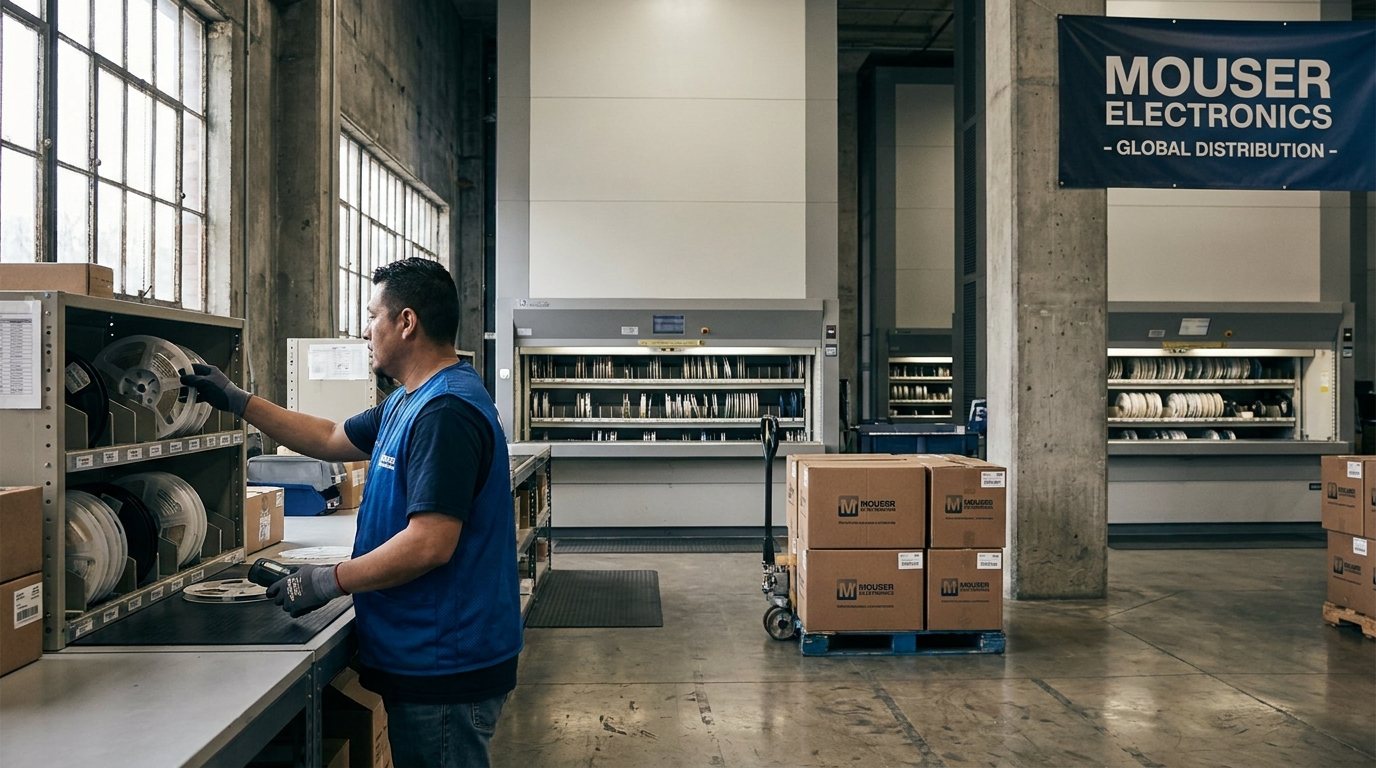
That is not a side benefit. It is the moat. Volume distributors are structurally bad at profitably picking, packing, and shipping single-digit quantities across a million-plus part numbers. Mouser built its physical and digital infrastructure specifically to do that well: a 100-acre, 1.5-million-square-foot campus in the Dallas-Fort Worth area running 216 vertical lift modules, described as the largest such automated-storage installation in North America. The company keeps adding to the breadth side of that bet too. Mouser added more than 60 new manufacturer lines in 2025 and over 9,000 new components in the first quarter of 2026 alone, according to its press release archive on PR Newswire. Being first to stock a newly released part, before design wins even exist, is how a catalog distributor earns the design win in the first place.
Franchise trust as a second moat
The other structural choice, easy to miss, is that Mouser sells exclusively as an authorized franchised distributor. It carries no gray-market or excess inventory and never competes with manufacturers on price outside the terms of a franchise agreement. That discipline shows up in the awards column rather than the earnings statement: Mouser's newsroom lists a steady stream of manufacturer honors, including Molex's Asia-Pacific e-Catalogue Distributor of the Year for an eighth consecutive year and an NXP Top Customer Count Asia award in 2025, per the same PR Newswire archive. Component manufacturers reward Mouser's channel because it generates design registrations, the moment an engineer specifies a part number into a new product, rather than just moving boxes at a discount. Design registrations are worth far more to a chipmaker than a one-time volume order, because they convert into years of repeat business once the design ships.
The tension in the model
The trade-off is real. A distributor built around prototype quantities and engineer traffic lives with more revenue volatility than one built around locked-in production contracts, and it depends on a steady, expensive stream of new product launches from manufacturers to keep the catalog fresh. Mouser has answered that by spending on content as much as on inventory, building out technical articles, project libraries, and its "Empowering Innovation Together" education program to keep engineers coming back to Mouser.com before they have a bill of materials, not after. It is a bet that owning the earliest, least monetizable moment in a design cycle pays off later, and Berkshire's ownership structure, with no pressure for quarterly production-volume growth, is exactly the kind of capital that can afford to wait for that payoff.
The result is a distributor that looks nothing like the volume-scale playbook its two largest competitors run, inside a corporate parent famous for never rewriting the playbooks of the businesses it buys.
Distribution's biggest advantages rarely show up on a balance sheet. They live in the catalog data, the warehouse layout, and the systems that get the right part to the right engineer first. This series looks at the companies that have built those advantages into something durable.