
How TTI Inc Built a Specialist Empire Inside Berkshire Hathaway
TTI Inc ranks #4 on MDM's 2026 electronics distributor list. Here is how a Fort Worth components house became Berkshire Hathaway's quiet federation of specialists.
Part of Distributor Playbooks — strategy teardowns of every company on the MDM Top Distributors lists.
TTI, Inc. lands at #4 on the electronics vertical of Modern Distribution Management's 2026 Top Distributors list, one of the largest names in a category most people outside the industry have never heard of: electronic components. No stores, no showrooms, just capacitors, resistors, connectors, and semiconductors moving by the million between manufacturers and the engineers who need them in stock, in spec, and yesterday. TTI has held that same narrow band on MDM's electronics list for years, which turns out to be the interesting part.
A components broker becomes a Berkshire subsidiary
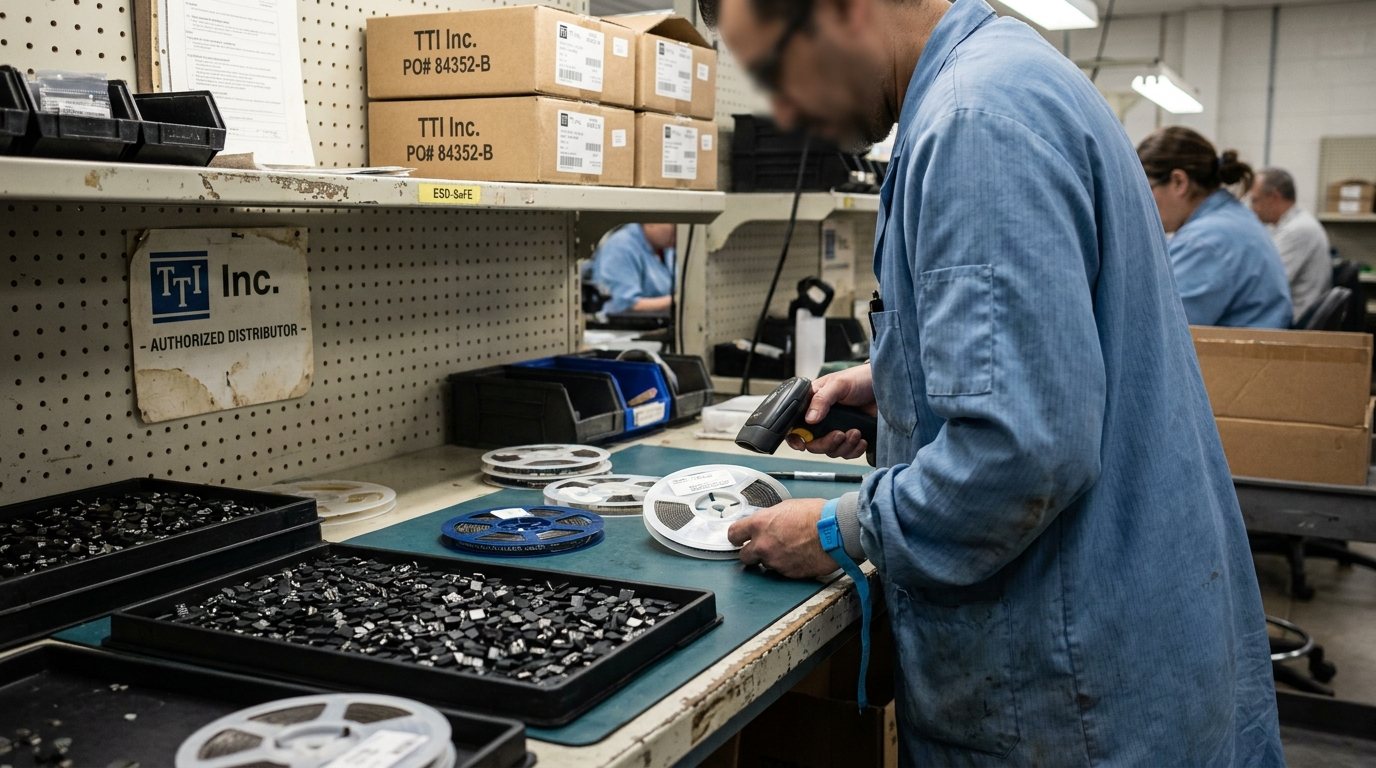
Paul Andrews started the company in Fort Worth in 1971 as Tex-Tronics, Inc., a name it dropped two years later to dodge a trademark fight. Andrews was a former General Dynamics buyer who understood the defense and aerospace supply chain from the customer side, and he built TTI around a bet that was unfashionable at the time: carry deep, available-to-sell inventory of passive and interconnect components instead of running a pure broker model that waited on manufacturer allocation. That inventory bet, plus an early and serious commitment to formal quality management, is what let TTI become the vendor engineers trusted when a part absolutely had to be on the shelf.
In December 2006, Andrews agreed to sell majority ownership to Warren Buffett's Berkshire Hathaway, with the deal closing on March 30, 2007, according to Wikipedia's company history. TTI still appears on Berkshire Hathaway's own subsidiary list today, one of dozens of operating companies Buffett has bought and then mostly left alone. Andrews stayed in charge for another 14 years, running the company until his death in February 2021, when Mike Morton, a 40-year company veteran, took over as CEO. No outside buyer, no private-equity operating partner parachuted in to "professionalize" the founder's shop. The succession moved sideways, from the founder to the person who had spent four decades learning the business under him.
The unique insight: a federation, not a rollup
Here is the thing that separates TTI from almost every other distributor of its size. Electronic components distribution has consolidated hard over the past two decades, and the standard playbook for a scaled acquirer is to buy competitors and fold them into one brand, one catalog, one sales force, to capture cost synergies. TTI does the opposite. Under the same Berkshire-owned parent, it operates what its own materials call the TTI Family of Specialists: TTI itself (branded as the interconnect, passive, and electromechanical specialist), Mouser Electronics, Sager Electronics, and Exponential Technology Group, each running as a distinct company with its own name, sales force, and customer relationships.
Mouser is the clearest illustration of why this matters. Jerry Don Mouser founded it in El Cajon, California in 1964, TTI bought it in January 2000, and Berkshire picked up TTI (and by extension Mouser) seven years later, per Wikipedia's account of Mouser's history. Mouser today runs a 100-acre campus in Mansfield, Texas, carries roughly 1.2 million SKUs from more than 1,200 manufacturers, and by 2020 ranked as the world's seventh-largest electronic component distributor in its own right, generating over $4 billion in annual revenue. It still competes in the market under its own name, still builds its own catalog and web experience, and most of its engineering customers have no reason to know it shares a parent with TTI. That is a deliberate choice: keep the specialist brands separate because the customer relationships, inventory philosophies, and even the parts of the market they serve (Mouser leans toward design engineers and smaller-quantity buyers, TTI's core business skews toward production-volume passive and interconnect supply) are different enough that merging them would destroy more value than it created.
Permanent Berkshire capital is what makes that structure sustainable. A private-equity owner on a five-to-seven-year hold needs consolidation synergies to hit its return target before the exit. Berkshire has no exit. It can leave four separate, well-run specialist companies alone indefinitely, funding their inventory and acquisitions out of its own balance sheet, and collect the earnings without ever forcing a merger that would show up nicely on a slide deck but confuse the actual customer base.
What the steady rank actually shows
| MDM Electronics Rank | Year |
|---|---|
| #5 | 2022 |
| #5 | 2023 |
| #6 | 2024 |
| #6 | 2025 |
| #4 | 2026 |
That table looks unremarkable until you place it against what happened in electronic components between 2021 and 2024: a historic semiconductor shortage that sent lead times past a year and prices soaring, followed by a brutal inventory correction as customers who had over-ordered during the panic worked down their stockpiles. Distributors who had leaned hardest into the shortage-era spot market took the hardest fall on the way back down. TTI holding a stable #5-to-#6 position through both halves of that cycle says its available-to-sell inventory model, the same discipline Andrews built the company on in the 1970s, did what it was designed to do: smooth out exactly this kind of demand whiplash rather than chase it. That plateau broke in the 2026 report, where TTI moved up to #4, its best electronics placement in the table above.
The honest tension in the federation model is channel overlap. TTI, Mouser, and Sager sell into overlapping supplier lines and, at the margins, overlapping customers, and a manufacturer negotiating distribution terms can find itself dealing with three ostensibly separate sales organizations that ultimately report to the same parent. TTI has apparently decided that cost is worth paying to preserve each brand's distinct customer trust rather than force a single unified go-to-market that would be cleaner on paper and weaker in the field.
Distribution rewards the companies willing to do the unglamorous work of stocking the right part, in the right catalog, before anyone asks for it, and TTI's federation of specialists is one answer to how that work gets organized without losing what made each piece of it good in the first place.