
Ben E. Keith: The $8 Billion Distributor That Won't Say So
Ben E. Keith made the 2026 MDM Top Distributors Food & Beverage list. Here's how a private, opaque foodservice-and-beer distributor built an estimated $8B business.
Part of Distributor Playbooks — strategy teardowns of every company on the MDM Top Distributors lists.
Ben E. Keith Co. landed on Modern Distribution Management's 2026 Top Distributors list in the Food & Beverage vertical, the annual ranking of North America's largest wholesale distributors. True to form, the company didn't hand MDM a revenue number. That single blank cell says more about how Ben E. Keith operates than most distributors' entire investor decks.
Two businesses that have nothing to do with each other
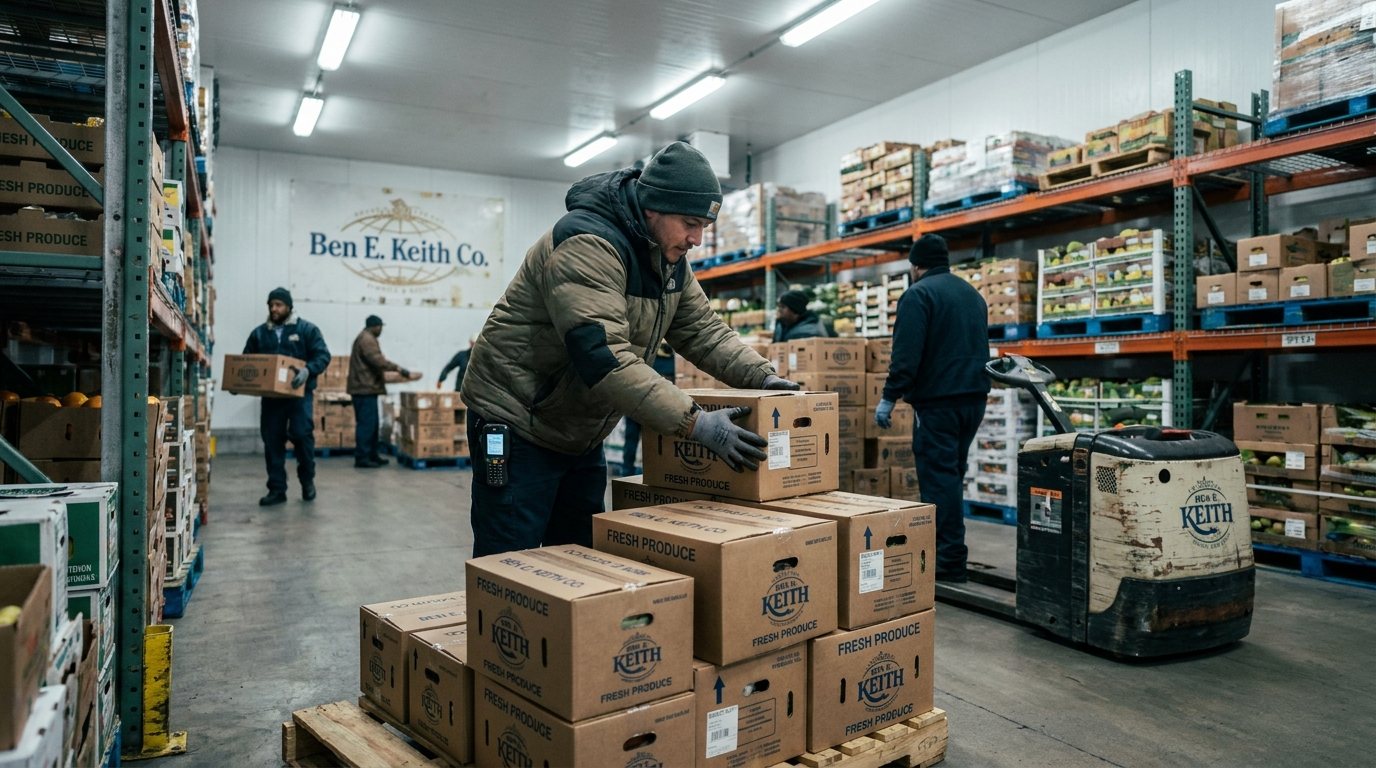
Walk into a Ben E. Keith building in Fort Worth and you could be looking at either half of the company. One side is a foodservice distributor: produce, frozen foods, meats, dry groceries, paper goods and kitchen equipment moving into restaurants, hospitals, schools and nursing homes, according to Wikipedia's summary of the company. The other side is a beer, wine and spirits wholesaler, the exclusive Anheuser-Busch distributor across most of Texas, running Budweiser, Bud Light and Michelob Ultra alongside a growing craft and spirits book.
Almost nobody else in either category runs both. National foodservice players like Sysco and US Foods don't hold beer franchises. Big beer wholesalers like Reyes Holdings don't run refrigerated trucks full of chicken breasts into school cafeterias. Ben E. Keith has done both since the mid-20th century, and the combination is the whole point: foodservice is a low-margin, high-volume grind that lives on route density and fill rate, while a territorial AB franchise throws off steadier, higher margins with none of the perishability risk. One division funds patience in the other.
The number Forbes had to guess
MDM's list shows Ben E. Keith's 2025 revenue as "not disclosed." Forbes doesn't have that luxury and estimates it anyway: its company profile pegs Ben E. Keith at roughly $7.3 billion in 2024, $7.9 billion in 2025, and $8.0 billion for 2026, good for #74 on Forbes' list of America's largest private companies. The trajectory is the real story.
| Year | Forbes-estimated revenue |
|---|---|
| 2012 | $3.1B |
| 2018 | $3.5B |
| 2022 | $5.1B |
| 2024 | $7.3B |
| 2026 (est.) | $8.0B |
A company can double its top line in a decade and still decline to confirm it to the trade press that covers it every year. That's not an oversight. Privately held distributors in food and beverage routinely disclose less than their publicly traded rivals, but Ben E. Keith takes the reticence further than most of its MDM cohort, treating its own scale as nobody's business but its own even as outside estimators do the math for it.
Building the beer side one brand at a time
The Anheuser-Busch franchise is the anchor, but Ben E. Keith Beverages has spent the past decade layering craft and spirits onto it rather than resting on flagship volume. It bought Artisanal Beverage Distributor, a Texas spirits wholesaler, in November 2019, giving it a three-tier presence beyond beer. On the brewing side it has methodically signed craft brands into its truck routes: Smuttynose and SanTan in 2014, Deep Ellum in 2015, Sweetwater and AleSmith in 2016, Viva Brewery and Big Country Hard Seltzer in 2020, Urban South in 2023, according to Brewbound's distribution roundups. None of those deals move the revenue needle much against a multibillion-dollar base. What they do is keep the beverage division's shelf space and route stops full as flagship domestic beer volume has flattened industry-wide, so the AB franchise stays the core without becoming the ceiling.
A name that outlived its family
The company traces to 1906 in Fort Worth, originally chartered as the Harkrider-Keith-Cooke Company. Ben E. Keith himself didn't take over as president and general manager until 1918 and ran it until 1959, more than a decade before the firm formally adopted his name in 1931, per Wikipedia. It has carried that name for nearly a century since, through leadership that has nothing to do with the Keith bloodline. Wikipedia's snapshot lists Howard Hallam as CEO since 1979; Forbes' current profile lists Robert Hallam as chairman and CEO. Whatever the exact handoff, the surname on the executive floor has been Hallam for decades, not Keith. That's the quieter insight sitting under the twin-division story: Ben E. Keith is a case of a distributor whose brand outlasted its founding family entirely, kept alive by successors who apparently never saw a reason to rename it.
The company's philanthropic footprint produced one genuinely odd footnote: a donation to Texas Tech University led researchers to name a newly identified bat species, Carollia benkeithi, after the founder. It's a strange little marker of how long institutional memory runs in a business this old.
The takeaway
Ben E. Keith's moat isn't a single clever maneuver. It's the willingness to run two structurally different distribution businesses under one name, fund the slower one with the steadier one, and say as little as possible about how well either is doing while the numbers speak for themselves anyway.
Distribution rarely rewards the loudest player in the room. It rewards the one that kept the trucks running, the territory intact, and the ledger quiet for a hundred and twenty years — which is as good a definition of this series' subject as any: the unglamorous machinery of catalogs, branches, and freight that decides who eats and who doesn't, long before anyone notices it's there.