
Bisco Industries: 53 Years Under One Founder's Control
Bisco Industries ranks on MDM's 2026 Top Distributors list while founder Glen Ceiley still holds roughly 96% voting control, rare in electronics distribution.
Part of Distributor Playbooks — strategy teardowns of every company on the MDM Top Distributors lists.
Bisco Industries lands at #44 in Industrial Supplies and #18 in Fasteners on MDM's 2026 Top Distributors list, the annual ranking from Modern Distribution Management that sizes up North America's biggest wholesale distributors across 20 verticals. What the ranking doesn't show is the stranger fact underneath it: the man who started Bisco in 1973 still runs it, and still controls it, in a corner of distribution that has spent three decades consolidating into a handful of giants.
A garage-scale start that never got acquired
Glen Ceiley founded Bisco Industries in Chicago on March 15, 1973, distributing fasteners and electronic hardware to manufacturers. The company moved to San Jose in 1977 to chase the electronics boom, then to Anaheim, California in 1987, where it's been headquartered since. By 2001 Bisco was a modest 21-location operation with 178 employees, still privately built, still Ceiley's.
That's an unremarkable growth curve for an electronic-components distributor. What happened next is not. In 2010, Ceiley took Bisco public not through an IPO but by merging it into EACO Corporation, a small public holding company Ceiley already controlled. A subsidiary called Bisco Acquisition Corp merged into Bisco, with Bisco surviving as EACO's wholly owned operating company. Because Ceiley held the controlling stake on both sides of the transaction, the deal read less like an acquisition and more like a founder relocating his own company into a public wrapper he already owned. At the time of the merger Bisco ran 37 sales offices and six distribution centers.
The number that explains everything else
Here is the detail that makes Bisco worth studying rather than just noting: Glen Ceiley still holds approximately 96% of EACO's voting control, largely through a family trust. EACO trades on the OTC market, publishes 10-Ks, and answers to public shareholders on paper. In practice it operates like the closely held company it always was. In a vertical where the biggest names, Arrow Electronics, Avnet, TTI under Berkshire Hathaway, got there by rolling up hundreds of smaller distributors under private-equity or conglomerate ownership, Bisco took the opposite path: go public for currency and reporting discipline, keep every real lever of control in the founder's hands, and never let the ticker change who runs the place.
That's the insight worth naming plainly. Most companies this size either sell to a strategic, get bought by a PE sponsor, or stay private forever. Bisco found a fourth lane: public markets without giving up the wheel.
Growth by branch, not by deal
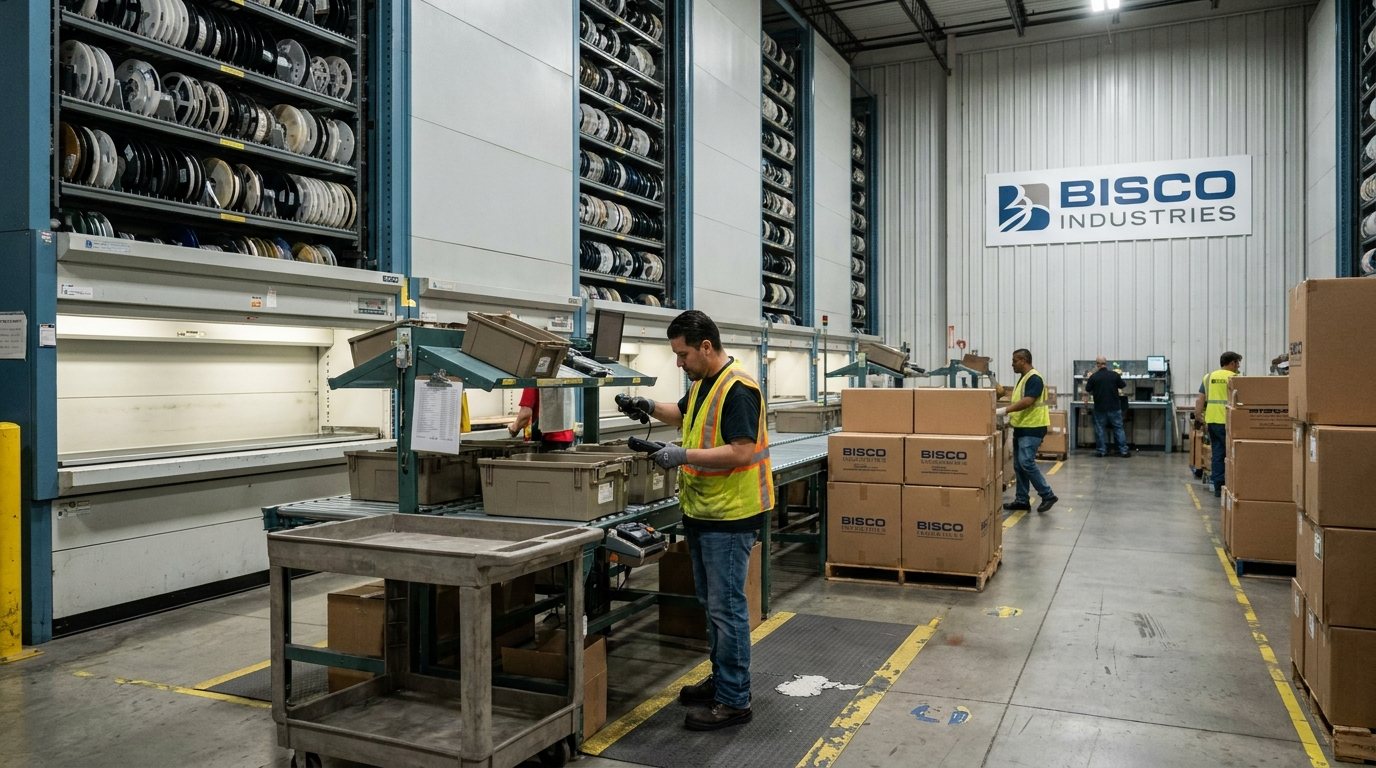
The other thing that separates Bisco from its electronics-distribution peers is how it grows. It doesn't buy other distributors. Since the 2010 merger, EACO's public filings show no significant acquisitions, only steady organic expansion: new sales offices, new distribution centers, more account reps. The company now operates 53 local offices and 7 distribution centers carrying roughly 3.1 million parts, same-day shipping until 8pm ET, according to Bisco's own site. In October 2022 it opened its 52nd location, and first outside North America, in Manila, a small but telling bet that the electronics supply chain's next growth is offshore.
The engine behind that expansion has a name inside the company: Sales Focus Teams, cohorts of reps assigned to specific accounts and territories. EACO's quarterly filings track SFT count the way other distributors track branch count. Fiscal 2025 closed with 116 SFTs and 418 sales employees; by the fourth quarter of fiscal 2026 that had grown to 122 SFTs and 491 sales employees, an 11% headcount increase in a single year, per StockTitan's earnings coverage. That's a distributor scaling revenue by adding humans to relationships, not by buying competitors' customer lists.
The results are recent, and they're accelerating
The payoff shows up starting in fiscal 2024. Net sales rose 11.5% to $356.2 million that year. Fiscal 2025 jumped 20.1% to $427.9 million, with net income more than doubling to $32.3 million. The momentum hasn't cooled: every quarter of fiscal 2026 reported so far has been a record, including a fourth quarter with net sales up 27.8% year over year. For a company with no acquisition pipeline, that kind of acceleration has to come from somewhere else, and it's coming from the branch network and the sales force Ceiley has been building for over five decades.
Timeline
| Year | Milestone |
|---|---|
| 1973 | Founded in Chicago by Glen Ceiley |
| 1977 | Moves to San Jose, chasing the electronics industry |
| 1987 | Relocates to Anaheim, current HQ |
| 2010 | Merges into EACO Corp, becomes a public company under Ceiley's control |
| 2022 | Opens first office outside North America, in Manila |
| 2025 | Net sales cross $400M for the first time |
The tension worth sitting with
Founder control this concentrated is a double-edged asset. It buys patience: Bisco can invest in a branch for years before it turns a profit, something a PE-owned roll-up under a five-year exit clock rarely tolerates. It also means the entire strategic direction of a $400-million-plus distributor rests on one person's judgment, with no acquisition war chest and no obvious succession plan on the public record. That's the bet EACO shareholders are making, knowingly or not, every time the stock trades.
Every distributor on the MDM list is, underneath the branch count and the SKU catalog, a bet on how well one organization can move the right part to the right customer before a competitor does. Bisco's answer has been to keep that bet in the same hands for over fifty years.