
How BJ's Wholesale Club Became Retail's Quiet No. 3
BJ's Wholesale Club ranks #26 on the NRF Top 100 with $21.05B in sales. Here is how a Zayre side project became a lasting warehouse-club power.
Part of Retailer Playbooks — history-first profiles of every company on the NRF Top 100 Retailers list.
BJ's Wholesale Club lands at #26 on the NRF Top 100 Retailers 2026, the National Retail Federation's annual ranking compiled with Kantar, with $21.05 billion in 2025 U.S. retail sales. It is the warehouse club that rarely makes headlines next to Costco, yet it has quietly outlasted nearly every other 1980s discount-era spinoff still standing. Its origin story runs through a company most shoppers today have never heard of.
A side bet inside Zayre
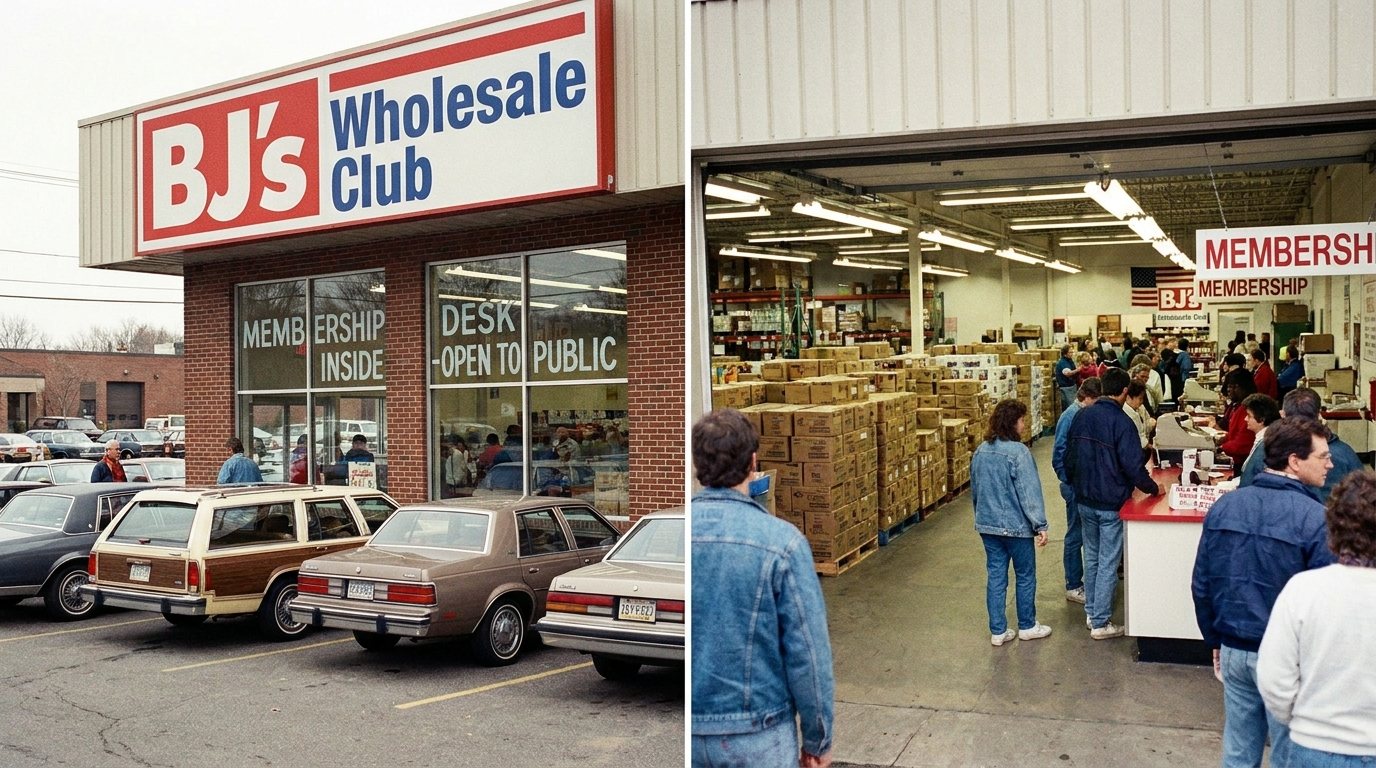
BJ's opened its first club on February 6, 1984, straddling the Medford and Malden line in Massachusetts, under Zayre Corporation, then a sprawling discount department store chain. The name has nothing to do with initials chosen for branding. It came from Beverly Jean Weich, daughter of Mervyn Weich, the executive who became the new warehouse chain's founding president, according to Wikipedia's account of the company. BJ's arrived a year after Costco and Sam's Club both launched in 1983, making it the late entrant in a format three companies were racing to define at once.
Here is the detail most retail histories skip: Zayre was also the company that had founded T.J. Maxx in 1976. So for its first several years, BJ's grew up as a sibling brand to T.J. Maxx inside the same corporate parent, two entirely different bets on how to sell goods for less, hatched by the same discount-store operator within a decade of each other. When Zayre sold its namesake discount stores to Ames in 1988 and renamed itself around the T.J. Maxx business, the new company took the name TJX. The warehouse-club side, BJ's along with the now-defunct HomeClub chain, got carved out into a separate holding company called Waban, Inc. in 1989. TJX kept the off-price fashion business that became its empire. BJ's went a different direction entirely.
Cut loose, then set free
Waban ran BJ's as one half of its portfolio for eight years. In August 1997, Waban split itself in two: BJ's became a fully independent public company headquartered in Natick, Massachusetts, while the remaining shell renamed itself HomeBase and eventually wound down. For the first time in its 13-year existence, BJ's was answerable to no other retail chain's balance sheet.
Independence let BJ's lean harder into the one structural choice that had separated it from Costco and Sam's Club since day one: it accepted manufacturer coupons. Both larger rivals built their margin models around refusing them, treating the warehouse club as a closed pricing system where the club's own price was final. BJ's let shoppers stack a store coupon with a manufacturer coupon on the same item, a policy it still runs today and one no other major warehouse club matches. Paired with smaller-format clubs sited closer to dense suburban populations rather than the highway-adjacent big boxes Costco favored, BJ's built a business aimed less at small-business bulk buyers and more at value-conscious households doing a full grocery trip. It was a narrower bet than Costco's, and a more grocery-heavy one, and it is the reason BJ's could survive being the smallest of the three national clubs for four decades running.
The private-equity decade
In 2011, Leonard Green & Partners and CVC Capital Partners took BJ's private in a leveraged buyout valued around $2.8 billion. Seven years of private ownership followed, the kind of stretch that kills off plenty of leveraged retailers before they resurface. BJ's instead used the time to keep opening clubs and building out its gas station network, then returned to public markets in 2018, with shares opening at $21.25 and the offering raising net proceeds of roughly $637.5 million.
A leadership shock, and the digital pivot
The company's most consequential recent chapter wasn't a strategy memo, it was a loss. Lee Delaney was named CEO in December 2019 and started the role in February 2020, only to die on April 8, 2021, a shock that forced an immediate transition. Bob Eddy, who had joined BJ's in 2007 as a finance executive and risen to CFO in 2011, stepped in as interim CEO and was confirmed permanent CEO on April 20, 2021. Continuity of leadership through finance rather than a fresh outside hire turned out to matter: Eddy has since pushed BJ's hardest into e-commerce and membership-fee growth, with digital sales now representing a meaningful and fast-growing share of the business and membership income posting double-digit gains in fiscal 2025.
The unglamorous advantage
The single most underappreciated fact about BJ's is not a number, it is a lineage. It is the surviving warehouse-club branch of the same corporate family tree that also produced T.J. Maxx and, later, Marshalls and HomeGoods under TJX. One holding company spent the 1970s and 1980s running two live experiments in undercutting full-price retail at the same time, off-price fashion and warehouse bulk-buying, and only one sibling stayed in that original house. BJ's left, kept its coupon-friendly, grocery-heavy, smaller-footprint model, and turned being the deliberate underdog to Costco into a business that has now run profitably, through a buyout, an IPO, and a leadership tragedy, for over four decades.
Retail's biggest chains rarely get remembered for the paperwork behind them, the spinoffs, the pricing rules, the coupon policies nobody thought to change. BJ's is a reminder that those unglamorous mechanics, quietly maintained, can outlast the flashier story next door.