
How Breakthru Beverage Grew Without Losing Family Control
Breakthru Beverage ranks on MDM's 2026 Food & Beverage list at $8.4B. The real story: a Chicago sports family kept ownership but hired an outsider to run it.
Part of Distributor Playbooks — strategy teardowns of every company on the MDM Top Distributors lists.
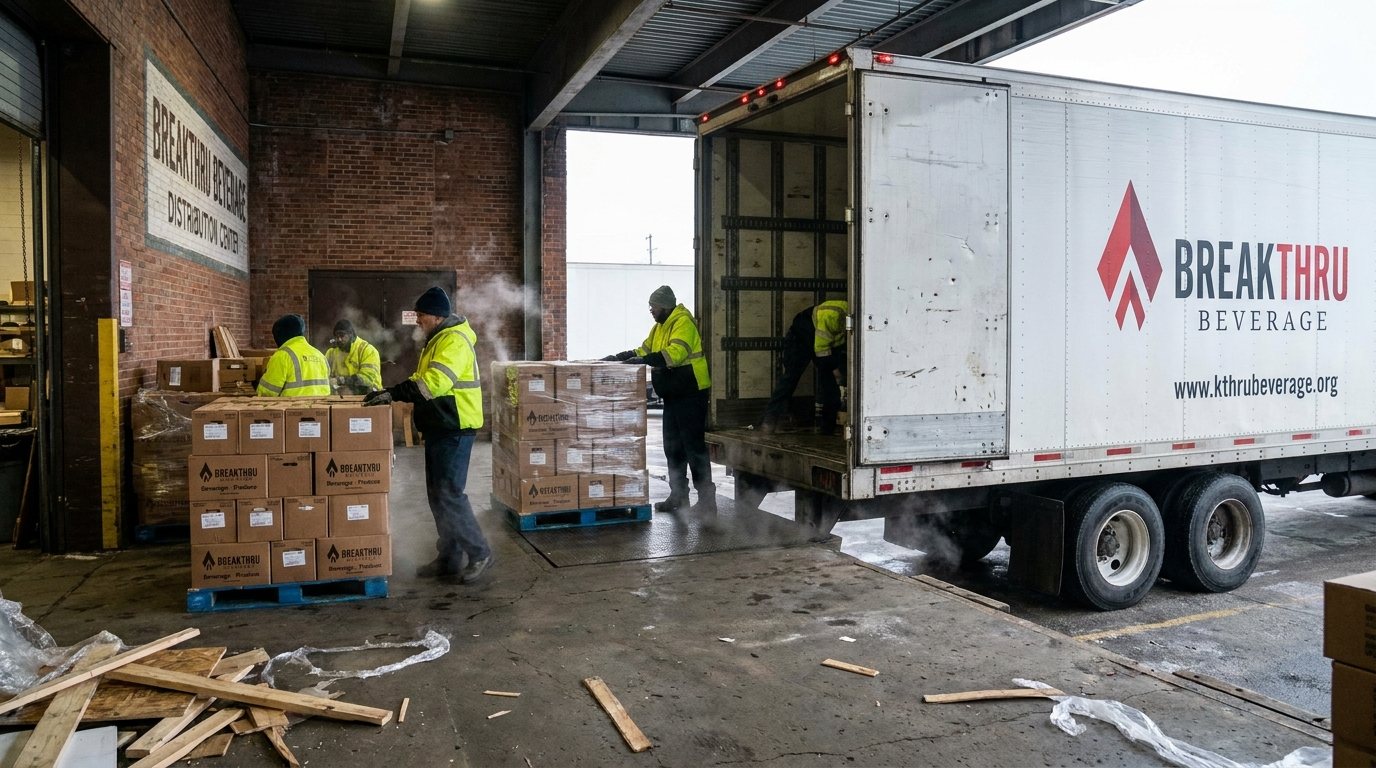
Breakthru Beverage Group shows up on Modern Distribution Management's 2026 Top Distributors list in the Food & Beverage category, on $8.4 billion in 2025 revenue. That scale puts it among the largest wine and spirits wholesalers in North America. What the number hides is that Breakthru sits inside a hundred-year-old Chicago holding company that also owns an NHL franchise and a piece of the arena it plays in, and that the family running that holding company recently handed the beverage business's top operating job to a total outsider.
A liquor house inside a sports-and-real-estate empire
Breakthru's lineage runs back to Judge & Dolph, a Chicago liquor distributor founded in 1922. The Wirtz family took control of it and folded it into Wirtz Corporation, the Chicago holding company Arthur Wirtz founded in 1926, eventually renaming the beverage arm Wirtz Beverage Group in 2009, per Wikipedia's entry on Wirtz Corporation. Beverage distribution has never been Wirtz Corporation's only business. The same holding company owns the Chicago Blackhawks (bought outright in 1966), once owned the Chicago Bulls, holds a stake in the United Center, and runs banking and insurance interests. That matters more than it might seem: a distributor whose capital comes from a diversified family conglomerate can absorb a slow beverage year, or fund a decade of acquisitions, in ways a wholesaler answering only to its own P&L cannot.
The 2016 bet: merge instead of sell
Wine and spirits distribution consolidated hard over the past two decades, largely through private-equity-backed roll-ups swallowing independent, family-run wholesalers state by state. In 2016, Wirtz Beverage Group took a different route: it merged with Charmer Sunbelt Group, a New York-based wine and spirits wholesaler, to form Breakthru Beverage Group, according to the same Wikipedia account. Rather than selling to a financial buyer, two large family-controlled distributors combined balance sheets and geography. The combined company kept dual headquarters, in Cicero, Illinois, and New York, according to its LinkedIn company page, and now covers 16 U.S. markets plus Canada, where it operates as the country's largest beverage broker.
Growth since has been fast for a business built on trucks, warehouses, and state-by-state licenses. Shanken News Daily pegged Breakthru's 2021 revenue at roughly $6.1 billion, ranking it the third-largest wine and spirits wholesaler in the U.S. at the time. By the 2026 MDM ranking, that figure stood at $8.4 billion, a jump of roughly 38 percent in under four years in an industry where organic case growth rarely moves that quickly. Some of the gain has come from picking up ground as rivals retreat: in September 2025, Business Wire reported that Q Mixers expanded its partnership with Breakthru into California as rival RNDC exited the state. In July 2026, Breakthru expanded its Illinois relationship with Edrington to carry the company's full ultra-premium portfolio, including The Macallan, Highland Park, The Glenrothes, and Brugal, building on existing Edrington ties in five other states.
Family capital, hired management
A hundred years of family ownership usually comes with a family name on the CEO title too. Breakthru broke that pattern in October 2021, appointing Tom Bené, a longtime PepsiCo executive with no prior history at either legacy company, as President and CEO, succeeding Greg Baird, who moved into an advisory role. That is an unusual governance call in this corner of distribution, where the two default models are full family control straight through the executive suite, or a sale to private equity that installs its own operators and owns the equity outright. Breakthru chose neither. The Wirtz family kept full ownership through its holding company while putting an outside packaged-goods veteran in charge of day-to-day operations.
That split also cushioned a real transition. Rocky Wirtz, who had led Wirtz Corporation for more than a decade, died in 2023; his son Danny Wirtz became chief executive of the parent company, per Wikipedia. Because the beverage business already had its own non-family operating chief, succession at the top of the holding company did not require a simultaneous changeover in who ran Breakthru's warehouses and sales force.
That is the pattern worth naming plainly: Breakthru is a wine and spirits wholesaler whose ultimate owner is not fundamentally a beverage company, and whose day-to-day leadership is deliberately not family. Most century-old distributors pick a lane, either keeping operations inside the bloodline or trading ownership for professional management. Breakthru kept the equity and rented the expertise, which is one reason it has been named a U.S. Best Managed Company five years running, according to the Edrington announcement, even as it absorbs new states and brands at a pace that would strain a purely family-run operator.
| Year | Milestone |
|---|---|
| 1922 | Judge & Dolph founded in Chicago |
| 1926 | Arthur Wirtz founds Wirtz Corporation |
| 2009 | Renamed Wirtz Beverage Group |
| 2016 | Merges with Charmer Sunbelt Group to form Breakthru |
| 2021 | Tom Bené named President and CEO |
| 2023 | Rocky Wirtz dies; Danny Wirtz becomes Wirtz Corp CEO |
| 2026 | $8.4B revenue; MDM Food & Beverage placement |
None of this shows up on an invoice. But every case that reaches a bar or grocery shelf through Breakthru's network depends on the same unglamorous machinery every large distributor depends on: accurate catalogs, clean product data, and a warehouse system that knows what it's holding.