
How Brenntag Wins Oilfield Chemicals by Keeping Local Names
Brenntag North America made MDM's 2026 Lubricants & Fuels list. Its real edge: buy oilfield chemical specialists and keep their names on the truck.
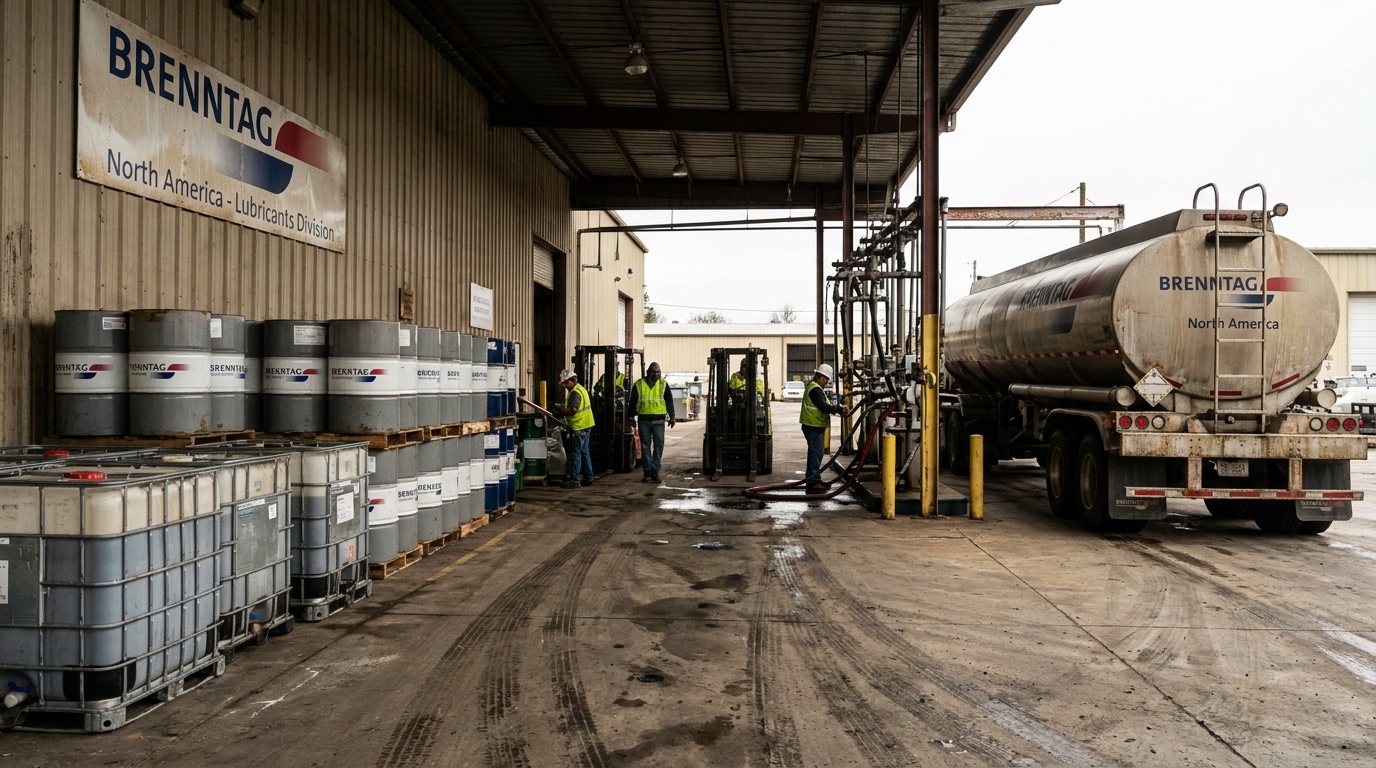
Part of Distributor Playbooks — strategy teardowns of every company on the MDM Top Distributors lists.
Brenntag North America placed in the Lubricants & Fuels category of Modern Distribution Management's 2026 Top Distributors list, the trade publication's annual ranking of North America's largest distribution companies across 20 verticals. It is an unusual entrant to profile, because the business behind that placement is barely visible under the Brenntag name at all. In the Permian Basin, on a rig site or at a gas plant, the truck that shows up says Coastal Chemical. It has said that since 1958.
A distributor built by not renaming things
Brenntag SE itself started in 1874 in Berlin as an egg wholesaler that drifted into chemicals, per Wikipedia's company history. It crossed into the US market in 1969 and then spent decades buying its way to scale, roughly 99 acquisitions between 2007 and 2021 alone, culminating in the 2021 purchase of food distributor JM Swank. That is the standard roll-up story: buy volume, fold it into one global brand, extract synergies.
The oilfield and energy piece of the business does not follow that script. Coastal Chemical was founded in 1958 in Abbeville, Louisiana, as a production-chemicals distributor to Gulf Coast oil and gas operators. At some point it became, in the company's own language, "a member of the Brenntag North America, Inc. group of companies." But it never became "Brenntag Energy" or a line item folded into a shared brand. It stayed Coastal Chemical, and Brenntag built its entire upstream-midstream-downstream energy platform around that surviving name rather than around its own.
The pattern repeated on November 18, 2025, when Brenntag announced the acquisition of Chem Tech Services, a Levelland, Texas production-chemicals provider founded in 1980 with more than $80 million in trailing-twelve-month sales across the Permian Basin. Chem Tech did not get absorbed into "Brenntag." It got folded into Coastal Chemical, the 67-year-old subsidiary, as Blake Willis, Coastal Chemical's president, put it: "Their deep expertise in oil and gas production chemicals and strong presence in the Permian Basin align perfectly with our strategic vision for growth and innovation." Chem Tech's own co-owner, Derek Waters, framed the deal the same way, as joining a shared mission rather than being acquired by a foreign parent.
The insight: consolidate the balance sheet, not the brand
That is the unique thing worth naming here. Most distribution roll-ups treat brand consolidation as the whole point, one name, one catalog, one sales force, so the acquirer's scale becomes visible to the customer. Brenntag's energy business runs the opposite play in the field: back-office scale, supplier leverage, and working capital roll up to Brenntag SE, while customer-facing identity stays local and, often, decades old. An oilfield operator in West Texas is not buying "Brenntag." It is buying Coastal Chemical's formulation know-how and the relationship its field reps built over years, with Brenntag's balance sheet and supplier network sitting quietly underneath.
It is a sensible bet for a category where trust is earned at the wellhead, not in a catalog. Production chemicals get chosen because they work in a specific well's chemistry, under a specific operator's conditions, recommended by a specific field tech. Torching a 67-year-old name to print "Brenntag" on the tank would spend brand equity the acquirer has no way to rebuild quickly. The trade-off is that Brenntag's own name carries limited weight in the vertical it just got ranked in. If Coastal Chemical or a future Permian bolt-on ever needed the parent's name to close a deal, decades of deliberately not using it would work against it.
The other consolidation, running backward
The timing makes the strategy more interesting, not less. In December 2023 Brenntag SE announced it would split itself into two independent divisions starting in 2024, Essentials and Specialties, after activist shareholders pushed for a full break-up. Finished lubricants, along with water treatment and semi-specialty products, moved into Essentials. CEO Christian Kohlpaintner called it a step toward "creating options," stopping short of committing to a complete corporate separation but leaving that door open past 2026.
So the same company is running two consolidation strategies at once, in opposite directions. At the corporate level, a 150-year-old chemicals conglomerate built by acquisition is now being pried apart by investors who think its parts are worth more separately. At the ground level, inside the exact division that houses lubricants and energy chemicals, the playbook is still buy-and-integrate, evidenced by a Permian acquisition closed the same month this profile was written. Brenntag Essentials is simultaneously the product of a break-up and an active acquirer of niche distributors it has no intention of renaming.
That tension is worth watching. A demerged Essentials, on its own capital structure and answering to its own shareholders, will need Coastal Chemical's Permian growth to justify the standalone story activists are pushing for. The federated-brand model that built trust locally now has to prove it can also carry a public equity story, without the global Brenntag name doing any of the talking.
Distribution rewards this kind of unglamorous discipline: keeping a 1958 name on a truck, buying an $80 million specialist quietly, and letting the catalog and the balance sheet do the consolidating that the brand never has to. This series returns to look at how the companies on MDM's list turn exactly that kind of infrastructure into a durable edge.