
Southern Counties Lubricants: One Name, Two Paths
Southern Counties Lubricants made the 2026 MDM Top Distributors list by staying independent while its fuel-side namesake sold to Pilot Company.
Part of Distributor Playbooks — strategy teardowns of every company on the MDM Top Distributors lists.
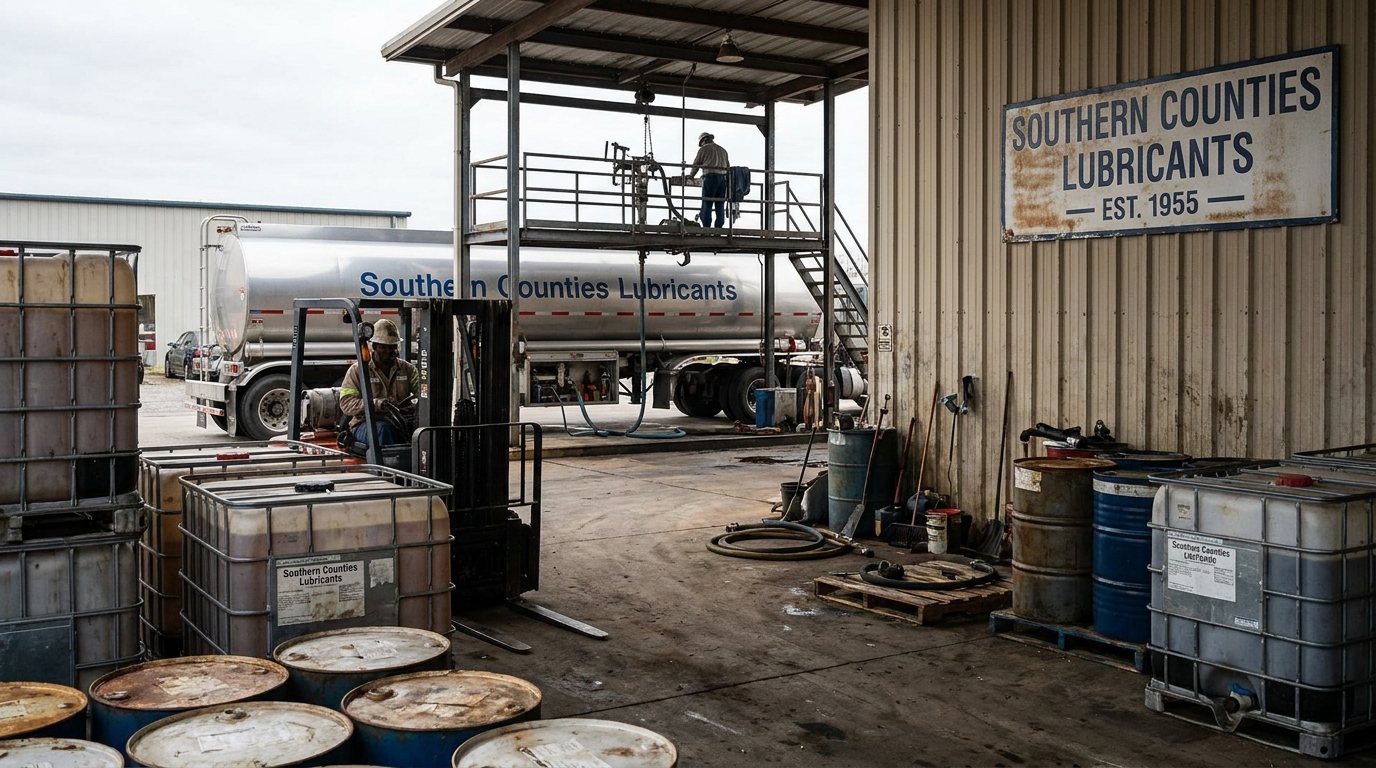
In December 2021, the Greinke family sold Southern Counties Oil Co., the California fuel and cardlock business it had run for generations, to Pilot Company, the truck-stop and travel-center giant. The lubricants half of that same "Southern Counties" name was never part of the deal. It kept operating out of Orange, California, and this year it landed on the 2026 MDM Top Distributors list, Modern Distribution Management's annual ranking of North America's largest wholesale distributors, in the Lubricants & Fuels category.
A name that used to mean one thing
Southern Counties Lubricants, now branded SCL, traces its roots to the 1960s, when a Tustin, California family ran a petroleum business that operated under a string of names over the decades, including Desert Counties Oil and, at one point, Southern Counties Oil itself. That last name is the tell. Today, a separate company legally named Southern Counties Oil Co., L.P. did business as SC Fuels until Pilot bought it, and its own founding story runs back to 1930 as a Signal Oil distributorship, according to Matrix Capital Markets Group's deal announcement and trade coverage of the Pilot acquisition. Two companies, one shared name, one overlapping California petroleum lineage.
The unique insight worth naming plainly: SCL is what happens when a family petroleum business splits its lubricants counter from its fuel counter, and the two halves are later pulled toward opposite endings, one toward a national buyer, one toward staying small and private on purpose.
The 1998 reset
The formal turning point for SCL came in 1998, when Richard Becktel, who had joined as an operations manager in the late 1970s, partnered with Frank Paul Greinke to build a dedicated wholesale lubricants business focused on Southern California. That partnership is the direct link between the Becktel family that runs SCL today and the Greinke family whose name sits on the Pilot transaction. Whatever the exact internal mechanics of the split, the practical result was two companies competing in adjacent lanes under overlapping names for the next two decades.
SCL rebranded from its old name to "SCL" in late 2016, adding a new logo and its first e-commerce platform, according to the company's own account of the transition. It is a small, deliberate modernization move, not a pivot, and it reads as a company protecting a legacy brand rather than trying to outrun it.
Buying territory from its own sibling
The clearest evidence of the two companies' entangled history is what happened in December 2020, a year before the Pilot deal closed. SCL acquired Bay Area assets from SC Commercial, the SC Fuels-affiliated business, picking up facilities in San Jose, Watsonville and Greenfield along with the customer relationships attached to them. Richard Becktel described it plainly: "We've maintained a long relationship of shared resources with SC Commercial." That is a company absorbing a piece of its former counterpart's Northern California footprint just as that counterpart was preparing to exit the industry entirely.
The timing lines up cleanly enough to read as more than coincidence:
| Year | Event |
|---|---|
| 1960s | Tustin family petroleum business operates under several names, including Southern Counties Oil |
| 1998 | Becktel and Greinke formalize Southern Counties Lubricants as a dedicated wholesale lubricants business |
| Dec 2020 | SCL acquires SC Commercial's Bay Area lubricants assets and customer base |
| Dec 2021 | Greinke family sells Southern Counties Oil Co. (d/b/a SC Fuels) to Pilot Company |
| 2026 | Southern Counties Lubricants appears on the MDM Top Distributors Lubricants & Fuels list |
Staying private on purpose
SCL does not disclose revenue. It sits on MDM's 2026 Lubricants & Fuels list alongside more than a dozen peers, most of them marked the same way, in a segment where MDM's own 2025 Top Distributors Report lists company after company as N/A on revenue. That reticence is not unusual for privately held distributors, but for SCL it lines up with a broader pattern: nine facilities split across Southern and Northern California, an employee count LinkedIn puts in the 51-200 range, and a leadership bench built from inside the family rather than outside capital.
Travis Becktel, Richard's son, now serves as general manager, focused on strategic planning and technology integration. Before that he played baseball in the Colorado Rockies organization and serves as an infantry officer in the California National Guard, a background that shows up nowhere in a balance sheet but says something about how the company thinks about succession. CFO Steve Jackson, who joined in 2021, brought outside financial discipline from prior CFO and interim CEO roles in aerospace and clean energy, per the company's leadership page. That combination, a second-generation operator in the GM seat and a professional CFO recruited from outside the industry, is how a lot of durable family distributors manage the handoff without selling.
The trade-off
The honest tension in SCL's story is the one every family distributor that doesn't sell eventually faces. Its former sibling business scaled to 47 cardlocks and 11,000-plus customers across 10 states before cashing out to a company with a national fuel network. SCL chose the opposite bet: stay regional, stay private, keep buying the adjacent pieces that make sense rather than the ones that would require outside capital to close. It is a smaller, harder-to-see kind of win, one measured in retained customer relationships and an intact family name rather than a headline transaction value. The MDM listing, unranked and revenue-blind like most of its neighbors on that page, is really the only public marker of how far that bet has carried the company.
Distribution rarely gets remembered for its balance sheets. It gets remembered, when it gets remembered at all, for the branches that stayed open, the deliveries that showed up, and the family names that kept their word longer than the market expected them to.