
Smitty's Supply: The Family Blender Selling Its Own Rivals
Smitty's Supply made the 2026 MDM Top Distributors list in Lubricants & Fuels. Its real story: a van, a nickname, and a bet on selling against itself.
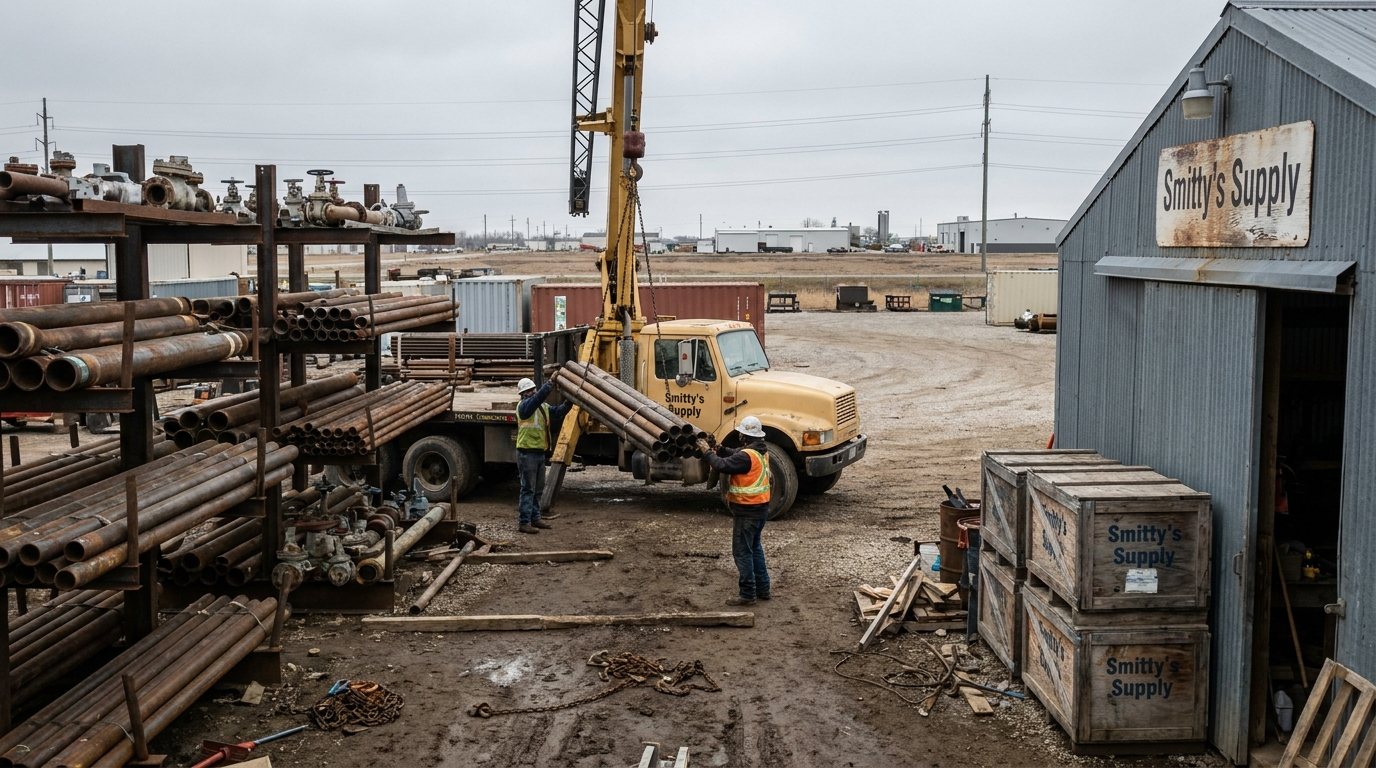
Part of Distributor Playbooks — strategy teardowns of every company on the MDM Top Distributors lists.
Smitty's Supply landed on the 2026 MDM Top Distributors list in the Lubricants & Fuels category, Modern Distribution Management's annual ranking of North America's largest distributors across 20 verticals. It got there by building something most lubricant blenders never attempt: a business that manufactures its own oil brand and distributes the brands competing against it, out of the same warehouses, to the same customers.
A van, $3,000, and a nickname
The company started in 1969 when Edgar Ray Smith Jr. began selling fishing tackle, sunglasses, notions, and auto parts out of his vehicle in rural Roseland, Louisiana, storing inventory in a room of his house, according to Smitty's Supply's own company history. Customers started calling him "Smitty." His wife, George Ann, joined the operation three years later. The name on the trucks today is a nickname that stuck, not a founder's ego.
That origin matters because it explains the culture that followed: a small operation run on "honesty, integrity, service and competitive prices," in the company's own words, that never took outside capital to scale. Ray built the first real warehouse in 1987, and the business grew from a rolling general store into a dedicated lubricant blender without a private-equity check anywhere in the sequence.
Sons take the wheel
In 2000, Ray and George Ann sold the company to their four sons: Ed, George, David, and Mitch. That handoff is the pivot the rest of the business rests on. Second-generation family ownership is not unusual in distribution broadly, but it is increasingly rare in lubricant blending and distribution specifically, a corner of the channel that has spent two decades consolidating into major-oil-company captives and private-equity roll-ups. Smitty's took the opposite path: four brothers running one company, expanding the brand portfolio rather than selling the company itself.
Under the sons, Smitty's added authorized distribution rights for Shell, Pennzoil, Quaker State, Chevron/Texaco, Castrol, Valvoline, and Mystik, according to company history published by longtime private-label partner Supers Products. At the same time, the company kept building out its own private label, the Super S line, now more than 200 products spanning passenger car motor oil, heavy-duty diesel oil, transmission fluid, gear oil, and hydraulic fluid, plus the SureGuard line for agricultural and industrial customers.
The insight: selling against yourself
Here is the part that does not show up on the About page framed as a strategy. Most companies that blend a private-label oil brand treat national brands as the enemy, something to displace shelf space from. Smitty's does the opposite on purpose. Super S now accounts for roughly 70 percent of annual revenue, per the Supers Products history, which means the other 30 percent is Smitty's actively distributing Shell, Chevron, and Valvoline oil into the same farm stores, quick-lubes, and industrial accounts where it is also pushing its own brand.
That is a deliberate hedge, not an accident. A private-label blender that only sells its own brand is betting the whole business on customers preferring house brands over the majors. A blender that also carries the majors gets paid either way the customer chooses, and it gets the shelf space, the relationship, and the delivery route regardless of which can the customer grabs. It is a distribution model built to be indifferent to brand preference, which is an unusual thing for a manufacturer to want.
A rural footprint built for volume, not proximity to headquarters
Smitty's never chased a Sun Belt metro address. Its blending and packaging network runs through Roseland, Louisiana (270,000 square feet, nine filling lines, 2 million gallons of bulk storage); Vicksburg, Mississippi (up to 100 million gallons of annual blending capacity); Hammond, Indiana (8 million gallons a month, with military-spec approval); and Jasper, Texas (375,000 gallons of storage). None of those are logistics-hub cities. All of them sit near rail, river, or highway freight corridors that matter more to a bulk-liquid business than an interstate exit near an airport. From that footprint the company ships into all 50 states and more than 50 countries.
Tested in August 2025
The network's redundancy got an unplanned stress test. A tank failure led to a fire at the Roseland blending plant on August 22, 2025, the EPA's Louisiana office confirmed, disrupting the original site's production. Rather than idle fulfillment, the company leaned on its multi-state blending capacity and a distribution arrangement with fellow Louisiana blender Cam2 International to keep product moving while the Roseland site rebuilt. For a company whose whole value proposition is that the truck shows up, that kind of continuity is the actual test of the model, more so than any brand mix on the shelf.
Fifty-seven years after a man sold sunglasses out of his van, the company still carries his nickname on the door, still answers to four brothers instead of a board, and still makes money whether the customer picks the can with its name on it or the can with somebody else's.
Distribution rewards look like branch counts and fleet size from the outside. From the inside, they are usually decided by less visible things: whose catalog is accurate, whose warehouse has the right gallon on the right shelf, and whose data didn't fall out of sync the last time a brand got added to the line card.