
How Casey's General Stores Turned Cheap Gas Into a Pizza Empire
Casey's General Stores ranks #72 on NRF's Top 100 Retailers 2026. Here's how a rural Iowa gas-station chain became one of America's biggest pizza sellers.
Part of Retailer Playbooks — history-first profiles of every company on the NRF Top 100 Retailers list.
Casey's General Stores ranks #72 on the NRF Top 100 Retailers 2026, the National Retail Federation's annual sales ranking compiled with Kantar, with $6.32 billion in 2025 U.S. retail sales. The chain now runs nearly 3,000 stores across 19 states, mostly in towns most retailers still don't bother to enter. It got there by refusing to compete where everyone else did.
A gas station named after someone else's initials
Donald Lamberti grew up around retail. His father Domenic had built a Des Moines coal-and-ice delivery route into a neighborhood grocery store with gas pumps back in 1935. Donald left his accounting studies at Drake University in 1960 to take over the family business, and by 1967 he was ready to expand. A gasoline salesman named Kurvin C. Fish talked him into buying a small oil company out of Ames, Iowa, with four service stations, for $200,000.
They needed a name for the new venture. Lamberti didn't want his own name on the sign. "There are a lot of folks who don't like Italians," he later explained. "We wanted a generic name that no one would dislike." So they used Fish's initials instead. The first Casey's General Store opened in Boone, Iowa, in 1968, according to Wikipedia's history of the company, and it was profitable from day one.
The map nobody else wanted
The decision that actually built Casey's came next: where to put the stores. As 7-Eleven and Circle K chased metro corners through the 1970s, Lamberti pointed his company at towns under 5,000 people, places the big chains had written off as too small to bother with. Per FundingUniverse's company history, by the mid-1990s roughly 72 percent of Casey's stores sat in communities under 5,000 residents, with only 6 percent in towns of 20,000 or more.
It looked like a modest strategy. It was actually an arbitrage. Real estate was cheap, labor turnover was low, and there was often no supermarket or fast-food competitor within twenty miles. A Casey's store in the mid-1980s cost roughly $250,000 to build, about half what a typical convenience store cost elsewhere. When the 1979 energy crisis pushed weaker operators to retreat from rural markets entirely, Casey's did the opposite: store count jumped from 119 to 226 in a single year. The company grew by walking into the vacuum its competitors created.
Betting on trucks and ovens, not franchise fees
Casey's used franchising early on to fund expansion, financed in part by proceeds after Fish's refinery interest was sold to Ashland Oil in 1970. But after the company went public in October 1983, it stopped issuing new franchises. Existing franchisees could keep operating, but growth from that point forward came from company-owned stores. By fiscal 1996, franchised units were down to 182 of 983 total locations, according to FundingUniverse.
That decision forced Casey's to build its own supply chain instead of leaning on outside distributors. It opened a 55,000-square-foot distribution center in Urbandale, Iowa, in 1983, expanded to 140,000 square feet by 1990, and ran its own truck fleet and drivers. It even built in-house printing and graphics departments. Most of the industry's giants ran on dealer networks and licensing deals; Casey's ran on its own trucks.
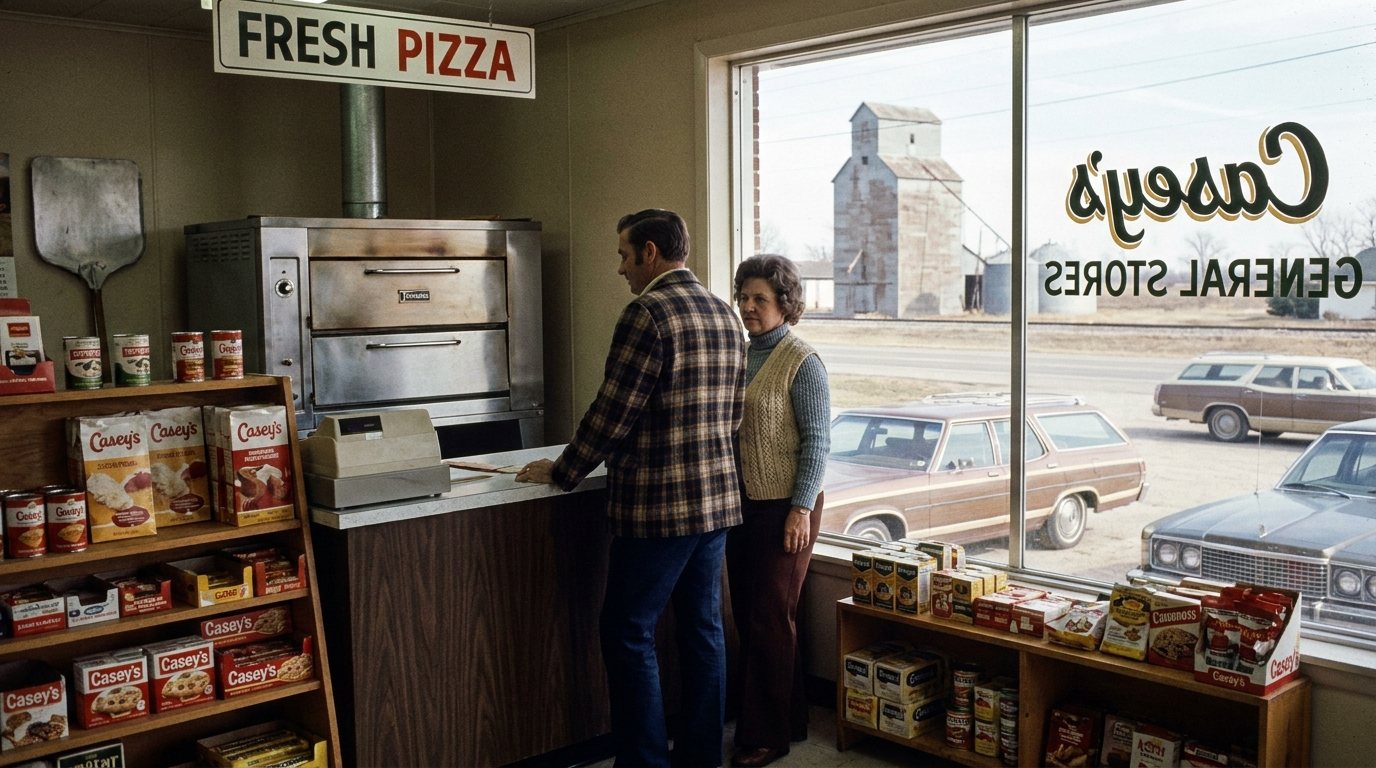
That same year, 1983, the company also started selling doughnuts and made-from-scratch pizza. It looked like a side item. It became the engine.
The insight: gas is the loss leader, pizza is the business
Here's the part of the Casey's story that doesn't show up on a "history of convenience stores" timeline. Casey's has long capped its fuel margins deliberately thin, around 11 cents a gallon in some markets, to keep local pump prices the lowest around. That pricing was aggressive enough that an Iowa fuel merchants' association sued the company in 1990 for predatory pricing, a suit that was dismissed in district court in 1994. Casey's wasn't selling gas to make money on gas. It was selling gas to get a truck or a pickup to stop, so the driver would walk inside past a made-to-order pizza counter.
That inversion is the whole model. Most retailers stack margin on top of traffic. Casey's built traffic as a cost center specifically to fund a food business, and it worked well enough that the company became the fifth-largest pizza retailer in the country, according to Wikipedia, ahead of chains that only sell pizza. A convenience store industry built around gasoline accidentally built one of America's biggest pizza companies as a byproduct of its pricing strategy.
Scaling by acquisition
Growth through the 2000s and 2020s came the same disciplined way, in bites the balance sheet could absorb: Gas 'N Shop and HandiMart in 2006, Bucky's Convenience Stores for $580 million in 2020, Minit Mart and Certified Oil in 2023, and the $1.145 billion purchase of CEFCO's roughly 200 stores in 2024, pushing Casey's into Alabama, Florida, and Mississippi for the first time. In April 2026, Casey's stock joined the S&P 500, a marker of how far a rural Iowa gas station chain had traveled from Boone's town square.
Every acquisition kept the same discipline the founders set in 1968: control the supply chain, keep the store clean, and never assume the gas pump is where the money gets made. Behind every pizza box and fuel receipt sits the same unglamorous machinery every retailer depends on, the trucks, the distribution centers, and the data that tells a company what its shelves actually need.