
Chedraui: How a Mexican Grocer Built a US Empire
Chedraui ranks #57 on the NRF Top 100 with $7.73B in US sales. Its El Super, Fiesta Mart, and Smart & Final banners hide a 154-year lineage.
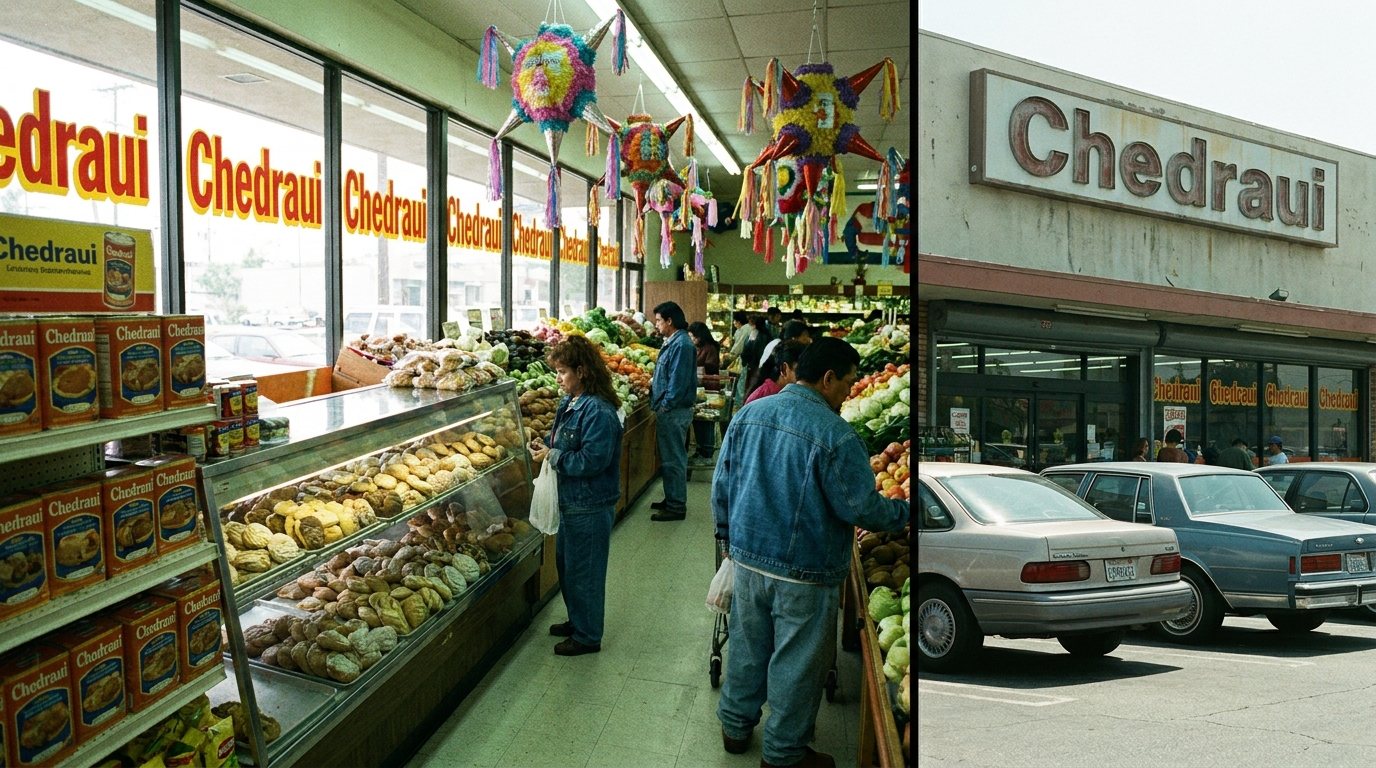
Part of Retailer Playbooks — history-first profiles of every company on the NRF Top 100 Retailers list.
Chedraui lands at #57 on NRF's Top 100 Retailers 2026, the National Retail Federation's annual ranking compiled with Kantar, with $7.73 billion in 2025 U.S. retail sales. Almost none of that revenue comes from a store called Chedraui. It comes from El Super, Fiesta Mart, and Smart & Final, three grocery chains most American shoppers assume are unrelated, independent, and homegrown. All three answer to a family retailer founded in Xalapa, Veracruz, in 1927.
A haberdashery becomes a supermarket
Lázaro Chedraui Chaya arrived in Mexico from Lebanon in the early 1900s and, with his wife Ana Caram, opened a dry-goods shop in Xalapa around 1920 called the Port of Beirut before the family name replaced it. The Chedraui banner itself dates to 1927. The pivot that mattered came decades later: in 1971 the family converted its retail operation into Xalapa's first supermarket, trading notions and yard goods for groceries at a moment when Mexican retail was consolidating around the self-service format. That single store became the seed of what is now Mexico's third-largest retailer, behind only Walmart de México and Soriana, per Wikipedia's history of Grupo Comercial Chedraui.
The company's defining growth move came in 2005, when it bought 29 supermarkets from Carrefour across central and southern Mexico, a bet on inorganic expansion that has defined every major chapter since. Chedraui now trades on the Mexican Stock Exchange under the ticker CHEDRAUI, run today by chairman Antonio Chedraui Obeso and CEO Antonio Chedraui Eguía, three generations removed from the Xalapa shop.
Crossing the border without changing the name on the door
Chedraui entered the United States in 1997 with the first El Super store in South Gate, California, operated through a subsidiary called Bodega Latina Corporation, headquartered in nearby Paramount. El Super grew methodically across Southern California, then Nevada, Arizona, New Mexico, and Texas, built as a Latino-format grocer selling to the same demographic Chedraui served at home. It stayed a modest regional chain for two decades.
Then came the acquisitions that turned Bodega Latina into something else entirely.
In April 2018, Chedraui bought Fiesta Mart, the Houston-based chain, from private equity firm Acon Investments. Fiesta's own founding story is one of the more unexpected in American grocery: it was started in 1972 by Donald Bonham and O.C. Mendenhall, two non-Hispanic operators who noticed that Houston's retailers were not serving its Mexican American population and opened a store in the Near Northside built around that gap. By the late 1970s Fiesta had broadened again, stocking African, Indian, Korean, Filipino, and Vietnamese products as Houston's demographics shifted under it, growing to 15 stores by the mid-1980s and posting $420 million in sales by 1989. It survived a sale to wholesaler Grocers Supply in 2004, a Levit family ownership era, and a 2015 sale to Acon before landing with Chedraui.
The bigger move came in 2021, when Chedraui announced a deal to acquire Smart & Final from Apollo Global Management, closing in 2022 for roughly $620 million and about 250 stores. Smart & Final is, remarkably, the oldest lineage in the portfolio by a wide margin: its predecessor, Hellman-Haas Grocery Company, was founded in Los Angeles in 1871, adopting the Smart & Final name in 1914 and reaching $10 million in annual sales by 1919, per the Wikipedia history of Smart & Final. It passed through French retailer Casino Guichard-Perrachon from 1984 to 2007, then Apollo, then Ares, a public listing in 2014, and back to Apollo before Chedraui's deal. On completion, Bodega Latina renamed itself Chedraui USA.
The insight: a foreign parent, three American centuries, zero rebrand
The non-obvious thing about Chedraui is not the acquisitions themselves. Roll-ups are common in grocery. It is the discipline of doing nothing to the storefronts. A shopper in Houston sees Fiesta Mart, a name invented in 1972 by two Houston businessmen with no connection to Mexico. A shopper in Bakersfield sees Smart & Final, a name that predates the automobile. A shopper in Las Vegas sees El Super, the only one of the three Chedraui actually built from scratch. None of them sees "Chedraui." That is not an oversight; it is the operating model. Chedraui bought market position, format expertise, and, in Smart & Final's case, 150 years of brand equity, and then made a conscious choice not to spend a dollar erasing it. The company that gets covered as a Mexican retail conglomerate crossing the border is, in the stores that actually generate its $7.73 billion in U.S. sales, functionally invisible to the customer.
That combination, an 1871 California grocery wholesaler, a 1972 Houston store built to serve an underserved community, and a 1997 Latino-format chain, now sits inside a single balance sheet controlled from Xalapa, Veracruz. Few conglomerates hold that much unrelated American retail history under one roof while asking none of it to change its name.
Every one of these chains, whatever the banner on the door, runs on the same unglamorous machinery: trucks, warehouses, shelves, and the data that tells a store what to stock and where. That infrastructure rarely gets the history-book treatment, but it is what turns a 1920s dry-goods shop into a retailer feeding three American cities a century later.