
Colonial Group: A Century-Old Fuel Distributor That Never Sold
Colonial Group made the 2026 MDM Top Distributors list in Lubricants & Fuels. Here is how a 1921 Savannah oil startup stayed family-run for four generations.
Part of Distributor Playbooks — strategy teardowns of every company on the MDM Top Distributors lists.
Colonial Oil Industries, the fuel and lubricants arm of Savannah's Colonial Group, made MDM's 2026 Top Distributors list in the Lubricants & Fuels vertical, the trade publication's annual ranking of North America's largest distributors across 20 product categories. That alone isn't remarkable in a sector full of scale players. What is remarkable: Colonial has been doing this since 1921, and it's still owned by the same family that started it.
The name they gave away
Colonial Oil didn't start as Colonial Oil. Founder Raymond M. Demere launched the business on July 21, 1921, in Savannah as the American Oil Company, the city's first independent wholesale petroleum marketer, according to Colonial Group's own company history. In 1933, the Demeres released that name to Standard Oil, which built it into the Amoco brand over the following decades. Colonial rebranded around its own name instead of riding a major's coattails, and the parent company, Colonial Oil Industries, was formally established in 1946.
It's a small decision that tells you what kind of company this became: one willing to give up a recognizable brand rather than get absorbed into a bigger one's orbit. Ninety years later, that instinct toward independence is still the throughline.
Four generations, one balance sheet
Wholesale fuel distribution has spent the last two decades consolidating into major integrated oil companies, convenience-store roll-ups, and private-equity-backed platforms. Colonial sat out that trend from the ownership side. Leadership has passed through exactly one family across five presidencies: Raymond M. Demere (1921-1953), a brief non-family interlude under Charles L. Jarrell (1953-1958), then Robert H. Demere Sr. (1958-1986), Robert H. Demere Jr. (1986-2018), and Christian B. Demere, the fourth generation, who took over in 2018, per the company's history page.
That kind of tenure is unusual anywhere in distribution, but it's especially unusual in energy wholesaling, where the capital intensity of terminals, pipelines, and fleets tends to pull independents toward a sale once a founder's generation ages out. Colonial's answer was succession planning measured in decades, not an exit.
The infrastructure is the moat, not the fuel
The more interesting story is what Colonial built around the original petroleum business, and it's not a scattershot of unrelated ventures. Every subsidiary reuses the same underlying asset: bulk liquid storage, marine transport, and pipeline-adjacent logistics.
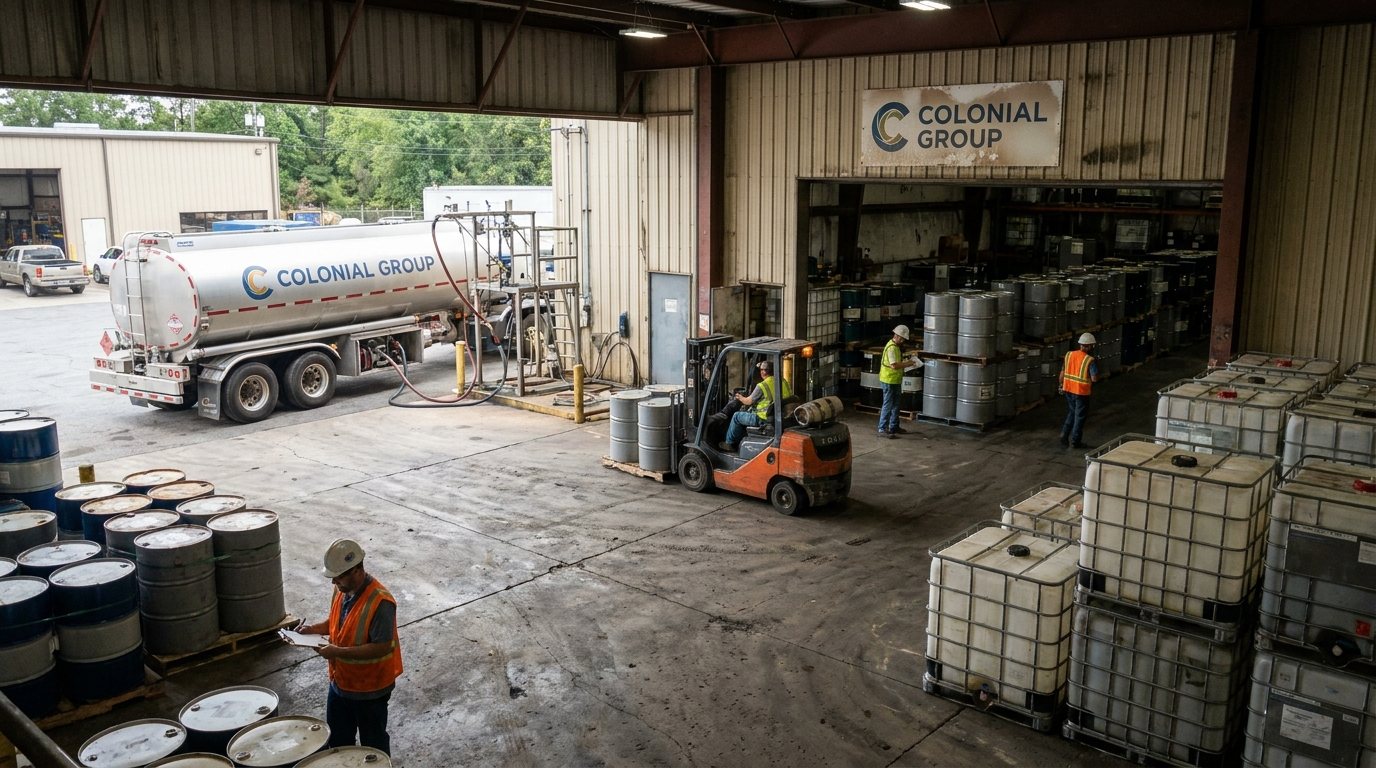
Colonial Terminals was added to store the fuel. Colonial Towing, launched in 1951, moved it by water and now handles marine bunkering. CTI Dry Bulk extended the terminal business to dry commodities in 1984. Colonial Energy applied the same storage-and-distribution logic to natural gas in 1995. Colonial Chemical Solutions, created in 2000, moved specialty and industrial chemicals through the same bulk-liquid infrastructure. AquaSmart, added in 2021, applies the group's water-handling expertise to water treatment.
That's the pattern worth naming: Colonial didn't diversify away from fuel distribution, it diversified around the physical infrastructure fuel distribution requires. A barge, a terminal tank, and a bulk truck route don't care whether the liquid inside is diesel, caustic soda, or treated water. Six subsidiaries deep, the group is still selling the same core competency: moving and storing liquids at scale. That's a more durable moat than any single product line, because a competitor can undercut Colonial on fuel margin but can't easily replicate a century of terminal and marine-logistics footprint on the Savannah River.
Buying its way through the 2020s, on its own money
Colonial hasn't stood still while staying independent. Recent moves read like a company using its balance sheet to do the consolidating rather than be consolidated:
| Year | Move |
|---|---|
| 2021 | Acquired AquaSmart and CCS Virginia; marked 100th anniversary |
| Dec 2023 | Acquired Buckeye's Wilmington, NC terminals (~550,000 barrels of storage) |
| Jul 2024 | Ryan Chandler promoted to chief commercial officer of Colonial Group |
| Apr 2026 | Colonial Chemical Solutions acquired Integrity Partners Group, including Chemisphere and Chemsolv |
| May 2026 | Colonial Oil Industries acquired Atkinson Oil Company, a Sandersville, GA fuel and lubricants distributor |
Those details come from Colonial Group's news page, and the fuel distribution footprint and service lines are detailed on Colonial Oil's site. The company now runs more than 1,800 employees across nine subsidiary businesses and operates in 34 states and growing, per its own materials.
The tension worth flagging honestly: family ownership gives Colonial patience that PE-backed rivals in the same MDM lubricants-and-fuels cohort don't have, but it also means growth capital comes from one balance sheet rather than a fund's. Every acquisition, from Atkinson Oil to Integrity Partners Group, has to be paid for out of the same family enterprise that's been reinvesting since 1921. So far, a century of compounding has made that constraint look more like discipline than limitation. Whether it can fund the next wave of terminal expansion as fast as a PE-backed competitor is the open question for the next generation, not this one.
Distribution rewards the unglamorous stuff nobody outside the industry notices: the terminal built decades before it was needed, the fleet that doesn't need to hurry because it's been running the same river routes since the 1930s, and a catalog of products and customers old enough to have outlasted three name changes and four generations of ownership. This series looks at the companies that made those bets.