
Cope Plastics: A Third-Generation Holdout in a Rolled-Up Market
Cope Plastics made the 2026 MDM Top Distributors plastics list while staying family-owned through three generations as private equity consolidates rivals.
Part of Distributor Playbooks — strategy teardowns of every company on the MDM Top Distributors lists.
Cope Plastics made Modern Distribution Management's 2026 Top Distributors list in the plastics category, MDM's annual ranking of North America's largest distribution companies across 20 verticals. That placement is routine for Cope, which has shown up on MDM's plastics list for years. What is not routine is who still owns the place: a family, three generations deep, in a corner of distribution where private equity has been buying up the competition.
A basement start, a $100 million business
Cope Plastics began in 1946, when Dwight Cope started fabricating and selling sheet, rod, and tube plastic out of his basement in the Alton, Illinois area, alongside his wife Mozelle. Eight decades later the company Jane Saale now runs as president and CEO has grown into a $100 million-plus distributor and fabricator with facilities stretching from Arizona to North Dakota to Kentucky — a mark it first passed in FY2018, according to the company's own announcement. Saale is the founder's granddaughter. She joined the company as a sales representative, moved through outside sales and finance, and took the top job after a stint as CFO — the kind of internal, function-hopping succession path that shows up far more often in companies that plan to stay in the family than in ones being groomed for a sale.
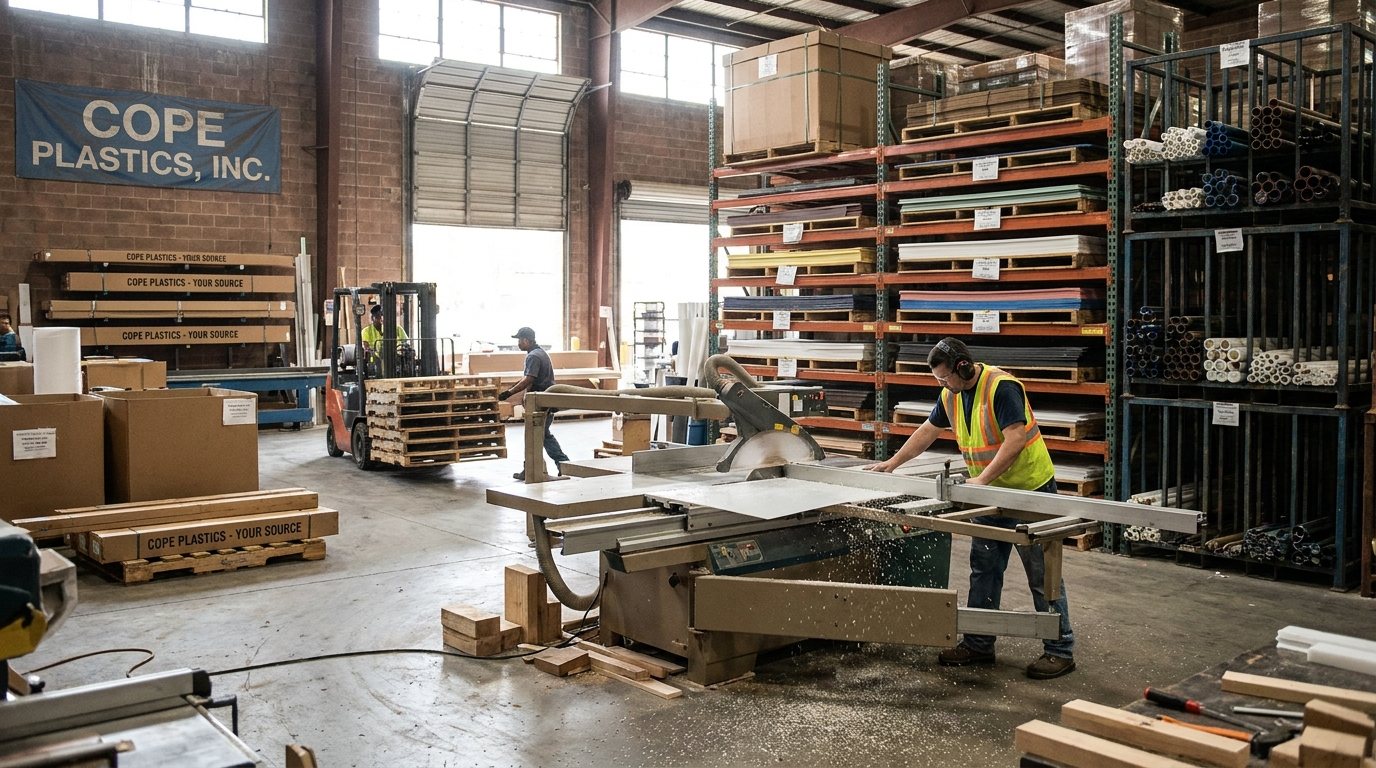
Cope's footprint today runs to more than 20 locations, anchored by corporate headquarters and a processing center in the Alton, Illinois area, with branches serving the industrial Midwest, the Sun Belt, and pockets of the Southeast. The company fabricates and distributes performance plastics for customers in food and beverage, mining, signage, material handling, oil and gas, and fluid handling. It describes its equipment base as one of the largest CNC plastic fabrication arrangements in the country, which matters more than it sounds: a distributor that can cut, machine, and finish material in-house is selling capability, not just inventory.
The insight: staying independent while the sector consolidates around it
Here is the part worth naming plainly. Plastics distribution has been consolidating hard, and private equity is a big reason why. In April 2026, Curbell Plastics, itself a large distributor, acquired Interstate Advanced Materials, adding nine locations and more than 150 employees to push Curbell's network to 31 sites. That deal is one data point in a broader pattern: distributors in this vertical get bought, bolted onto larger platforms, and run for the multiple. Cope has taken none of those calls, or at least none that closed. It is still Cope-owned, still headquartered where it started, still run by a Cope descendant.
Family ownership by itself is not a moat. Plenty of family plastics shops have sold precisely because staying independent got harder every year: capital for new CNC lines is expensive, national accounts want a supplier with coast-to-coast reach, and PE-backed rivals can out-price a smaller player on freight and raw material. Cope's answer has been to build the reach organically, branch by branch, rather than borrow it through a roll-up, and to lean into the one differentiator a PE-owned competitor structurally cannot match: it formalized its status as a woman-owned business.
In 2025, Cope earned WBENC certification for the first time and recertified with NWBOC, a designation it has held since 2012, according to the company's own announcement. Both certifications require verification that the business is at least 51 percent owned, operated, and controlled by women. That is not a marketing footnote. Supplier diversity programs at large industrial buyers and public agencies specifically seek out certified women-owned vendors, and it is a lane that is effectively closed to a distributor once it becomes a portfolio company of a private equity fund, because the certifying bodies require verified independent ownership and control. Cope's board member Roxanne Wittman put it plainly in that release: the certifications "open new doors while reinforcing the values that have guided our company for decades."
What the model trades away
The honest tension is that Cope's growth path is slower than the roll-up path. Organic branch openings and internal succession do not compress a decade into a year the way an acquisition can. Cope will not match a PE-backed platform's ability to bolt on nine locations overnight. What it gets in exchange is control over its own culture, an internal motto ("OneCope") that Saale has pushed to keep 20-plus branches feeling like one company rather than a collection of acquired shops, and a certification status that turns its ownership structure into a sales asset rather than a constraint.
The unglamorous truth
None of this shows up in a press release headline, but distribution rewards the plumbing nobody notices: which branch has the material in stock, whose fabrication line can turn a cut order around by Friday, and whose ownership paperwork opens a bid that a competitor's cannot. Cope's three generations are a bet that the plumbing still matters more than the platform.