
Couche-Tard: How a Quebec Corner Store Ate the Convenience Industry
Alimentation Couche-Tard is #44 on NRF's Top 100 with $11.58B in 2025 U.S. sales. Here's how one Laval dépanneur built a 17,000-store empire.
Part of Retailer Playbooks — history-first profiles of every company on the NRF Top 100 Retailers list.
Alimentation Couche-Tard ranks #44 on the NRF Top 100 Retailers 2026 list, with $11.58 billion in 2025 U.S. retail sales, according to the National Retail Federation's ranking compiled with Kantar. That number covers only its American footprint. Globally the company runs roughly 17,300 stores across 27 countries, most of them wearing the Circle K name it didn't invent and didn't own until 2003.
A Store That Never Closed
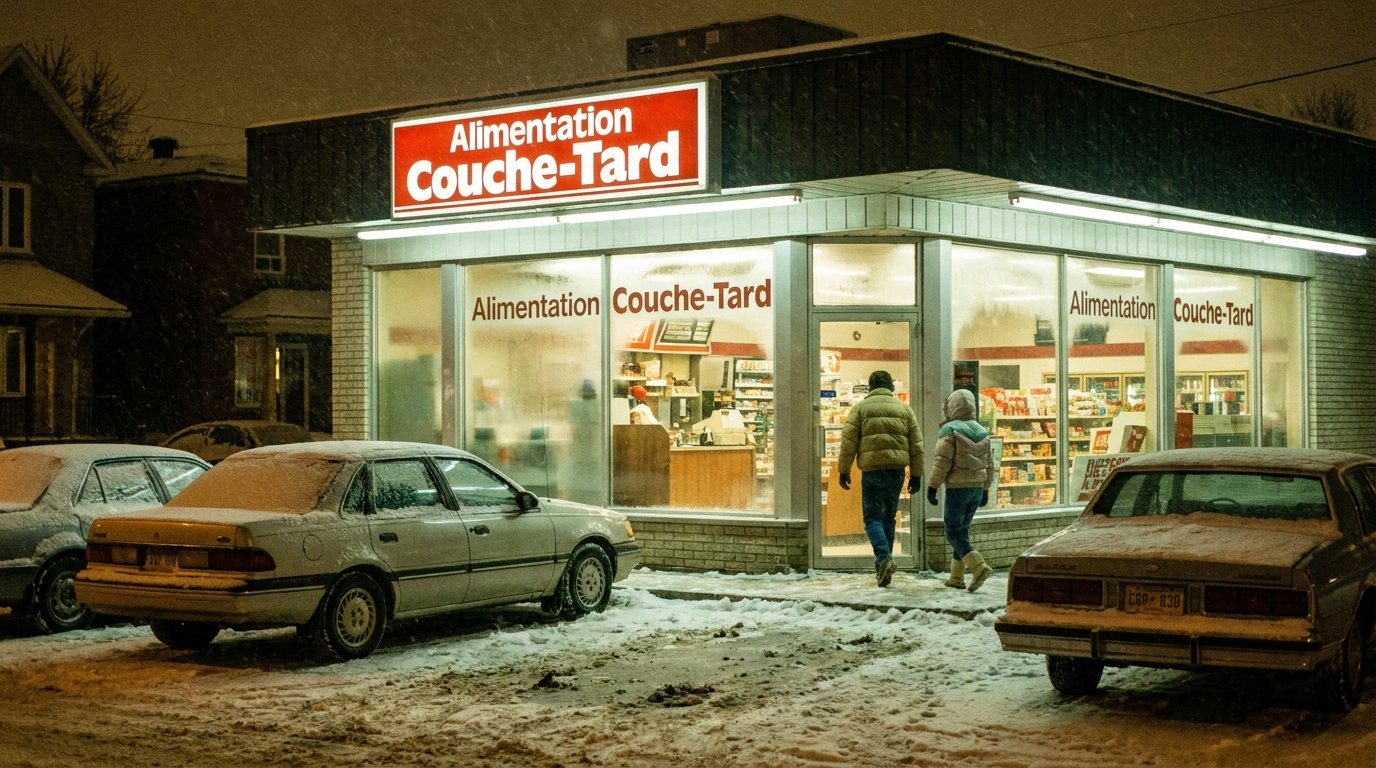
Alain Bouchard opened his first convenience store in Laval, Quebec, in 1980. Quebec's dépanneurs, small neighborhood shops that stayed open when the big grocery chains locked up for the night, were already a local institution, and Bouchard built his business on the same premise: be open when nobody else is. In 1985 he bought eleven stores that already carried the name "Couche-Tard," Québécois slang for a night owl, and merged them with his Montreal locations. The name stuck because it described the business model exactly.
What followed was not organic growth so much as a two-decade buying spree through other people's distress. In 1993 Couche-Tard picked up 54 Mac's and La Maisonnée stores from Silcorp. In 1997 it absorbed C Corp, a Provigo subsidiary holding the Provi-Soir, Winks, and Red Rooster banners, pushing its Canadian count past 600 outlets. By 1999 it had folded Dépan-Escompte and Provi-Soir under one Couche-Tard banner. The company was still a Quebec story. That changed fast.
Crossing the Border by Buying the Wreckage
Couche-Tard's U.S. entry in 2001, 172 Bigfoot stores, was a toe in the water. The real move came in 2003, when it bought Circle K from ConocoPhillips for $830 million. Circle K was not a healthy asset changing hands. Fred Hervey had founded it in El Paso, Texas, in 1951 by renaming three Kay's Food Stores, and under CEO Karl Eller it grew into the country's second-largest convenience chain by the late 1980s, more than 4,600 stores. Then it overreached on debt during the leveraged-buyout era and filed Chapter 11 in May 1990. It passed through Investcorp, then Tosco, before landing at Couche-Tard, a company one-tenth its former size buying a brand with three times the name recognition.
That sequence, buy the wounded market leader, is the pattern that explains almost every major deal Couche-Tard has made since:
| Year | Acquisition | What it added |
|---|---|---|
| 2003 | Circle K (from ConocoPhillips) | ~830M USD, the brand that would eventually replace all others |
| 2012 | Statoil Fuel & Retail | $2.8B, 2,853 stores across Scandinavia and Eastern Europe |
| 2015 | The Pantry (Kangaroo Express) | $860M, a struggling Southeast U.S. chain |
| 2016 | CST Brands | $3.78B, ~2,000 stores, the largest deal in company history |
| 2023 | 1,600 TotalEnergies stations | Germany and the Netherlands |
| 2024 | 270 GetGo stores (Giant Eagle) | Pittsburgh-area density |
One Name, Every Continent
For most of its life Couche-Tard operated as a holding company for other people's brand names: Mac's in Canada, Statoil in Norway, Kangaroo Express in the Carolinas. Starting in 2015 it began the slow, expensive work of converting nearly all of them to Circle K, betting that a single global brand was worth more than the accumulated local goodwill of a dozen regional ones. It is a bet few convenience operators have had the balance sheet, or the nerve, to make at this scale. Most roll-ups keep acquired banners alive indefinitely because rebranding thousands of storefronts is slow and disruptive. Couche-Tard treated brand unification as core infrastructure work, the same category as supply chain or point-of-sale systems, not a marketing nice-to-have.
The Deals That Didn't Happen
Not every swing connected, and the misses are as instructive as the hits. In 2010 Couche-Tard ran an unsolicited proxy fight for Casey's General Stores and lost. In 2020 it chased Speedway's roughly 3,900 stores and was outbid by 7-Eleven's parent at $21 billion. Then, in a reversal that shows how far the company's ambitions had grown, Couche-Tard itself made an unsolicited approach in 2024 to acquire Seven & I Holdings, the Japanese parent of 7-Eleven, in a deal reported at roughly $47 billion, before withdrawing the offer in 2025 amid antitrust friction and management resistance in Tokyo. A company that entered the U.S. market in 2001 with 172 Bigfoot stores had, within a generation, positioned itself to attempt the largest foreign acquisition in Japanese corporate history.
The unglamorous insight here, one that doesn't show up in the corporate "our story" copy, is that Couche-Tard's actual core competency was never the convenience store. It is acquisition integration at a scale most retailers never attempt: buying distressed or divested networks during downturns, in bankruptcy, in an oil-price bust, in a private equity exit, and then running the unglamorous multi-year work of unifying systems, supply contracts, and signage. Alain Bouchard, now executive chairman, built a company that treats M&A as its primary growth engine and store operations as the thing that has to work well enough to make the next acquisition financeable.
Every one of those thousands of Circle K stores runs on the same unglamorous backbone every retailer depends on: a supply chain, a point-of-sale system, and a product catalog someone has to keep accurate at scale. This series keeps returning to that infrastructure, one company's history at a time.
Sources: