
How a Macaroni Machine Shop Became Curbell Plastics
Curbell Plastics made the 2026 MDM Top Distributors list in Plastics. Its origin story explains why the 80-plus-year-old company still isn't for sale.
Part of Distributor Playbooks — strategy teardowns of every company on the MDM Top Distributors lists.
Curbell Plastics landed on Modern Distribution Management's 2026 Top Distributors list in the Plastics vertical, one of the largest independent suppliers of plastic sheet, rod, tube, and film in the country. What the ranking doesn't show is where the name came from, or why a company that size has stayed in the same family's hands since Franklin Roosevelt was president.
A machine shop on the side of a macaroni plant
Curbell's origin has nothing to do with plastic. In the early 1940s, brothers Edmond and Leonard Leone ran a macaroni-producing business in Buffalo, New York, that included, almost incidentally, a small machine shop attached to the operation, according to Curbell's own company history. Buffalo at the time was thick with wartime aviation manufacturing, and the machine shop found its first real customers not in pasta but in airplane parts: Curtiss-Wright and Bell Aircraft, two of the manufacturers building fighters and bombers a few miles from the Leones' plant.
The company's name is the tell. "Cur-Bell" is a mashup of Curtiss and Bell, the first two accounts that mattered. It's a small, odd fact, and it explains a lot about how this company thinks: name yourself after the customer, not the product. Plastics came later, as Curbell Medical's history page notes, once the postwar synthetic-materials boom gave a Buffalo machine shop a much bigger material to work with than metal.
Two divisions, one family, no obvious reason they belong together
Most distributors that reach Curbell's scale pick a lane and go deep. Curbell instead runs two businesses that share a name, a headquarters in Orchard Park, New York, and little else: Curbell Plastics, which sells sheet, rod, tube, film, tape, and fabricated plastic parts to industrial and commercial buyers, and Curbell Medical Products, which makes patient-communication and call-light systems for hospitals.
That's an unusual structure to still be running eight decades in. Industrial distribution has spent the last twenty years consolidating under private equity, and the natural move for a family owner sitting on two unrelated divisions would be to sell one, focus the other, and take the multiple. Curbell has done neither. The plastics side has instead used its own balance sheet to keep building itself into, per industry profiles, one of the nation's top-five plastic materials suppliers, while the medical side runs as its own thing entirely. The insight worth naming plainly: staying private and staying diversified across two unrelated verticals is not a placeholder strategy here, it's the strategy, and it's let Curbell make decisions on an eighty-year clock instead of a fund's five-to-seven-year one.
Building plastics distribution the boring, compounding way
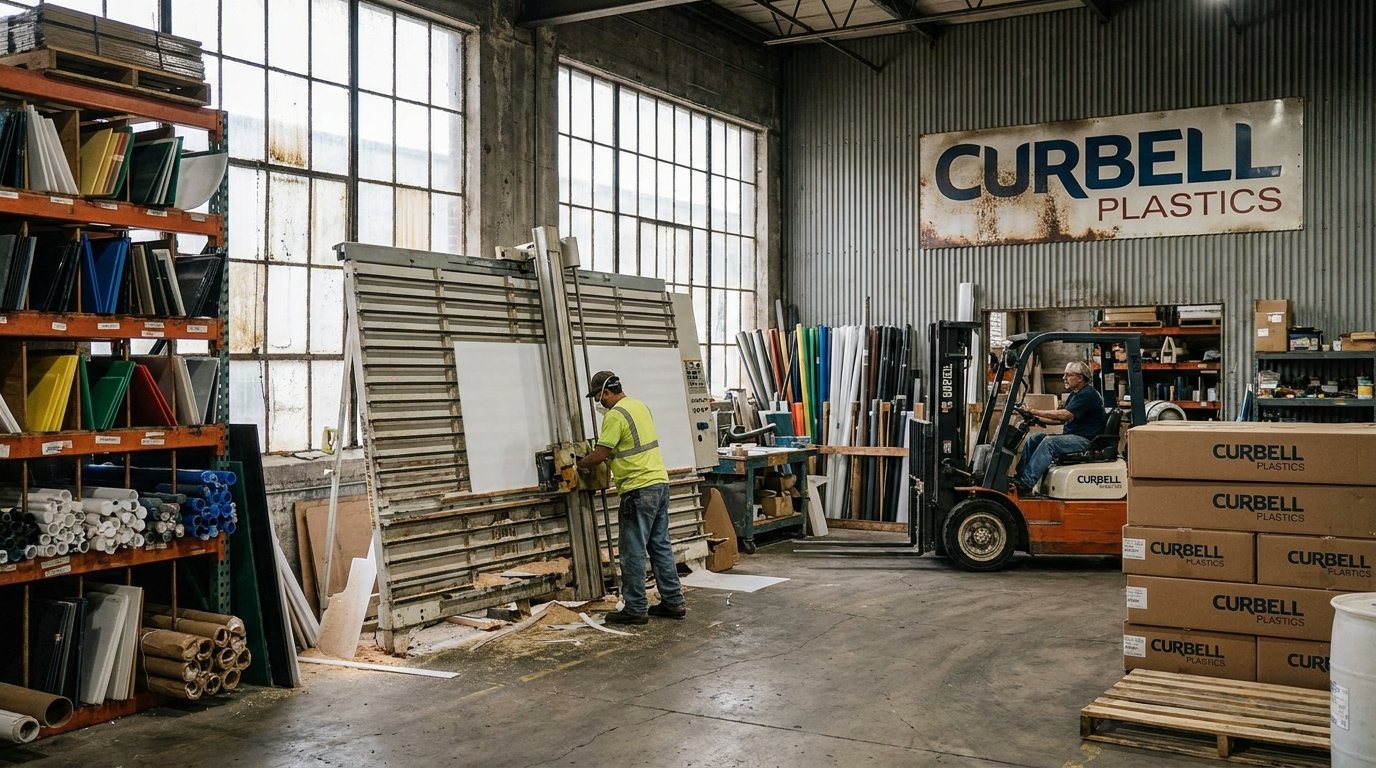
Curbell Plastics itself competes the way specialty material distributors have to: not on price, since sheet and rod are close to commodity inputs, but on the stuff that surrounds the material. The company's site runs an "Ask a Plastics Expert" technical resource, and its sales organization is built around application know-how across markets that each have their own compliance and performance quirks, including oil and gas, aerospace and defense, machine building, transportation, and semiconductors and electronics, per the same industry profile. Add fabrication, cut-to-size processing, and inventory management programs, and the pitch becomes: don't just buy plastic here, offload the plastic problem here.
Growth has come from bolting on geography rather than reinventing the model. In its most recent expansion, Curbell Plastics acquired Interstate Advanced Materials, a California-based plastics and composites distributor, adding nine locations to its network in one move. That's the pattern: a company with roughly 18 branches and more than 150 employees a few years ago, according to the same profile, growing largely by buying regional plastics distributors who have the local relationships but not the national purchasing scale, then leaving their people and customer relationships mostly intact.
The tension worth sitting with
Family ownership at this scale cuts both ways, and Curbell is a useful case study in the trade-off rather than a pure success story. The upside is patience: no earnings call to manage, no private-equity playbook forcing a sale in year five, room to run a medical-device business and a plastics distributor side by side because the owners simply want to. The downside is that the same structure that enabled patience also caps the acquisition firepower available to a distributor competing against PE-backed rivals with committed capital lines built for roll-ups. Curbell has answered that by acquiring carefully rather than constantly, picking targets like Interstate that add geography without adding integration risk. Whether that pace stays sufficient as plastics distribution keeps consolidating is the open question for the next decade, not the last eight.
Why it still matters
Eighty-plus years after two brothers named a machine shop after their first two aircraft customers, the through-line is consistency of ownership married to steady expansion of reach: more locations, more fabrication capability, more technical depth, same family. In a distribution channel where sheet plastic can look interchangeable branch to branch, Curbell's bet has been that the surrounding service, and the discipline to build it slowly, is the actual product.
Every company in this series made the 2026 MDM Top Distributors list for a reason, and underneath most of those rankings sits the same unglamorous machinery: a catalog someone maintains, a branch network someone built, and data that someone has to keep straight for the deal to work at all.