
How CVS Health Turned a Discount Drugstore Into a Health Giant
CVS Health ranks #6 on NRF's Top 100 Retailers with $139.37B in 2025 U.S. sales. Here's how a self-service discount store became a health-care pipeline.
Part of Retailer Playbooks — history-first profiles of every company on the NRF Top 100 Retailers list.
CVS Health ranks #6 on the NRF Top 100 Retailers 2026, the National Retail Federation's annual ranking with Kantar, posting $139.37 billion in 2025 U.S. retail sales. Most people know it as the drugstore on the corner. Fewer know that its biggest bets over sixty years had almost nothing to do with the store shelves and everything to do with the plumbing behind the pharmacy counter.
A Self-Service Bet in Lowell
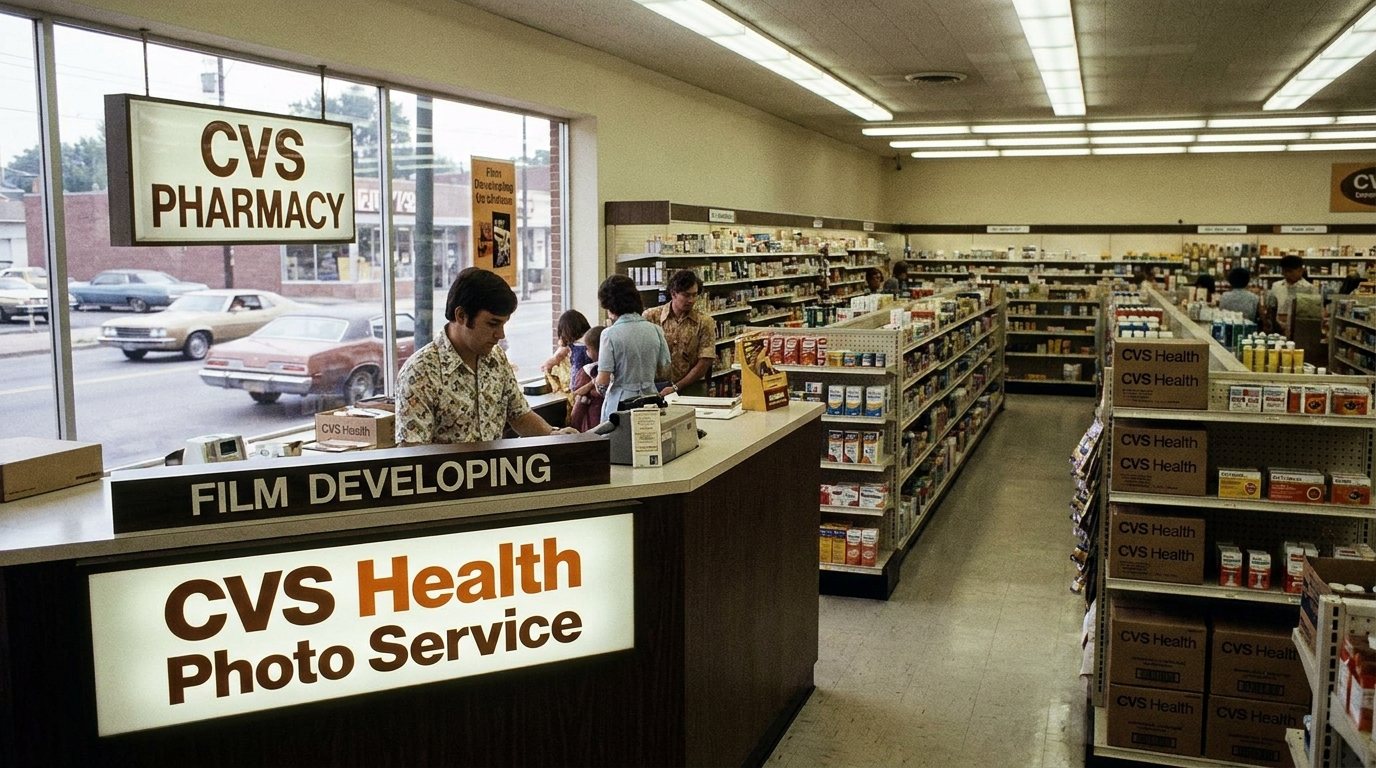
CVS opened its first store in Lowell, Massachusetts, in 1963. Brothers Stanley and Sidney Goldstein, along with Ralph Hoagland, built it as a discount health-and-beauty-aid shop where shoppers bagged their own merchandise instead of asking a clerk behind a counter to fetch it, according to FundingUniverse's company history. Self-service was still a novelty in general merchandise retail at the time, and it let the founders cut labor costs and pass the savings on as everyday discounts. The name Consumer Value Stores got shortened to CVS by 1964, when the chain already counted 17 locations.
The pharmacy came later than you'd expect. CVS didn't add its first pharmacy departments until 1967 and 1968, meaning the company spent its first several years as a beauty-aid discounter that only gradually became a drugstore, per Wikipedia's account of CVS Pharmacy. By 1970, under new parent Melville Corporation (then a shoe retailer that had bought the 40-store chain in 1969), CVS had reached 100 stores across New England.
The Crisis Melville Didn't See Coming
The expansion wasn't a straight line up. By 1974 CVS had 232 stores but pharmacies in fewer than a fifth of them. The early 1990s turned rough: CVS pulled out of California entirely in 1992, selling 85 stores, and Melville announced plans to close as many as 800 stores company-wide that same year, according to FundingUniverse. A shoe-and-variety-store conglomerate trying to run a drugstore chain alongside Marshalls, Kay-Bee Toys, and This End Up was straining under its own sprawl.
The fix, in 1996, was radical simplification: Melville sold off every non-drugstore business and reorganized itself as CVS Corporation, a company with exactly one focus. That bet paid off almost immediately. In 1997, the newly independent CVS bought Revco D.S. for $2.8 billion plus $900 million in assumed debt, picking up roughly 2,600 stores and becoming the largest drugstore chain in the country by store count overnight.
Buying the Infrastructure, Not Just the Storefronts
Here's the part of the CVS story that rarely makes the About page: after Revco, almost every major move CVS made was aimed further from the retail shelf and deeper into the machinery that decides who pays for a prescription and who fills it. Competitors like Walgreens and Rite Aid spent the 2000s mostly opening more stores. CVS spent the 2000s and 2010s buying the businesses that sit upstream and downstream of the store.
| Year | Move | What it bought CVS |
|---|---|---|
| 1997 | Acquires Revco (2,600 stores) | Scale as the largest U.S. drugstore chain |
| 2004 | Acquires Eckerd's 1,268 stores | Southeast and Northeast footprint |
| 2007 | Merges with Caremark Rx | A pharmacy benefit manager — control over which drugs get covered |
| 2014 | Drops tobacco, renames CVS Health | A health-care identity, not just a retail one |
| 2015 | Acquires Target's in-store pharmacies | 1,600+ built-in pharmacy locations |
| 2018 | Acquires Aetna ($70B) | A health insurer — control over who's covered at all |
| 2023 | Acquires Oak Street Health ($10.6B) | Primary-care clinics — control over the doctor visit itself |
That 2007 Caremark merger is the hinge most retail histories underweight. It didn't add stores. It added a pharmacy benefit manager, the entity that negotiates drug prices and decides formularies for tens of millions of insured people, long before they ever reach a CVS counter. Combined with Aetna eleven years later, CVS had assembled a rare vertical stack: the insurer that pays, the PBM that negotiates, and the pharmacy that dispenses, all under one roof.
The $1.5 Billion Signal
The clearest evidence of where CVS was heading came in February 2014, when it announced it would stop selling cigarettes in all its stores, forgoing roughly $1.5 billion a year in tobacco revenue, effective that September. The name changed from CVS Caremark to CVS Health the same month the tobacco sales stopped. Executives framed it as incompatible with a health-care mission, and it read at the time as a symbolic gesture. In hindsight, it looks more like an early tell: a retailer preparing to sell health insurance and manage prescription benefits can't easily also be in the business of selling the products that cause the conditions it's now financially on the hook for treating.
The unique insight worth naming plainly: CVS's growth story isn't really a retail expansion story at all. It's a company that used a drugstore chain as the visible front end of an increasingly invisible health-care infrastructure business, and each of its largest, most expensive bets, Caremark, Aetna, Oak Street, moved the center of gravity further from the shelf and closer to the claim form.
Every retailer on this list has a version of this tension: what shows up on the sales floor versus what actually decides the transaction. For CVS, that tension is the whole business model, and it's been building toward it since the day a self-service bet in Lowell first let shoppers reach for their own toothpaste.