
Defense Commissary Agency: The Retailer Built to Never Profit
DeCA ranks #85 on NRF's Top 100 Retailers with $4.83B in sales. Its history reveals a grocery chain engineered to break even, not win margin.
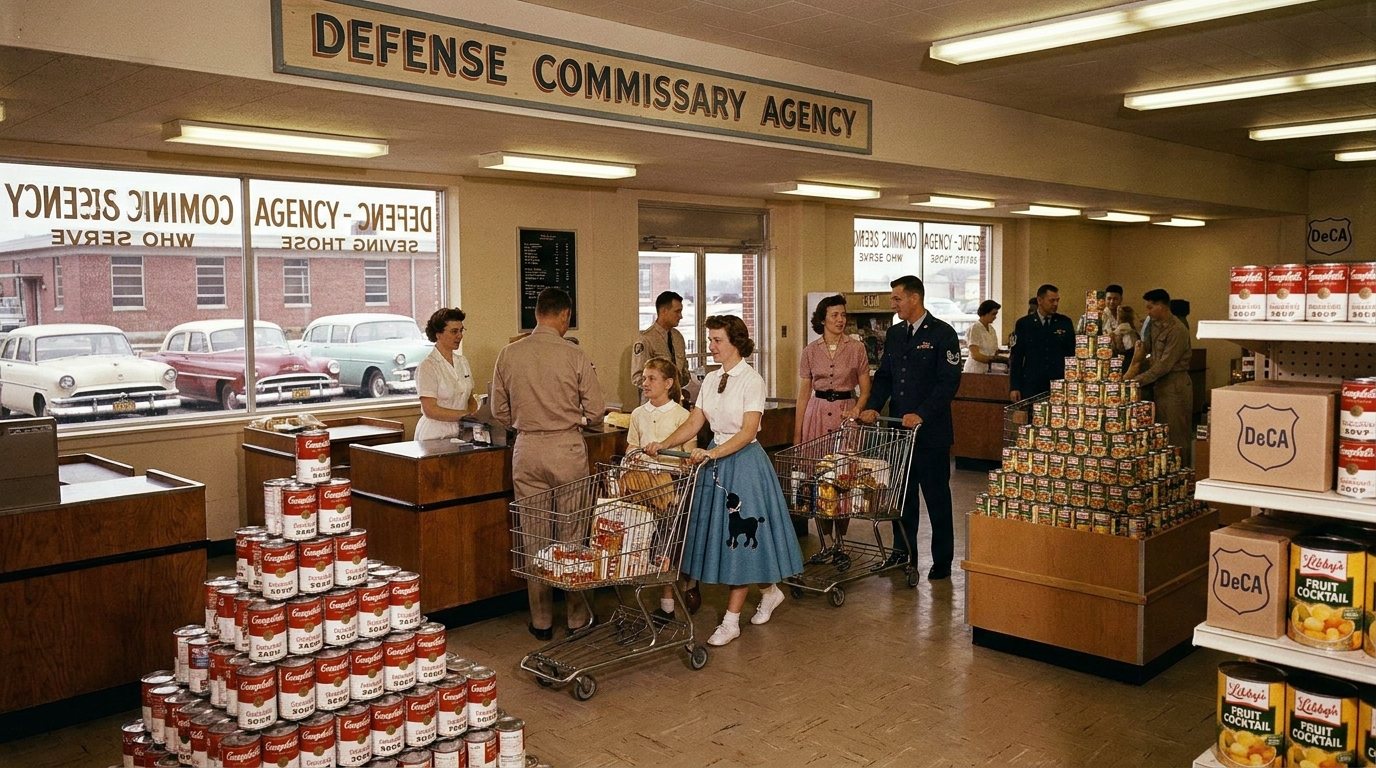
Part of Retailer Playbooks — history-first profiles of every company on the NRF Top 100 Retailers list.
The Defense Commissary Agency ranks #85 on the NRF Top 100 Retailers 2026 list, with $4.83 billion in 2025 U.S. retail sales, a number few shoppers connect to a name they've never heard. DeCA runs the commissary system: nearly 240 grocery stores on U.S. military bases worldwide, serving active-duty troops, retirees, and their families. It has been ranked among the country's largest retailers for years by revenue, while operating on a business model almost every other name on that list would consider a failure state: it is built to make no profit at all.
A benefit older than the supermarket
The commissary predates the modern grocery store by nearly a century. In 1825, Army officers won the right to buy provisions at cost through military stores. By 1841, that privilege extended to their immediate families. The turning point for the enlisted ranks came in 1867, when soldiers who were not officers finally secured the same cost-based purchasing rights, a recognition that the private who carried the same pack as the lieutenant deserved the same grocery bill, according to DeCA's own history as recorded on Wikipedia.
The system followed the flag. Commissaries opened in Cuba, the Philippines, and China between 1898 and 1904 as the U.S. military expanded overseas. The Navy and Marine Corps stood up their own stores in 1909 and 1910. The Air Force, created as a separate service in 1947, inherited a commissary network of its own by 1948. For most of the 20th century, four branches ran four separate grocery bureaucracies, each with its own warehouses, its own buyers, and its own overhead.
One Cold War consolidation, one new agency
That fragmentation ended in 1990. Congress had directed the Pentagon in 1989 to study merging the service-specific commissary systems, and a body known as the Jones Commission recommended folding the Army's Troop Support Agency, the Navy Resale System Support Office, the Marine Corps Services Command's commissary section, and the Air Force Commissary Service into a single organization. The Defense Commissary Agency stood up on May 15, 1990, and took over full operations on October 1, 1991, headquartered at what is now Fort Gregg-Adams in Virginia. It was, by the agency's own account, the first full functional consolidation of a Department of Defense agency in the post-Cold War drawdown, a rare case of the military voluntarily shrinking its own bureaucracy rather than growing it.
The pricing model that makes it an outlier
Here is the detail that separates DeCA from every other name on the NRF list: commissaries sell at cost, plus a flat 5 percent surcharge. That surcharge rate was set in 1952 and fixed at its current level in April 1983, and it has not moved since, even as grocery inflation has reshaped every other retailer's pricing strategy. The surcharge does not fund store operations. It funds facility construction, renovation, and equipment. The roughly $1.4 billion that keeps the lights on and the shelves stocked comes from congressional appropriation, not from markup on a gallon of milk.
The result, per figures cited in Wikipedia's entry on commissary stores, is that patrons save more than 30 percent compared to shopping at a civilian grocery store. A typical store now carries more than 12,000 line items, up from 82 in 1868, a hundred-and-fifty-year expansion in assortment with no corresponding expansion in profit motive.
The unique insight: the anti-company-store
Retail has a long, uncomfortable history with the idea of a captive-customer store. Coal camps and steel mill towns ran their own commissaries in the early 20th century, and sharecroppers in the agricultural South were tied to plantation stores that paid them in scrip redeemable only on-site, the arrangement immortalized in the phrase "you load sixteen tons, and what do you get." Those company stores extracted margin from workers who had nowhere else to shop. DeCA is the commissary model inverted: a captive-customer retailer engineered by law and by surcharge cap to extract nothing. The incentive structure that made 20th-century company stores infamous is precisely the one DeCA was built to prevent, and it is why the model survived a century and a half while its civilian cousins largely died out or were outlawed. It is likely the only retailer on the NRF Top 100 whose stated mission is to minimize, not maximize, its own take from every transaction.
That structure has not made DeCA immune to scrutiny. The Government Accountability Office reviewed the agency's savings methodology in both 2017 and 2022, pushing for more rigorous ways to measure the discount patrons actually receive, particularly overseas, where GAO found the calculations still unreliable as of 2025, according to the same Wikipedia summary of the agency's oversight history. DeCA implemented the 2017 recommendations within months; the overseas fix remains a work in progress.
Widening who gets to shop there
The most consequential recent change wasn't a store opening but an eligibility expansion. In January 2020, Congress broadened commissary access beyond active-duty troops and 20-year retirees to include Purple Heart recipients, veterans with service-connected disabilities rated 10 to 90 percent, their caregivers, and former prisoners of war. It was a quiet acknowledgment that the commissary benefit, first fought for by enlisted soldiers in 1867, still functions as a form of deferred compensation for service, one Congress keeps choosing to widen rather than trim.
Four separate commissary bureaucracies collapsed into one, a surcharge frozen for four decades, and a patron base still growing after a century and a half: DeCA is a reminder that the biggest retail operations aren't always the ones fighting hardest for margin. Sometimes they're the ones that spent 150 years perfecting the discipline of not taking one.
This series keeps circling back to the same unglamorous truth: whether a retailer is chasing margin or, in DeCA's case, deliberately refusing it, the outcome still comes down to the same plumbing of shelves, distribution, and pricing data that every operator has to get right.