
Dillard's: How a Tater House Store Built a Quiet Retail Giant
Dillard's ranks #73 on the NRF Top 100 with $6.27B in 2025 U.S. sales. The history behind its family-run, real-estate-heavy path through a century of retail.
Part of Retailer Playbooks — history-first profiles of every company on the NRF Top 100 Retailers list.
Dillard's ranks #73 on the NRF Top 100 Retailers 2026, with $6.27 billion in 2025 U.S. retail sales, compiled annually by the National Retail Federation with Kantar. It is one of the last big department store chains still run by the family that founded it, and one of the few that owns more square footage than it leases. Both facts trace back to a single decision made in a small Arkansas town in 1938.
The tater house
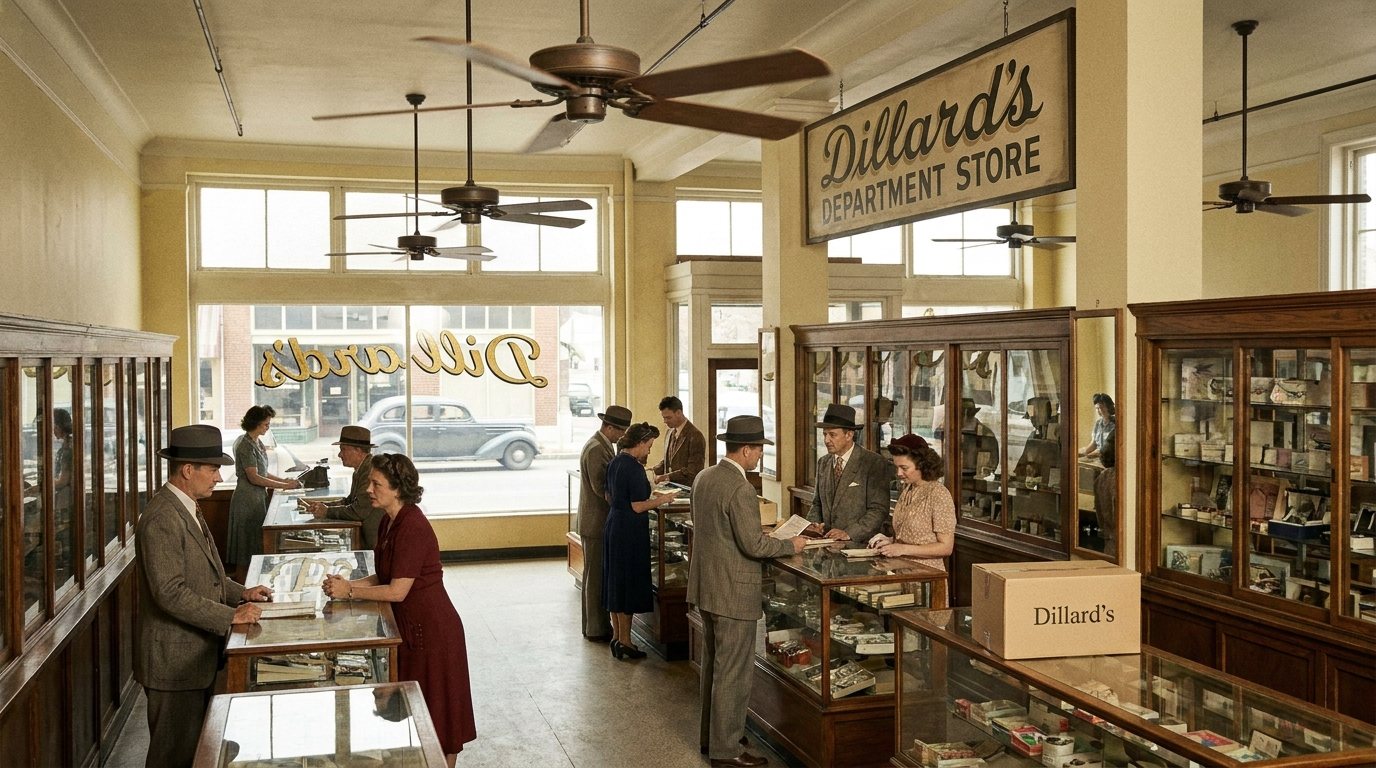
William T. Dillard was 23 years old when he borrowed $8,000 from his father, a grocer in Mineral Springs, Arkansas, and opened a store in Nashville, Arkansas, in a building locals called "the tater house," according to Wikipedia. Dillard had grown up working the register in his father's general store and had picked up formal training along the way, a business degree from the University of Arkansas and an MBA from Columbia, according to Wikipedia's entry on Dillard. Few small-town merchants of the era had both a wholesaler's eye for credit terms and a Columbia Business School frame for thinking about scale.
The bet paid off fast. The store did $42,000 in sales its first year, built on name-brand merchandise and aggressive newspaper advertising, according to FundingUniverse's company history. Dillard closed during World War II and reopened in 1944 to strong demand. By 1946 he had outgrown Nashville and moved to Texarkana, where he bought a stake in Wooten's Department Store and took full control by 1949, pairing it with the same playbook: renovate the store, restock with recognizable brands, and buy heavy local newspaper space to announce it.
Buying the wounded, one town at a time
That playbook became the business. Instead of building new stores from scratch, Dillard spent the 1950s through the 1980s buying department stores that were struggling, then fixing them with fresh merchandise, remodels, and marketing. Mayer & Schmidt in Tyler, Texas, in 1956. Brown-Dunkin in Tulsa in 1960. Joseph Pfeifer in Little Rock in 1962. By 1974, he was saturating the Dallas-Fort Worth market with the Leonard's chain, a strategy of clustering stores so tightly in a region that a market became hard for competitors to enter, per FundingUniverse.
The company went public in 1969 and moved its headquarters to Little Rock, and the acquisitions kept coming: Stix, Baer & Fuller in St. Louis in 1983 or 1984, 18 John A. Brown and 12 Diamond stores for $140 million in 1984, a dozen R.H. Macy's locations for $100 million in 1985, then Joske's in 1987, D.H. Holmes in 1989, and Ivey's in 1990, according to Wikipedia and FundingUniverse. Each deal followed the same logic: find a regional chain that had lost its edge, apply Dillard's merchandising and marketing discipline, and fold it into a growing footprint anchored in Southern and Midwestern malls.
One quieter decision mattered as much as any acquisition. In 1964, Dillard installed the company's first computer system for inventory tracking, an early bet on data discipline that let the chain price on everyday value rather than chase discount promotions, watching local competitors and adjusting rather than running perpetual sales, per FundingUniverse. That system became a genuine edge: while rivals leaned on markdowns to move goods, Dillard's could hold price and still turn inventory, because it actually knew what was on the floor.
The deal that almost broke it
The run of disciplined growth met its hardest test in 1998, when Dillard's paid $2.9 billion for Mercantile Stores, absorbing nameplates like Bacon's, Castner Knott, and Gayfers. The math never worked. Operating expenses nearly doubled, profit margins collapsed, and from 2000 through 2003 the company posted heavy losses tied to soft women's apparel sales and marketing missteps, according to FundingUniverse. Moody's downgraded Dillard's debt in late 2003. For a company built store by store over six decades on the idea that you buy the wounded and heal them, Mercantile was the first acquisition Dillard's itself needed healing from.
Recovery came the unglamorous way: cost cuts, debt paydown, and shedding businesses that weren't core retailing. In 2004 the company sold its proprietary credit card operation to GE Consumer Finance and exited its ticket-sales business, redirecting focus back to stores and merchandise. William Dillard stepped back from day-to-day leadership in 1998 and died in 2002, having watched his company grow from one Arkansas storefront into the country's third-largest department store chain by decade's end, per Wikipedia's profile of him. His son, William T. Dillard II, has run the company since, with other family members in senior roles and the Dillards retaining control through Class B stock even as Class A shares trade publicly.
The unglamorous insight
Here's the detail that rarely makes it into a retail retrospective: Dillard's owns its real estate. As of a 2019 filing, the company held roughly 44.3 million of the 49 million square feet it operates in, according to Wikipedia, an ownership ratio almost unheard of among mall-based department stores, most of which lease. For fiscal 2023, on net sales of $6.75 billion, Dillard's reported net income of $738.8 million against $1.77 billion in operating expenses, a net margin north of 10 percent, a figure that dwarfs what most department store peers report in a good year.
That combination, owned buildings and a lean cost structure, is the through-line from the tater house to today. Dillard's never chased the flashiest growth story in retail. It bought what was broken, tracked inventory before most competitors bothered, held onto its buildings instead of renting them back, and let a family keep making the calls. The result is a chain that looks, on paper, like the plainest department store in the mall and performs like one of the more efficient retailers in the country.
Retail history is full of chains that grew fast and thin. Dillard's grew slow and owned the ground it stood on, and that patience is its own kind of infrastructure.