
Dilmar Oil: The 90-Year-Old Distributor That Reclaims Its Own Oil
Dilmar Oil Company made MDM's 2026 Top Distributors list in Lubricants & Fuels. Here is how a 90-year-old family jobber built a closed-loop reclamation business.
Part of Distributor Playbooks — strategy teardowns of every company on the MDM Top Distributors lists.
Dilmar Oil Company shows up on MDM's 2026 Top Distributors list in the Lubricants & Fuels category, one of the smaller and less-covered names in that vertical. It has also been in continuous, private, family operation since 1932. That combination is rarer than it sounds in a distribution sector that big oil majors and private equity have spent three decades consolidating, and it is the reason Dilmar is worth a longer look than its size alone would suggest.
Two counties and a Depression-era bet
The name is a contraction, not a founder's surname. R.E. Atkinson and M.H. Cox started the business in 1932 to sell Shell products across Dillon and Marion counties in South Carolina, and they fused the county names into "Dilmar" rather than branding it after themselves, according to the company's own history page. Fourteen years later, in 1946, the Atkinson family bought out the partnership and became sole owners, a transition the company still marks as the real founding moment of its family-ownership story.
Robert Earle Atkinson Jr., who ran the company from the mid-20th century until his death in 2015, is the figure Dilmar credits with shaping its current footprint: a Shell jobber that grew, county by county, into a multi-state lubricants distributor without ever taking on outside ownership. That is the through-line worth naming plainly: in a vertical where independent oil jobbers have been rolled up into regional platforms and private-equity-backed groups for a generation, Dilmar has stayed a single family's business for going on 80 years since that 1946 buyout.
From selling oil to owning the whole loop
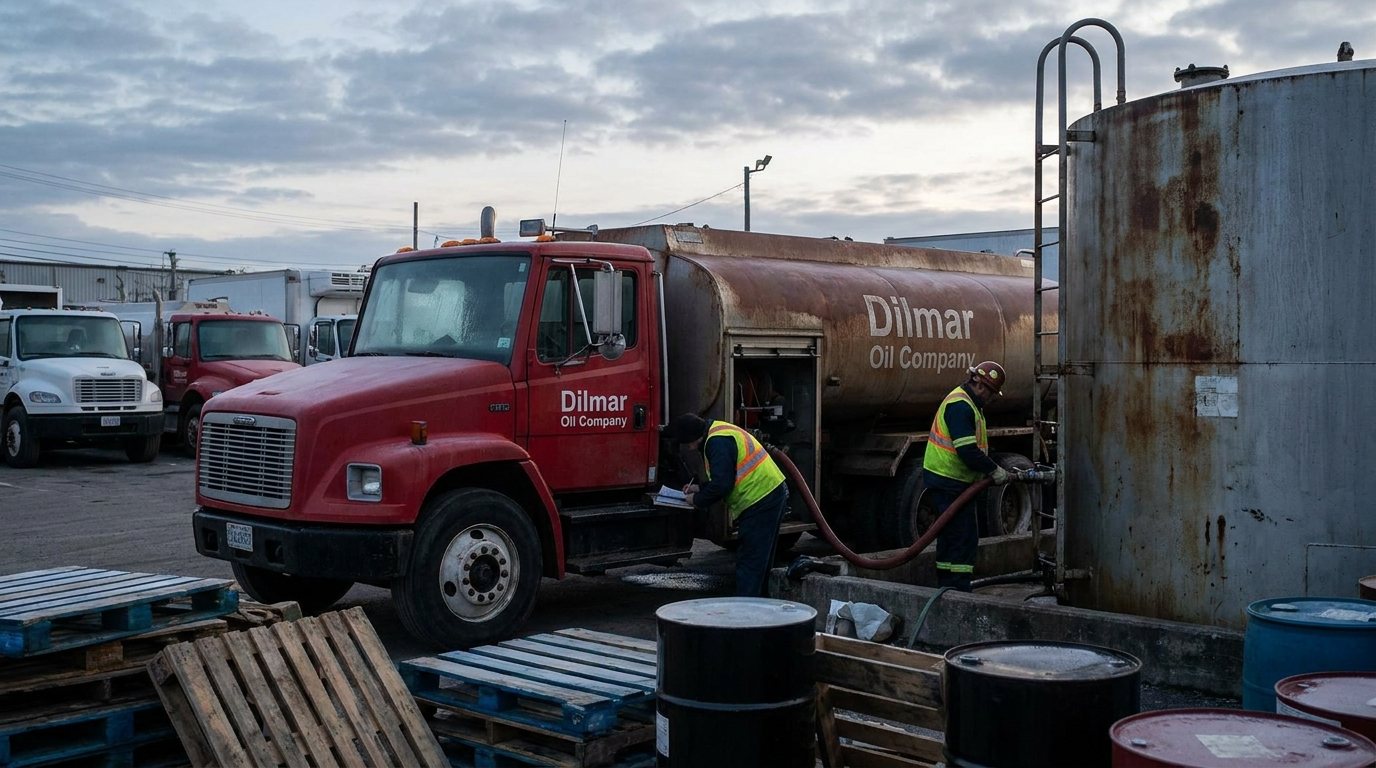
Most lubricants distributors make their margin once, when the drum or tote leaves the warehouse. Dilmar built a second business on the other end of that same transaction. Dilmar Fluid Services (DFS) reclaims used industrial oil, filtering turbine oil, hydraulic fluid, gear oil and cutting oils back into usable condition on customer sites, and the company's own materials describe the economics bluntly: reclaimed fluid running 40 to 60 percent cheaper than virgin oil, with some industrial accounts cutting new-oil purchases by as much as 90 percent.
That is the unique wrinkle in Dilmar's model. A conventional distributor's incentive is volume: sell more virgin product, move more gallons. A reclamation business's incentive is the opposite: keep a customer's existing fluid in service longer and sell them less new oil per unit of output. Dilmar runs both businesses out of the same branches, using four portable reclamation units and one stationary facility that has operated in this capacity for close to two decades per the company's about-us page. Rather than treat that as a conflict, Dilmar has folded reclamation into a broader Industrial Reliability Management offering, so the sales conversation isn't "how many drums do you need" but "how do we manage your total fluid cost." For an industrial account, that reframes Dilmar from vendor to lifecycle partner, which is a stickier and harder-to-replace position than being the low-price drum supplier.
The footprint behind the pitch
None of that works without physical infrastructure, and Dilmar's is substantial for a company its size: eight bulk plants, more than 40 bulk and packaging trucks, roughly 1 million gallons of bulk storage and 125,000 square feet of package warehousing spread across seven branch locations in South Carolina, North Carolina and Georgia, plus a newer Knoxville, Tennessee location that extends the network into a fourth state, according to the company's service-locations pages. That is the classic distribution moat: branch density and bulk storage close enough to customers that reclamation trucks and lubricant deliveries can share routes and relationships.
A quiet answer to industry consolidation
Here's the tension worth sitting with. Family ownership over 90 years is a genuine asset. It buys patience for a reclamation business that took years to pay off, and it buys credibility with the industrial accounts that value a distributor who answers the phone the same way for decades. But it also means Dilmar has grown organically inside a four-state Southeastern footprint while sitting in a vertical where scale increasingly comes from acquisition. MDM's own lists are populated with lubricants and fuels distributors that got large by buying peers; Dilmar's path has been to go deeper in fewer states and add adjacent services rather than add geography by roll-up. That is a defensible strategy as long as reclamation and reliability management keep differentiating the pitch. It is a harder one if a better-capitalized competitor decides to build the same closed-loop service at a scale Dilmar's organic growth model can't match quickly.
Ninety-plus years in, Dilmar's bet is that owning both ends of the oil's life, the sale and the reclamation, is worth more than owning more zip codes. It is a bet that has outlasted a lot of distributors who chose differently.
Distribution has always run on unglamorous fundamentals: what's in the branch, what's in the tank, and whether the truck shows up. Dilmar's version of that discipline just happens to include the oil coming back out the door as well as the oil going in.