
Dollar General: How a Depression-Era Idea Built 20,000 Stores
How J.L. Turner's Depression-era liquidation business became Dollar General, and why a brutal 2007 buyout timed perfectly for the recession that followed.
Part of Retailer Playbooks — history-first profiles of every company on the NRF Top 100 Retailers list.
Dollar General ranks #17 on the NRF Top 100 Retailers 2026, the National Retail Federation's annual ranking compiled with Kantar, with $43.13 billion in 2025 U.S. retail sales. That figure sits on top of a business that started with $5,000 in cash and a truckload of liquidated merchandise in rural Kentucky, and it survived an accounting scandal and a $6.9 billion leveraged buyout to get there.
A father, a son, and a truckload of bankrupt inventory
In October 1939, James Luther "J.L." Turner and his son Cal opened J.L. Turner and Son in Scottsville, Kentucky. J.L. had spent the Depression years buying up the inventory of failed general stores and reselling it, learning the wholesale trade one bankruptcy at a time, according to Wikipedia's history of the company. The father-son shop wasn't glamorous. It was a Depression-economy hustle: buy what nobody else could move, sell it cheap, keep the lights on.
It worked. By the early 1950s the business was doing more than $2 million a year, respectable money for a rural Kentucky operation with no name recognition beyond its own counties.
The pivot that outgrew the company that made it
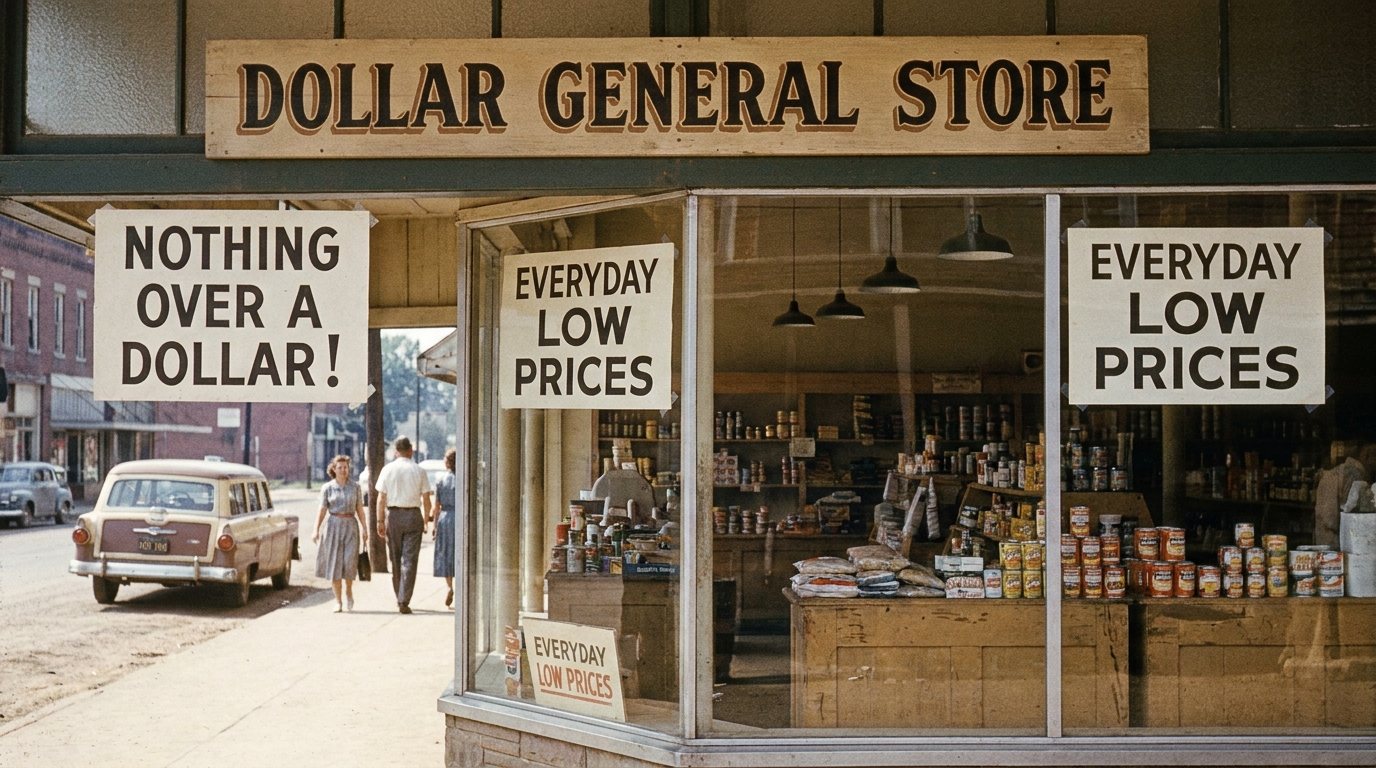
The moment that actually built the company we know today came in 1955, and it wasn't a new store format or a financing trick. Cal Turner took a department store in Springfield, Kentucky and ran it as a "dollar day" promotion, the kind of gimmick discount stores used to clear inventory for a weekend. He kept it running. That store became the first Dollar General, and the one-price idea that was supposed to be a sale event became a permanent operating model, per Dollar General's own account of its history.
This is worth sitting with, because it's the one insight that doesn't show up on the company's About page: Dollar General's entire identity is a promotional stunt that never ended. Most retailers that build a business around a pricing gimmick eventually graduate away from it as they scale. Dollar General did the opposite. It let the gimmick eat the parent company. J.L. Turner and Son, the wholesale liquidation business with the family name on the door, was absorbed entirely into the throwaway marketing line from a single Kentucky storefront. By 1968 the company was profitable enough to list on the New York Stock Exchange with more than $40 million in sales.
Three generations, then a rupture
J.L. Turner died in 1964 and Cal Sr. took over. Cal Turner Jr. joined the family firm in December 1965, worked his way up through the business, and became president in 1977. Under his leadership the chain grew past 6,000 stores and $6 billion in annual sales. But the Turner family story didn't end as a tidy multigenerational handoff: at one point Cal Jr. forced both his own father and his brother out of the business, according to Wikipedia's account of Cal Turner Jr.'s career. It's the kind of chapter family businesses rarely put in their own retrospectives, and it's part of how Dollar General ended up run by a single, singularly focused Turner for a quarter century.
That focus had a dark side. In April 2001, the company settled for $162 million after being found liable for false statements about its financial results, and it restated three years of earnings for accounting irregularities that included allegations of fraud. A second restatement followed in 2005 over lease-accounting issues. Cal Turner Jr. retired in 2002, and David Perdue took over as CEO the following year.
The buyout that arrived at exactly the right moment
Perdue resigned in June 2007. One month later, a private equity consortium of KKR, Goldman Sachs, and Citigroup completed a $6.9 billion acquisition, taking the company private at $22 a share. The new owners closed more than 400 stores and pushed an "EZstore" remodel to strip out complexity and simplify the box.
Here's the part that doesn't get said plainly enough: a debt-financed buyout is usually a company's most dangerous chapter, not its best one. Loading $6.9 billion onto a discount retailer's balance sheet right as the economy tipped into the worst recession since the Depression should have been a disaster. Instead, the operational discipline the new owners forced through arrived at the exact moment American shoppers started trading down in droves, and a leaner, simpler Dollar General was standing there to catch them. The buyout that was supposed to be a liquidity event became, almost by accident, the best-timed remodel in the company's history.
Dollar General returned to the public markets in August 2009 with a $750 million IPO. What followed was the fastest expansion in the company's 85-year run: geographic pushes into Wyoming, Washington, Idaho, and Montana left only Alaska and Hawaii without a location, and the store count climbed past 20,000 across 48 states, according to Wikipedia. Todd Vasos, who first became CEO in 2015, stepped away in 2022 and returned to the role in October 2023, a rare round-trip at the top of a company this size.
Along the way came new formats built to test whether the small-box model could stretch: Dollar General Market for groceries in 2003, DGX for urban instant-consumption shoppers in 2017, and pOpshelf in 2020 for higher-margin home goods under five dollars.
The through-line
Every era of Dollar General's history is really the same bet made over and over: that the fastest way to serve a town too small for anyone else to bother with is to keep the box small, the price simple, and the overhead lower than the competition can match. A liquidation wholesaler figured that out by accident in 1955. A leaned-out balance sheet proved it again by accident in 2009.
This profile is part of Anglera's Retailer Playbooks series, which is really about a simpler idea: behind every storefront, however small, is a supply chain and a catalog of data working to keep the shelves right.