
Dollar Tree: The Discipline Behind a Single-Price Empire
Dollar Tree rode a one-dollar price cap to a national chain, bought Family Dollar for $8.5B in 2015, then sold it a decade later. Here is that arc.
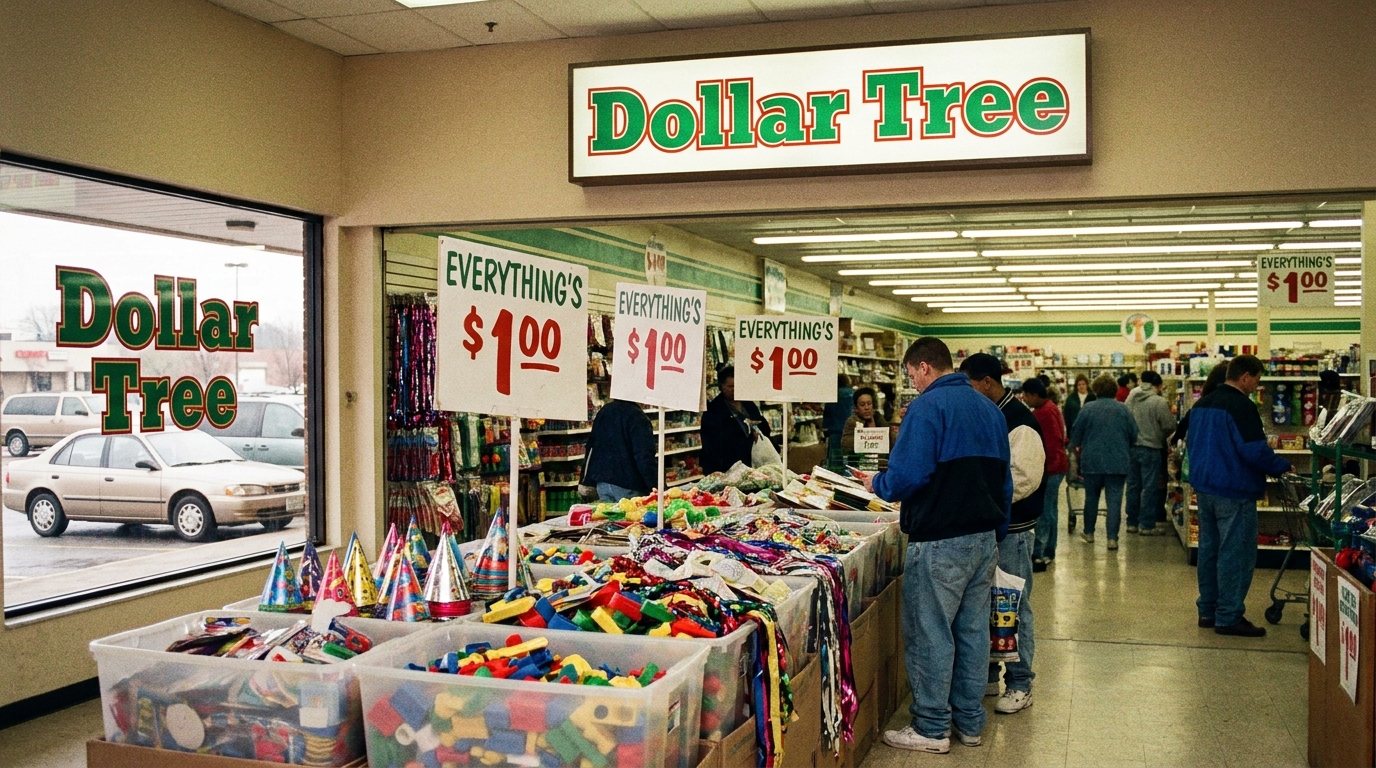
Part of Retailer Playbooks — history-first profiles of every company on the NRF Top 100 Retailers list.
Dollar Tree lands at #29 on the NRF Top 100 Retailers 2026 list, with $18.93 billion in 2025 U.S. retail sales. That figure covers the Dollar Tree banner alone, which is itself the tell: this is a company whose defining strategic move of the past two years was becoming smaller on purpose.
A Toy Store That Became a Five-and-Dime
The roots go back to 1953, when K.R. Perry opened a Ben Franklin variety store in Norfolk, Virginia, that grew into K&K 5&10. In 1970, Perry, his son J. Douglas Perry, and Macon Brock launched K&K Toys, a mall-based chain that reached more than 130 East Coast locations. Toys built the balance sheet. They were not, however, the founders' last idea.
In 1986, Doug Perry, Macon Brock, and H. Ray Compton incorporated a new venture in Virginia under the name Only $1.00, opening five stores across Georgia, Tennessee, and Virginia stocked largely with closeout merchandise, according to FundingUniverse's company history. The first store to carry the Dollar Tree name opened on April 27, 1989, at Jessamine Mall in Sumter, South Carolina.
The Pivot That Made the Format Work
The early closeout model had an obvious flaw: closeout inventory is unpredictable, and a store built around a fixed price point cannot afford unpredictable inventory. Around 1991 and 1992, management remade the concept from the ground up, moving away from distressed goods toward a curated, repeatable assortment of basic merchandise, still capped at one dollar. That shift, more than the founding itself, is what turned a regional closeout chain into a format other retailers would spend decades trying to copy.
The company sold K&K Toys to a Melville Corporation subsidiary in October 1991 to fund the pivot fully, then renamed itself Dollar Tree Stores in 1993, with Brock installed as CEO. Stores moved out of enclosed malls and into strip centers anchored by Kmart, Target, and Walmart, standardized around a roughly 3,200-square-foot footprint. Dollar Tree went public in 1995, the same year it opened its 500th store and crossed $300 million in sales, per Wikipedia's account of the company's history.
Buying Growth, One Chain at a Time
Through the late 1990s and 2000s, Dollar Tree grew as much by acquisition as by new construction: Dollar Bill$ in 1996, Only $One in 1999, Dollar Express in 2000, Greenbacks in 2003, and the 138-store DEAL$ chain in 2006. The company entered all 48 contiguous states by 2004, opened its 3,000th store in 2006 on the 20th anniversary of the $1 price point, made the Fortune 500 in 2008, and pushed into Canada in 2010 by acquiring Dollar Giant.
Every one of those deals shared a logic: buy a chain, convert the stores, keep the price fixed. The 2015 deal broke that pattern entirely.
The Family Dollar Gamble
On July 28, 2014, Dollar Tree announced an agreement to acquire Family Dollar for $8.5 billion plus roughly $1 billion in assumed debt. Dollar General crashed the deal with a $9.7 billion counteroffer that August, but Family Dollar's board stuck with Dollar Tree, betting that a Dollar General combination would draw a harder antitrust fight. To close its own deal, Dollar Tree divested 330 stores to Sycamore Partners in June 2015 to satisfy regulators.
The acquisition made Dollar Tree, Inc. a two-banner company running well over 14,000 stores, but it also imported Family Dollar's weaker real estate, thinner margins, and a supply chain that never fully merged with Dollar Tree's own. A decade later, the company reversed course. In March 2025 it agreed to sell Family Dollar for roughly $1 billion to Brigade Capital and Macellum Capital, a fraction of the original purchase price, and the divestiture closed on July 7, 2025.
That is the unique thread in Dollar Tree's history that rarely makes the retrospectives: the company has now unwound a major diversification twice. It sold its founding toy business in 1991 to focus on the dollar format, then sold the largest acquisition in its history in 2025 to focus on that same format again. Both times, the strategic conclusion was identical: run one banner, at one kind of price point, extremely well, rather than two banners adequately.
Breaking Its Own Price Cap
The other defining move of the last five years happened inside the surviving banner. For 32 years, Dollar Tree held the line at $1, a promise baked into the name. CEO Michael Witynski announced in September 2021 that prices would rise, and by late 2021 most items across roughly 8,000 stores moved to $1.25. In 2024 the company went further, rolling out a "3.0" format with price points running up to $7 on select shelves, alongside a 2024 quarter that included a $1.71 billion loss, nearly 1,000 planned store closures, and the loss of a distribution center to a tornado in Marietta, Oklahoma. It also picked up leases and intellectual property from the collapsed 99 Cents Only chain that May, a reminder of how unforgiving the fixed-price category can be for operators who get the cost side wrong.
Michael C. Creedon Jr., who joined as COO in 2022, became permanent CEO in December 2024 and is now running a company that looks, structurally, close to what it was before 2015: a single-banner, small-box variety retailer, just one with a higher price ceiling and a much longer memory of what happens when the format drifts.
Retail history keeps circling back to the same unglamorous question: what belongs on the shelf, at what price, and how do you know before the customer tells you. Dollar Tree's answer has changed twice in forty years. The next installment in this series picks up that same question at a different retailer.