
E&T Plastics: The Fabricator That Became a Distributor
E&T Plastics made the 2026 MDM Top Distributors Plastics list. Its origin story explains a footprint that looks nothing like its bigger rivals.
Part of Distributor Playbooks — strategy teardowns of every company on the MDM Top Distributors lists.
E&T Plastics shows up on Modern Distribution Management's 2026 Top Distributors list in the Plastics category, one entry in a vertical dominated by chains with three and four times its branch count. MDM doesn't disclose a revenue figure for the company this year, which fits: E&T has spent eighty years building a business with almost no public paper trail, no press office, and no corporate history page. What it does have is an origin story that inverts how most plastics distributors were built, and that inversion still shapes where it competes today.
Started as a shop, not a warehouse
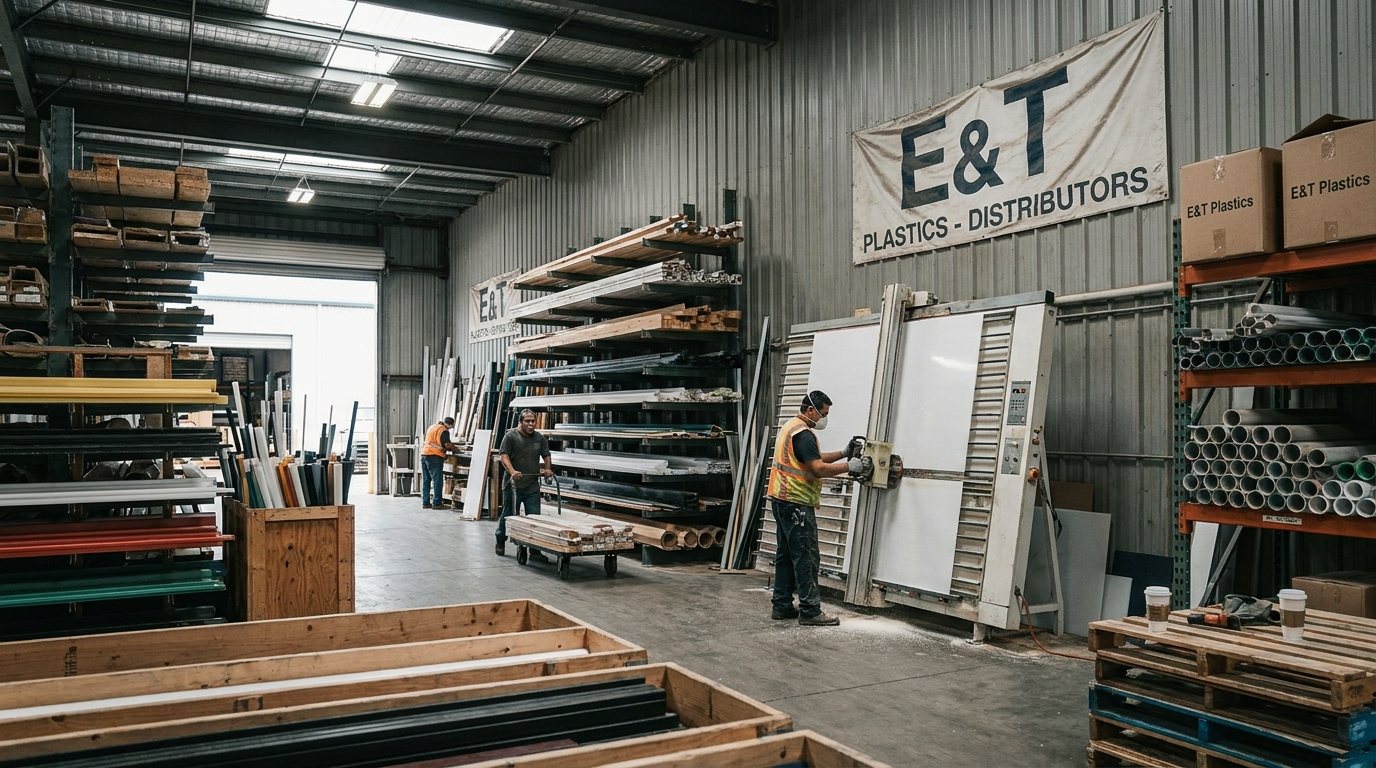
Most plastics distribution companies begin as trading operations: a founder buys sheet, rod, and tube in volume, resells it in smaller cuts, and adds fabrication services later as a margin-boosting extra. E&T Plastics ran the sequence backward. According to the company's own materials, it opened in 1945 as a fabricator, cutting and forming plastic parts for customers, and only afterward grew into distribution (e-tplastics.com). Its contact page puts it plainly: "the history of E&T Plastics is unique in the Industry, in that we started out in 1945 as a Fabricator of Plastics and later became one of America's largest and most well respected distributors" (store.e-tplastics.com). Most of the company's marketing elsewhere, its product catalog, its PR.com profile, its social pages, cites 1946 as the founding year instead. Nobody at E&T seems to have reconciled the two dates, which is itself a small, honest signal: this is a company that has never needed a polished founding narrative to sell sheet stock.
That fabricator-first sequence is the piece worth naming directly. It means the shop floor was never a bolt-on. CNC routing, laser cutting, vacuum forming, and four separate polishing techniques (diamond edge, flame, buff, and laser) aren't value-added services layered onto a trading desk. They're the original business, with distribution built around them.
A footprint sized to the model, not the market
E&T runs roughly ten locations: Long Island City, New York (the original site); Teterboro and Mt. Laurel, New Jersey; Fall River, Massachusetts and a New England sales office in Rumford, Rhode Island; Akron, Ohio; Addison, Illinois; Blaine, Minnesota; Riverside, Missouri; Fort Lauderdale, Florida; and Dallas, Texas (e-tplastics.com/locations). That's a tight cluster running the Northeast industrial corridor, the upper Midwest, and two Sun Belt outposts in Florida and Texas. It's not a national network, and it doesn't try to be.
Compare that to the company's own description of its fabrication arm as "one of the largest plastic fabricators" in the country (e-tplastics.com/acrylic-sheet). A distributor claiming outsized manufacturing scale while running one-third the branch count of its biggest category rivals is an unusual combination. It suggests E&T has chosen depth of capability at each site over breadth of geography, betting that a customer within reach of ten well-equipped shops, each able to cut, route, laser, and polish in-house, doesn't need an eleventh location so much as a faster answer from the ones that exist.
The materials list backs that up. Acrylic, polycarbonate, PVC, and higher-spec engineering plastics like Delrin, nylon, PEEK, and Ultem sit alongside end markets as varied as aerospace, construction, food processing, retail display, and security glazing (e-tplastics.com). That's a generalist's product mix, sold through a specialist's branch count, which only works if each location can actually process what it sells rather than just ship it.
Quiet ownership in a noisy category
Plastics distribution has consolidated hard over the past decade, and much of that growth story in trade press is written in acquisition language: platforms buying branch networks to add geography faster than they could build it. E&T doesn't appear in that narrative. There's no acquisition history on its site, no press page, no LinkedIn presence built around funding or leadership announcements. What's visible instead is a company still doing the same two things it did in 1945: fabricating plastic and moving sheet stock, now with a line of 100% post-consumer recycled acrylic added to the catalog as the newer nod to where the market has moved (e-tplastics.com).
That combination of near-invisibility and eighty-year continuity is the tension worth sitting with. A company this quiet either has nothing worth writing about, or it has simply never needed outside attention to keep ten branches full of work. Given that it still shows up on MDM's national ranking eight decades after opening as a small fabrication outfit, the second explanation looks like the better bet.
The takeaway
E&T Plastics isn't chasing the branch count of its biggest category peers, and it isn't trying to. Its edge is that the fabrication shop came first and the distribution business grew up around it, not the more common story of a trading desk that later bolted on a router table.
Stories like this one rarely make headlines, because the real edge sits in unglamorous machinery: which branch has the router free this week, and how fast a cut sheet can leave the dock. That's where distributors actually win or lose, long before anyone writes the history down.