
EWIE Group: The Safety Distributor That Isn't One
EWIE Group ranks #20 on MDM's 2026 Safety distributors list, yet its real business is tool cribs and vendor-managed inventory, not PPE catalogs.
Part of Distributor Playbooks — strategy teardowns of every company on the MDM Top Distributors lists.
EWIE Group of Companies lands at #20 on Modern Distribution Management's 2026 Top Distributors list for safety products, a category where household names like Grainger and Airgas dominate. But walk into an EWIE account and you will not find a safety showroom. You will find a tool crib, a vending machine dispensing abrasive discs, and a supply chain engineer counting cutting-tool inventory. Safety just happens to be riding along.
A commodity manager first, a safety distributor second
EWIE was built to manage the unglamorous consumables that keep a factory floor running: abrasives, cutting tools, chemicals, and general MRO. Its own materials describe the core business as engineering-led "Integrated Supply Solutions" that track more than two million part numbers and roughly $300 million in customer-owned inventory across 18 countries and 350-plus manufacturing sites, generating what the company says amounts to over $40 million a year in customer savings. That is a vendor-managed-inventory (VMI) shop, not a catalog house.
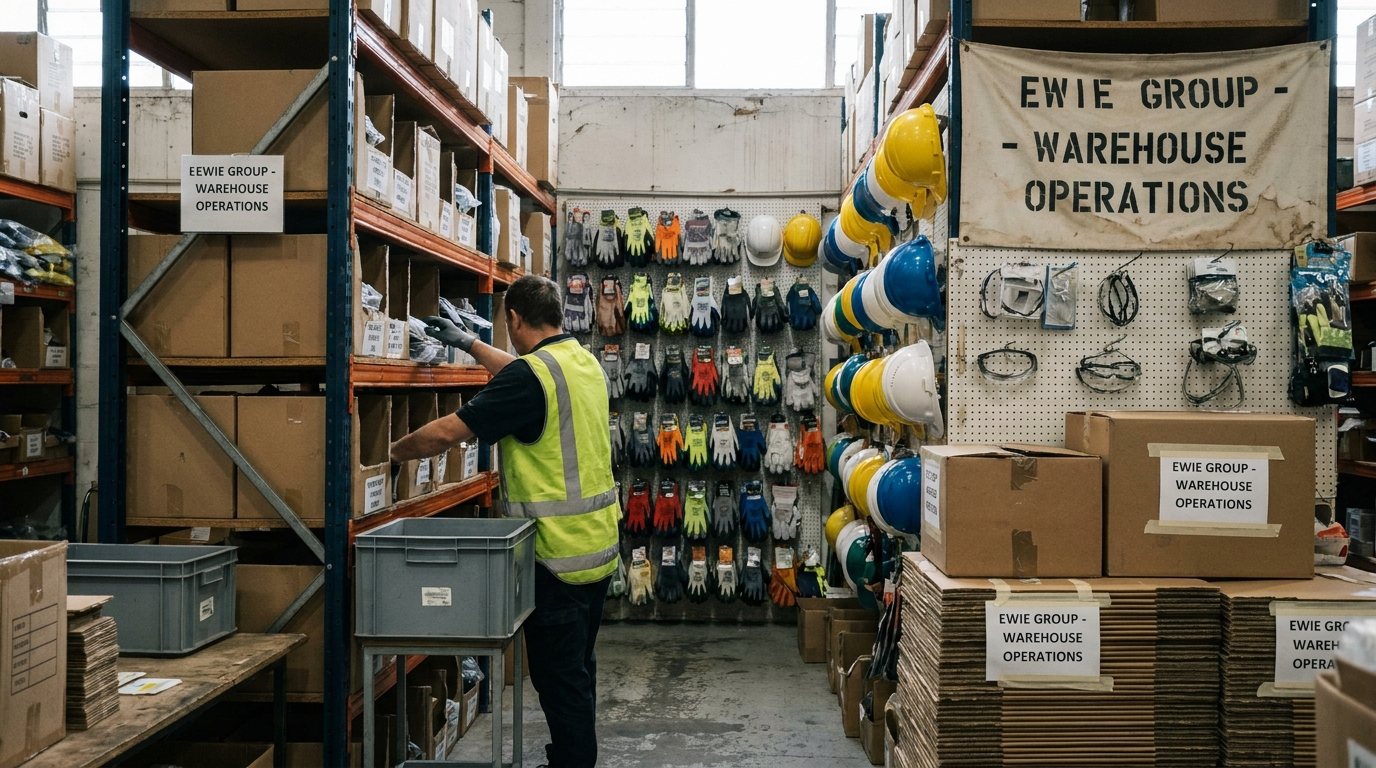
Safety and PPE enter through the same door. Hard hats, gloves, eyewear, hearing protection, and fall-protection gear show up as line items inside the same crib and vending programs that dispense cutting wheels and coolant, sold through the company's e-commerce arm, EGC Supply, which markets itself as a certified minority-owned MRO catalog serving both large manufacturers and small machine shops. That is the mechanism behind the MDM ranking: EWIE does not have to out-market a pure-play safety distributor. It just has to already be inside the plant.
The insight: safety wins by being embedded, not by being a specialty
That is the piece worth naming plainly. Most companies on MDM's safety list are safety companies first, whether industrial distributors with dedicated PPE divisions or specialists who built their brand on protective gear. EWIE inverts the model. It competes for safety spend by owning the point-of-use dispensing infrastructure for a completely different category, cutting tools and abrasives, and letting PPE ride the same crib, the same vending unit, the same replenishment data feed. A plant manager who already trusts EWIE to keep grinding wheels stocked has little reason to run a separate bid for gloves and glasses. The competitive battle for that safety-spend line item is mostly won before it's ever put out to bid, because the incumbent VMI relationship already owns the shelf.
The trade-off is real. A distributor that wins safety through attachment rather than specialization is vulnerable if a customer ever splits the contract, and it has less incentive to build the deep technical safety expertise, fit testing, compliance consulting, and OSHA-focused service layers that specialist players lean on to defend price. EWIE's bet is that convenience and embeddedness beat specialization for a large swath of MRO-adjacent safety spend, and the MDM placement suggests it is working, even if #20 keeps the company well behind the safety-first incumbents in absolute scale.
The acquisition that tests the model abroad
EWIE's clearest recent move is exporting that VMI logic internationally rather than just adding U.S. branches. In July 2024, EWIE Group of Companies completed the acquisition of a majority stake in Kromi Logistik, a German firm that describes itself as the only manufacturer-independent supplier of integrated tool management worldwide, combining tool trading with on-site dispensing units and IT-based tracking. The deal, first announced as a signed letter of intent, was reported by industry outlets covering European tooling and MRO markets. Kromi is not a safety company either. It is a tool-vending and management business, which means EWIE bought a European mirror of its own core model rather than a new product line.
That pattern extends across the rest of the EGC family: PSMI, Source Pro, and GS&S sit alongside EWIE, EGC Supply, and Kromi under one holding structure, each running a variant of the same consumables-management playbook in a different geography or customer segment. The M&A engine is not building a conglomerate of unrelated businesses. It is replicating one operating model, tool crib by tool crib, market by market.
Privately held, family-founded, still standing outside the roll-up
The other detail worth flagging: EWIE has spent more than four decades as an independent, founder-led company in a sector that has consolidated hard around private equity and public strategics. Chairman and CEO Manoj Sachdeva co-founded the business in the early 1980s in the Saline and Ann Arbor area of Michigan, and he still runs it. Meanwhile the broader industrial-distribution and MRO space, safety and abrasives included, has spent the last two decades absorbing independents into PE-backed platforms and publicly traded consolidators. EWIE has grown into a multi-country, multi-brand operation without that ownership shift, layering its own acquisitions on top of organic growth instead of being acquired itself. Combined with EGC Supply's certified minority-owned status, that makes EWIE an outlier on a list otherwise dominated by scaled, professionally financed operators.
None of this means EWIE is coasting. A #20 safety ranking behind PPE-first incumbents is a real gap, and the embedded-attachment model only holds as long as customers keep buying consumables and safety gear from the same vendor-managed program. But the strategic shape is distinctive enough to name: a tooling and chemicals company that shows up on a safety list because it never tried to be a safety company at all.
Distribution rewards the company that owns the crib, the van, or the catalog page a buyer never has to leave, whether the product on the shelf is a grinding wheel or a pair of safety glasses.