
How Exxon Mobil Turned Gas Stations Into a Retail Empire
Exxon Mobil is No. 87 on NRF's Top 100 Retailers with $4.79B in U.S. sales. The century-long history behind the pumps, from Standard Oil to On the Run.
Part of Retailer Playbooks — history-first profiles of every company on the NRF Top 100 Retailers list.
Exxon Mobil ranks No. 87 on the NRF Top 100 Retailers for 2026, with $4.79 billion in 2025 U.S. retail sales moving through the convenience stores attached to its gas stations. That figure sits inside a corporate lineage longer than almost anything else on the list: the empire John D. Rockefeller built, broken apart by the Supreme Court, and rebuilt twice under two different names before either one sold a candy bar.
From a Cleveland refinery to a Supreme Court defendant
Standard Oil was incorporated in Ohio in 1870 by John D. Rockefeller, his brother William, Henry Flagler, Samuel Andrews, and Stephen Harkness, with $1 million in capital and a plan to consolidate Cleveland's chaotic refining business. Rockefeller's method was rebates: railroads that wanted Standard's steady daily shipments cut its freight rates so far below what competitors paid that rivals either sold out or shut down. By 1904 the company controlled 91 percent of American oil refining. In 1911 the Supreme Court ruled that dominance an "unreasonable monopoly" under the Sherman Antitrust Act and split Standard Oil into 34 independent companies.
Two of those pieces are the direct ancestors of today's Exxon Mobil. Standard Oil of New Jersey became, decades later, Exxon. Standard Oil of New York, nicknamed Socony, went its own way and eventually became Mobil.
Two brands, two paths, one Pegasus
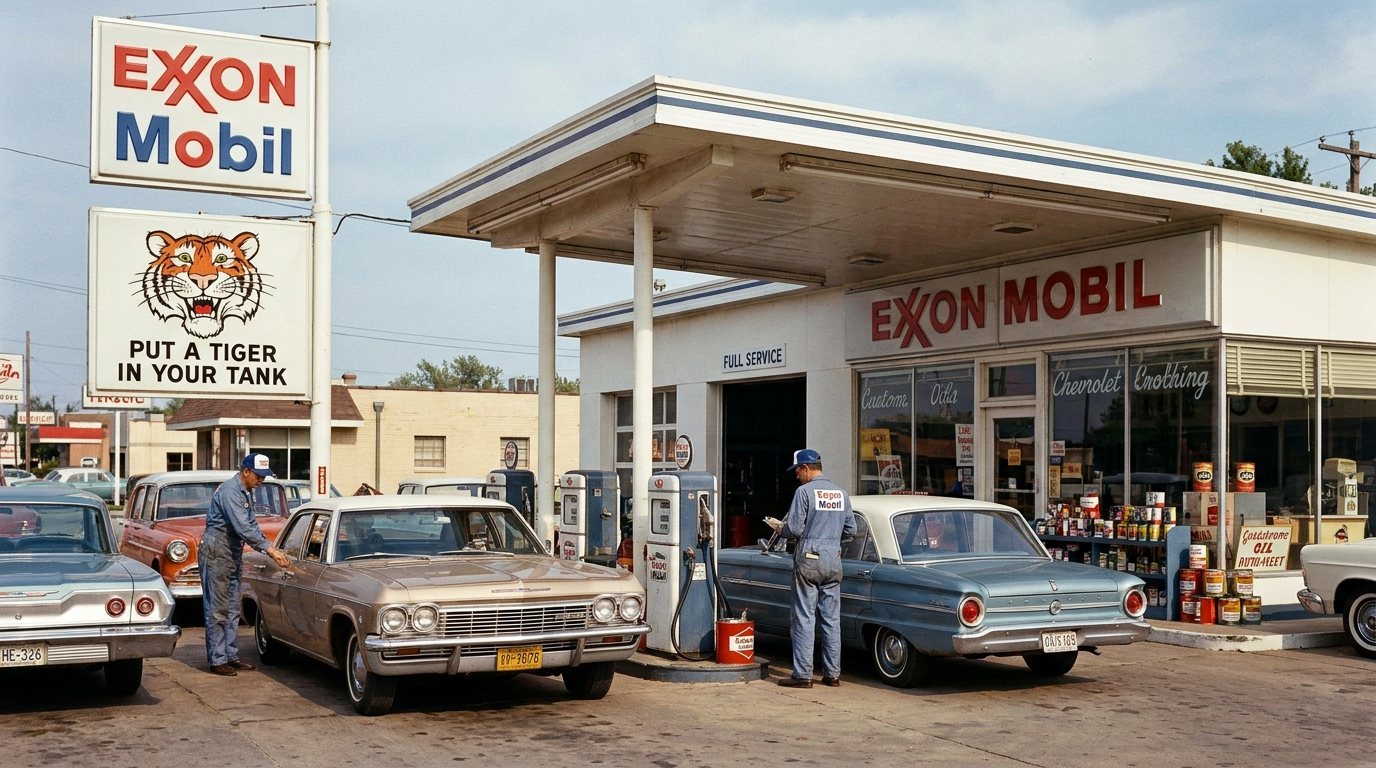
Jersey Standard couldn't use the Standard Oil name in every state, so it built Esso in 1926, then layered on Enco and Humble Oil as it expanded regionally. All three folded into a single identity in 1972, when the company chose "Exxon" for a simple reason: it was pronounceable worldwide and belonged to nobody else.
Socony took a stranger route. It merged with the Vacuum Oil Company in 1931 to form Socony-Vacuum, inheriting Vacuum's Mobiloil brand and, through an affiliation with Magnolia Petroleum, the flying red horse logo known as Pegasus. The corporate name spent decades catching up to the product name: Socony Mobil Oil Company in 1955, Mobil Oil Corporation in 1966, Mobil Corporation in 1976. Mobil also has a real claim on two conveniences drivers now take for granted: it says it was first to let customers pay at the pump, and it later built Speedpass, an early tap-to-pay keychain token that beat smartphone wallets to the idea by more than a decade.
Exxon and Mobil then spent another quarter century as full rivals, competing for the same drivers on the same corners, an arrangement the 1911 court order had specifically engineered. It ended on November 30, 1999, when the two merged in an $83 billion deal that reassembled a large share of the old Standard Oil trust under one roof, this time with the government's blessing rather than against its will.
The convenience store that isn't really Exxon Mobil's
Here the story turns unexpected. Mobil had opened small shops attached to its stations as Mobil Mart, then relaunched the format under a name with more energy: On the Run. The brand kept expanding after the 1999 merger, crossing 1,000 locations by 2004 across both Exxon and Mobil sites. For a stretch, it looked like the convenience counter might become the part of the business that actually made money, since gasoline is a commodity shopped on price to the penny, while snacks, drinks, and cigarettes are not.
Then Exxon Mobil did something a century of Standard Oil history would not have predicted: it started handing the stores to other operators. In 2009 it sold 450 franchised On the Run locations, plus 43 company-run stores in Phoenix, to Alimentation Couche-Tard, the Canadian chain better known today as Circle K. In 2011, 51 Dallas-Fort Worth stores went to 7-Eleven. In 2016 the Canadian network, run by affiliate Imperial Oil, was broken up further, with Seven & I Holdings picking up 148 sites across Alberta and British Columbia. By 2021 the On the Run name still appeared at roughly 2,000 locations in 40 countries, but increasingly as a license on someone else's convenience store rather than a shop Exxon Mobil ran itself.
That divestiture is the least obvious part of this history, and it is the piece worth naming plainly: the company that put its name on more American gas pumps than nearly any rival made a deliberate choice not to be a convenience-store operator. It kept the fuel supply contracts, the brand, and the real-estate economics of the corner lot, and handed the daily business of stocking coolers and running registers to companies built to do exactly that at scale. The $4.79 billion in 2025 retail sales that lands Exxon Mobil at No. 87 on the NRF list is earned largely by other companies' employees, working under Exxon Mobil's tiger or Pegasus.
The unglamorous logic underneath
It reads almost like an inversion of Rockefeller's original genius, which was to own every link in the chain from wellhead to retail counter, in an era when owning more was always the answer. His corporate descendant relearned, a century later, that not every link is worth owning, and that a brand can outlive the operator flying it.
Every century-old retailer eventually has to decide which parts of the business are worth running directly and which are worth licensing out. Few show that decision as plainly as the gas station chain that built the corner store, then let someone else keep the lights on.