
Family Dollar: The Small-Box Chain Two Giants Fought Over
Family Dollar ranks #43 on NRF's 2026 Top 100 Retailers list at $11.91B. Its history runs from a $2 price cap in 1959 to a 2014 bidding war and a 2025 resale.
Part of Retailer Playbooks — history-first profiles of every company on the NRF Top 100 Retailers list.
Family Dollar ranks #43 on the National Retail Federation's Top 100 Retailers 2026 list, compiled with Kantar, on $11.91 billion in 2025 U.S. retail sales. That figure sits inside a much longer story: a chain built on the radical simplicity of a fixed price ceiling, one that grew for five decades before becoming the prize in one of retail's more instructive bidding wars.
A factory sale funds a hunch
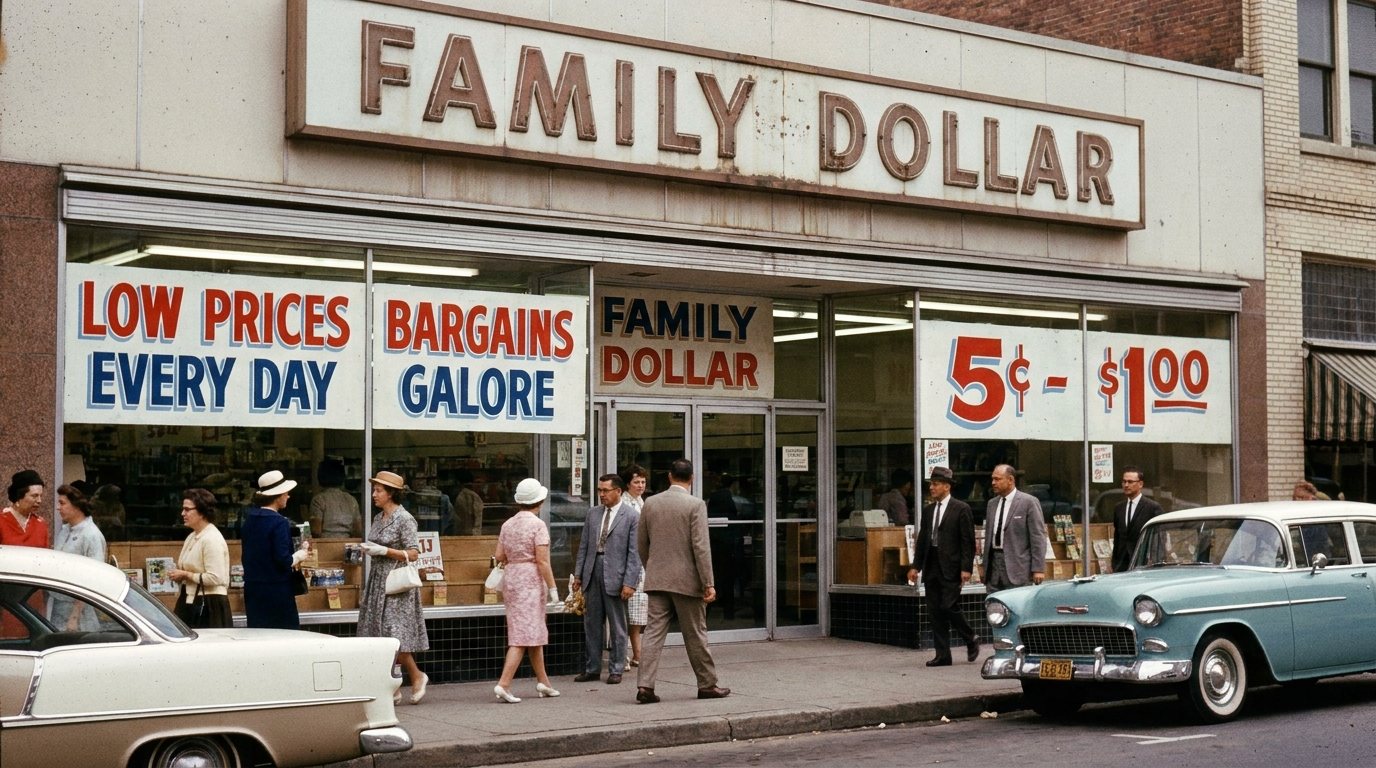
Leon Levine was 22 when he opened the first Family Dollar store in November 1959, in the 1500 block of Central Avenue in Charlotte, North Carolina. He'd already lived a compressed apprenticeship in retail: his father died when he was 12, and when his older brother Sherman was drafted in 1951, teenage Leon took over running the family's general store in Rockingham while still attending school. In 1956 the brothers bought a chenille bedspread factory in Wingate; two years later they sold it. With that money in hand, Levine visited a dollar store in Kentucky, liked what he saw, and came home to build his own version, with merchandise capped at $2 an item, according to Leon Levine's biography on Wikipedia.
The format traveled well. Family Dollar reached South Carolina in 1961, Georgia in 1962, Virginia in 1965. Charlotte alone had fifty stores by 1969. The company went public in 1970 at $14.50 a share, and by 1979 it operated roughly 380 stores across eight states, per Wikipedia's history of Family Dollar and FundingUniverse's company history.
The price ceiling that had to bend
Fixed low prices are a clean idea until the surrounding economy stops cooperating. In the mid-1970s, the textile, tobacco, and furniture industries that employed much of Family Dollar's customer base collapsed, and profits fell fifty percent in 1974 and 1975. Management's answer was to let the ceiling rise, first to $3, then to abandon a hard cap altogether, while tightening inventory controls and pushing into new states. Sales reached $151 million by 1979, and the company bought 40 Top Dollar stores to add scale.
The next threat had a name: Wal-Mart. As the Arkansas chain expanded through the South in the 1980s, Family Dollar's same-store sales fell ten percent in 1987. New CEO Ralph Dillon answered with a blunt "will not be undersold" pricing policy and a swing back toward private label and manufacturer overruns, which lifted sales ten percent within two months. It's a pattern worth noting for any category captain watching a bigger rival arrive in its backyard: the fix wasn't a new format, it was a faster, more disciplined version of the original one.
Scale, then a changing of the guard
The 1990s and 2000s were the chain's clearest growth years. Sales passed $1 billion in 1992. Howard Levine, Leon's son, returned to the company in 1996, became president in 1997, and took over as chairman and CEO when his father retired in 2003, the same year Family Dollar opened its 5,000th store, in Jacksonville, Florida, after 30 consecutive quarters of record results. The company had joined the Fortune 500 the year before. By the end of the 2000s, roughly 3,500 new stores had opened, built on a small-box format, typically 6,000 to 8,000 square feet, that let Family Dollar plant flags in rural crossroads and dense urban blocks that superstores skipped entirely.
The bidding war
That footprint eventually made Family Dollar a target rather than just a competitor. Activist investor Nelson Peltz's Trian Fund Management tried an unsuccessful takeover in March 2011 at $55 to $60 a share. In June 2014, Carl Icahn disclosed a 9.4 percent stake and pushed for an immediate sale. Dollar Tree moved first, offering $74.50 a share ($8.5 billion) that July. Dollar General countered in August at $78.50 a share, a materially higher number.
Family Dollar's board took the lower bid anyway, citing the antitrust exposure of combining the two largest dollar-store chains in the country. Shareholders approved the Dollar Tree deal in January 2015. It's a clean case study for any strategy team: the highest bid on the table is not always the winning bid once regulatory risk is priced into deal certainty. A board choosing $8.5 billion in hand over $8.9 billion that might never clear review isn't leaving money on the table, it's discounting the value of a deal that closes.
The insight: acquisition isn't the finish line
Here's the part the press releases from 2014 don't tell you. A decade after Dollar Tree paid $8.5 billion for Family Dollar, it sold the chain to Brigade Capital Management and Macellum Capital Management for $1 billion, a deal announced in March 2025 and completed that July, following waves of store closures. The gap between those two numbers is the real lesson of this history: winning the bidding war is not the same as winning the integration. Dollar Tree got the store count, the real estate, the customer base built over 65 years, and still struggled to make the combined company work as one operating model. A chain built on a single, disciplined idea, a hard price ceiling that flexed only when it had to, turned out to be hard to fold into a different chain's playbook without losing the thing that made it valuable in the first place.
Retail history keeps circling back to unglamorous fundamentals: where the stores sit, what's on the shelf, and whether the systems behind both can actually merge when the deal closes.