
Five Below: How Two Bankrupt Founders Built a $5 Empire
Five Below ranks #89 on NRF's Top 100 Retailers with $4.76B in sales. Its founders had already gone bankrupt twice before betting on stuff under $5.
Part of Retailer Playbooks — history-first profiles of every company on the NRF Top 100 Retailers list.
Five Below sits at #89 on NRF's Top 100 Retailers 2026 list, the National Retail Federation's annual ranking of U.S. retailers by sales, with $4.76 billion in 2025 U.S. retail sales. That number is easy to read as an overnight success story about cheap candy and phone cases. It isn't. Five Below exists because two Philadelphia retailers had already failed at the thing everyone told them was the smart version of this business, and built the opposite of it instead.
The two failures that came first
David Schlessinger's first company was Encore Books, a regional bookstore chain that eventually folded. His second was Zany Brainy, an educational toy retailer he founded in 1991 that ran workshops, author visits, and concerts alongside its shelves of learning-focused toys, with Thomas Vellios eventually running it as CEO. Zany Brainy grew into a real chain, then bought a rival, Noodle Kidoodle, in 2000. The combined company couldn't carry the debt and overhead. By May 2001 it was in Chapter 11, and its roughly 187 stores were sold off in pieces, with the last locations closed by the end of 2003, according to Wikipedia's account of Zany Brainy.
That is the part of the story a retail historian lingers on, because Schlessinger and Vellios didn't wait for Zany Brainy to finish dying before starting again. They opened the first Five Below store in Wayne, Pennsylvania, in October 2002, according to Wikipedia's Five Below entry — while their previous company was still working through liquidation. Whatever conclusions they drew from watching an ambitious, curated, experience-heavy specialty retailer collapse under its own cost structure, they applied fast.
Building the opposite company on purpose
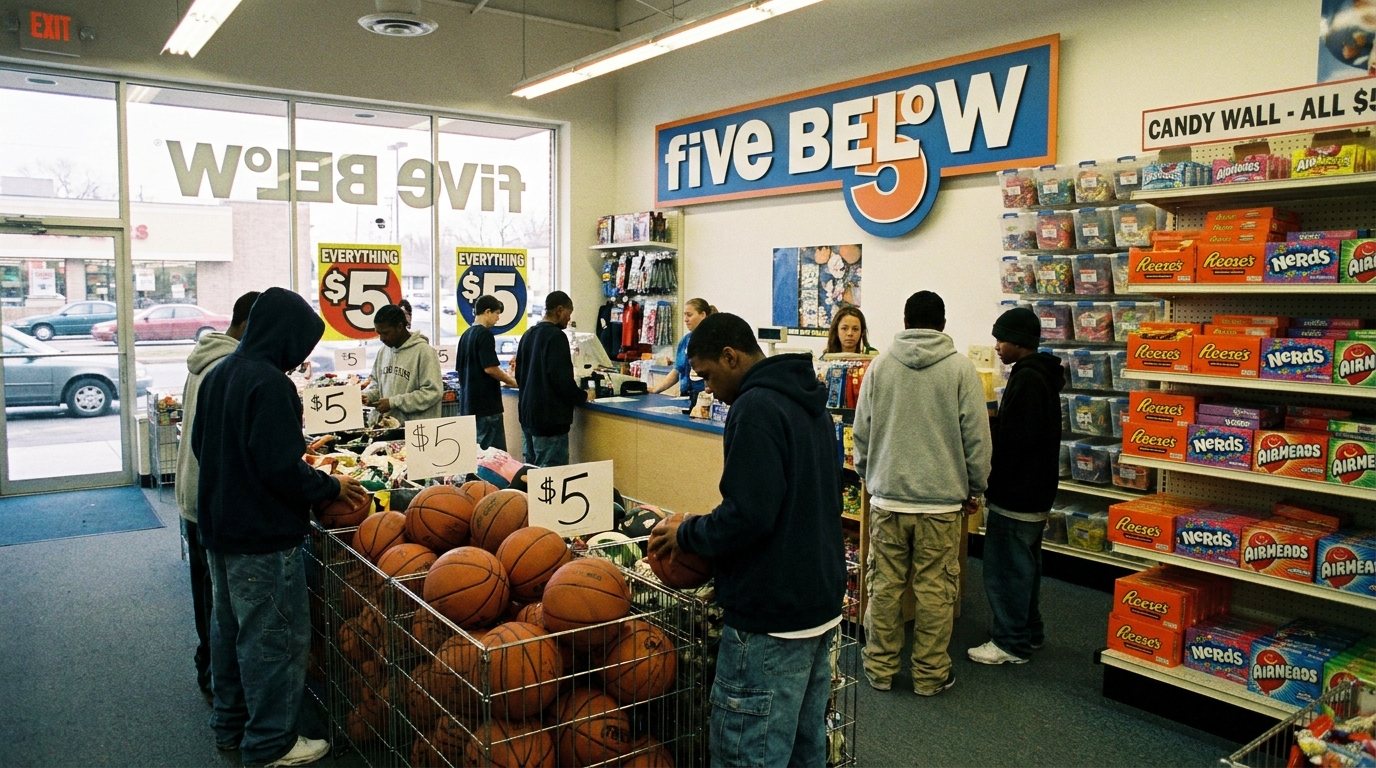
Zany Brainy sold expertise: staff who knew educational toys, in-store programming, a curated assortment aimed at parents who wanted to make a smart choice. Five Below sells almost none of that. Nearly everything in the store rings up at $5 or less, in stores averaging around 8,000 square feet, aimed squarely at tweens and teens with cash in their pocket and no shopping list. There is no expert on staff explaining why one item beats another. The price ceiling does the persuading, and a fast-churning, trend-chasing assortment of candy, tech accessories, room décor, beauty, sports gear, and seasonal novelties does the rest.
That is the unique insight worth naming plainly: Five Below's real invention wasn't the $5 price point, which plenty of dollar stores had already claimed. It was a deliberate structural inversion of the two businesses that had just failed on them. Where Zany Brainy asked customers to trust curation and staff knowledge, Five Below asks customers to trust almost nothing except that everything in reach costs less than a movie ticket. Lower the ceiling far enough and you don't need deep category expertise to sell the room decor next to the candy next to the phone case. The price does the work that a knowledgeable buyer used to do, and impulse replaces intention as the reason to walk in.
From Wayne, PA to NASDAQ to 2,000 doors
The company grew store by store, then state by state: Illinois and Michigan in 2011, Georgia, Kansas, Missouri, and western Michigan in 2012, Texas in 2013, past 350 stores by 2014. Five Below went public on NASDAQ on July 19, 2012, at $17 a share. By 2018 it had outgrown its original footprint enough to move headquarters into the historic Lit Brothers Building in Philadelphia, a former department store the company nicknamed its "WowTown" campus. Growth kept compounding through the following decade; by 2024 the chain operated more than 1,800 stores across 46 states, and it has since crossed a symbolic milestone of 2,000 stores, according to stock analysis of the company's public filings. Along the way the company built a modest but consistent philanthropic footprint, partnering with Alex's Lemonade Stand Foundation starting in 2006 and St. Jude Children's Research Hospital starting in 2008.
The 2024 stumble, and a second reinvention in progress
Joel Anderson, who took over as CEO in 2014 and oversaw most of that expansion, resigned abruptly in July 2024. The stock dropped roughly 25% in a single day on the news, a reminder that a two-decade growth story can still have a bad week. Kenneth Bull steadied the company as interim CEO before Winnie Park, previously CEO of Forever 21, took over in December 2024. Park inherited a company navigating the same pressure every extreme-value retailer eventually meets: a business built on razor-thin per-item margins is unusually exposed to import costs and tariff swings, since so much of a $5 store's assortment is sourced overseas. Five Below's own recent results, including a return to double-digit comparable sales growth, suggest the current leadership is finding a way through it rather than around it.
Retail rewards founders who fail forward. Five Below is what happened when two people who had just watched a curated, expertise-driven concept collapse decided the next store they built would trust the customer's wallet instead of the customer's need for advice, and it worked well enough to earn its own spot on next year's balance sheets.
This profile is part of Anglera's Retailer Playbooks series, a look at the companies whose stores, catalogs, and supply chains quietly built American retail.