
Gap: The Store That Sold Only Levi's, Then Reinvented Itself
Gap is #37 on NRF's 2026 Top 100 Retailers ($13.43B). How a single San Francisco Levi's shop became a three-brand empire, lost its way, and rebuilt.
Part of Retailer Playbooks — history-first profiles of every company on the NRF Top 100 Retailers list.
Gap ranks #37 on the NRF Top 100 Retailers 2026 list, with $13.43 billion in 2025 U.S. retail sales, part of a Gap Inc. portfolio that also carries Old Navy, Banana Republic, and Athleta. The company that eventually invented the modern casual-basics category almost didn't survive long enough to build one. It started as a single-brand reseller, reinvented itself as a manufacturer of its own identity, then had to relearn that lesson twice more the hard way.
A jeans store born from a sizing problem
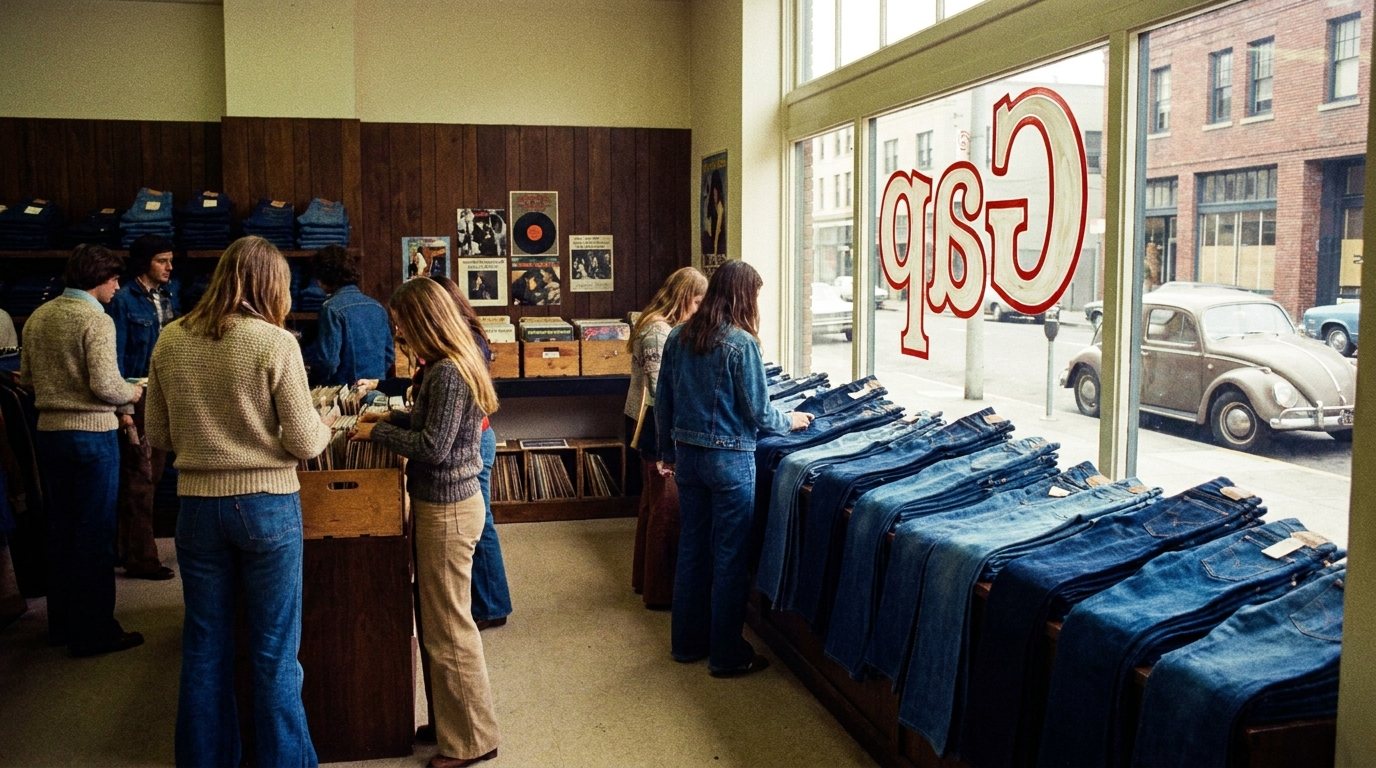
Donald Fisher opened the first Gap store near San Francisco State University on August 21, 1969, with his wife Doris. The trigger was mundane: Fisher, a real estate developer, couldn't find a pair of Levi's in his own size at a local department store. Rather than complain, he and Doris rented a storefront, partnered with Levi Strauss executive Walter Haas Jr., and stocked every cut and size of Levi's jeans in one place, alongside records, an odd pairing meant to pull in the same young customers buying both, according to Wikipedia. They named it Gap for the "generation gap," the cultural fault line of the era they were selling into.
The idea worked because it solved a real distribution failure: even big department stores couldn't stock every Levi's size and style, and Gap made a business out of simply having it. A second store opened in San Jose in 1970. By 1973 the chain had passed 25 locations and pushed east to New Jersey. By 1976, sales hit $2.5 million and the company went public at $18 a share, only to watch the stock slide to $7.25 as retail cooled and Gap settled a shareholder lawsuit for $5.8 million in 1979, per FundingUniverse. Sales kept climbing regardless, reaching $307 million across nearly 200 stores by 1980.
The pivot that mattered: 1974
The single most consequential decision in Gap's early history is easy to miss because it wasn't a store opening or an ad campaign. In 1974, the company began selling its own private-label merchandise alongside Levi's, the first step away from being a reseller of somebody else's brand. It mattered because Gap's entire business, up to that point, depended on Levi Strauss's goodwill and inventory. Owning a label meant owning a future. That single decade-early bet is what let Gap survive when Levi's later expanded into mass-market department stores directly, cutting out the specialty middleman that Gap had originally been built to be.
Mickey Drexler and the invention of "basics"
Millard "Mickey" Drexler joined as president in 1983 and did something almost contrarian for a retailer drowning in a warehouse-discount identity: he eliminated the competing labels Gap still carried, built an in-house design team, repainted the stores in neutral tones, and launched the "Individuals of Style" campaign. Profits actually dropped 43 percent in 1984 as the transition bit, but the strategy held, and by 1985 Gap was growing again, per FundingUniverse. Drexler also engineered Gap's most durable structural move: acquiring the struggling safari-themed Banana Republic in 1983 and repositioning it upscale, then launching Old Navy from scratch in 1994 as the value tier. By the mid-1990s, Gap Inc. had assembled something genuinely new in specialty retail: three price tiers of the same design sensibility under one roof, so a customer could trade up or down within the same company as their life stage or budget changed. That structure, more than any single ad, is what competitors spent the next two decades trying to copy.
The late 1990s were the peak. Old Navy crossed $1 billion in sales by 1997. Gap.com launched in 1998. By 1999, Gap Inc.'s net earnings topped $1.1 billion on close to $9 billion in company-wide sales, driven by khaki and denim campaigns built around simple basics rather than trend chasing.
The slump, the ouster, and an inconvenient coincidence
Growth outran demand. Gap opened 731 stores in 2000 even as comparable sales fell 5 percent, and 2001 brought the company's first loss in years. Drexler was pushed out in 2002 after what Wikipedia's account describes as 19 years at the company ending amid over-expansion, a 29-month sales slump, and friction with the Fisher family. Here is the detail most retrospectives skip past: the merchandise Drexler had already ordered before his exit triggered a sales recovery within a month of his departure. It's a small, almost uncomfortable footnote, and it is the unique insight worth sitting with. It suggests his final collections weren't the problem; the timing of the market, the balance sheet, and boardroom patience simply ran out before his own product cycle could vindicate him.
Paul Pressler, arriving from Disney, tried to steady the ship without fully restoring Gap's design authority. Robert Fisher stepped in as interim CEO in 2007, followed by Glenn Murphy, who brought in designer Patrick Robinson. The 2010s and pandemic years forced further contraction, including roughly 350 store closures by 2024 as mall traffic thinned nationally.
The current chapter
Gap Inc. named designer Zac Posen Creative Director in February 2024 and has been rebuilding a design-forward identity across Gap and Old Navy since. Fiscal 2024 revenue reached $15.1 billion company-wide with operating income of $1.11 billion, both up year over year, according to Wikipedia. In September 2025, the company said it would expand Old Navy into personal care and cosmetics, a bet on adjacency rather than another price tier.
Every one of Gap's turning points, the 1974 private-label pivot, the three-tier brand ladder, even the awkward Drexler exit, traces back to the same question every apparel retailer eventually has to answer: whose taste is on the label, and who actually owns it.
Sources: Wikipedia — Gap Inc., FundingUniverse — The Gap Inc. company history, Gap Inc. — About, NRF — Top 100 Retailers