
Gas and Supply: The Independent Airgas Never Bought
Gas and Supply made the 2026 MDM Top Distributors list in Gases & Welding Supplies by staying private while its whole sector rolled up into three global majors.
Part of Distributor Playbooks — strategy teardowns of every company on the MDM Top Distributors lists.
Gas and Supply Co. shows up on the 2026 MDM Top Distributors list in the Gases & Welding Supplies category, one of the relatively few names in that vertical that isn't a subsidiary of a European or Japanese industrial conglomerate. Modern Distribution Management doesn't disclose the company's 2025 revenue, which is itself a small tell about how this distributor operates. It has spent 44 years building density across the Gulf South without ever needing to answer to a parent company's quarterly call.
An accident of timing that became a strategy
Gas and Supply was founded in 1981 in the Gulf South, according to the company's own history page. A year later, in 1982, Peter McCausland founded a company called Airgas. Both started as regional welding gas outfits. Only one of them chased scale through acquisition.
Airgas made more than 500 acquisitions on its way to becoming the largest distributor of industrial, medical, and specialty gases in the United States, survived a hostile takeover bid from Air Products in 2010, and then sold itself to France's Air Liquide for $13.4 billion in 2016. Linde and Praxair, the other two national-scale players in industrial gas, merged in 2018 into a single global entity. By the late 2010s, the top of the American welding-gas market was almost entirely foreign-owned or globally consolidated.
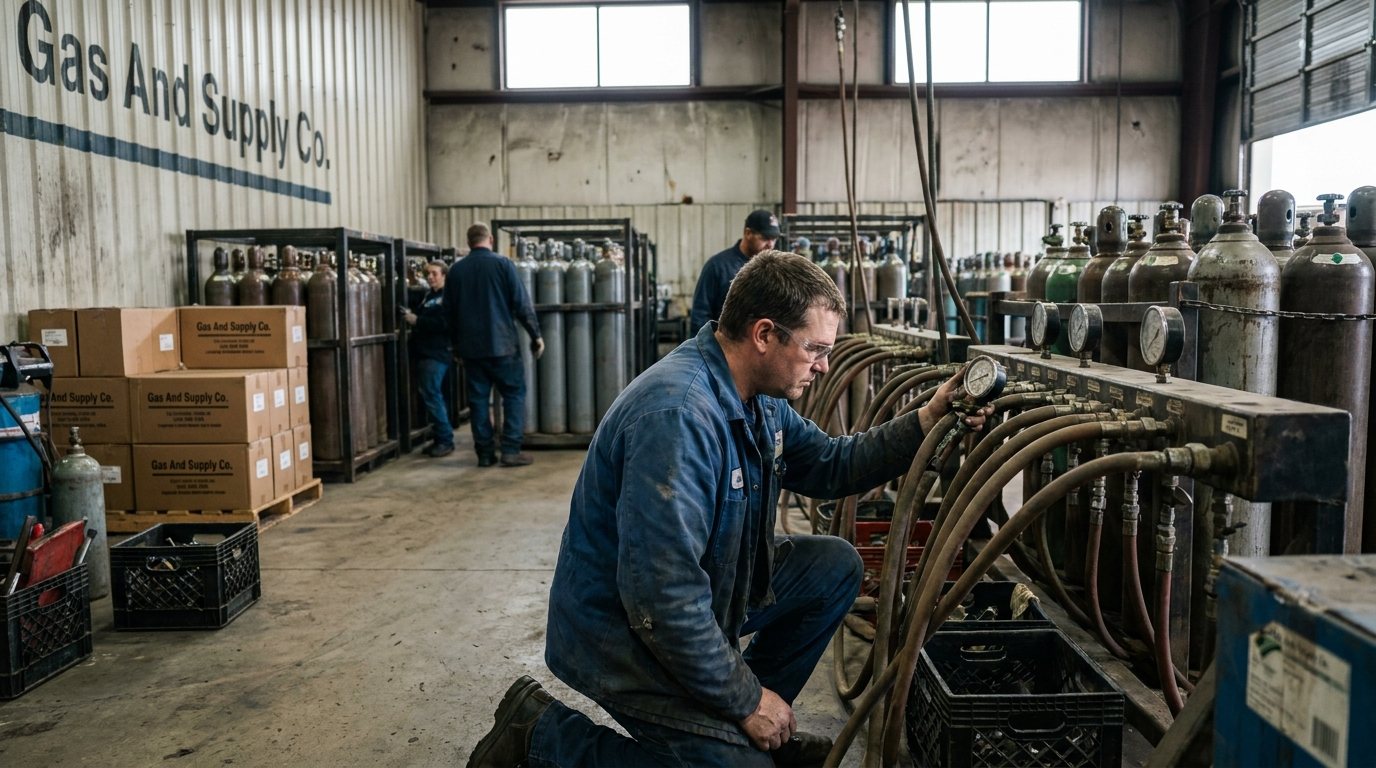
Gas and Supply took the other fork. It never sold. It never merged. Its own about page puts it at 57 locations today, spread across seven states per its locations directory — Alabama, Georgia, Louisiana, Mississippi, Oklahoma, South Carolina, and Texas — and it calls itself, in its own marketing, "the Gulf South's largest independent welding supply distributor." That word "independent" is doing real work. In a category where the biggest names answer to Paris or Munich, being the largest of the ones that don't is its own kind of moat.
The insight: independence as the actual product
The obvious read on Gas and Supply is that it's a regional gas distributor that never got big enough to attract a buyer. The more interesting read, and the one the company's own history supports, is that staying independent for four decades in a sector defined by roll-ups is not an accident of scale. It is the strategy. National consolidators compete on balance sheet and footprint. An independent competes on being reachable, being local, and never making a customer feel like an account number inside a much larger company. Gas and Supply's stated mission is blunt about this: to "make it so easy to do business with us that no alternatives are considered." That is not a growth slogan aimed at capturing new markets. It is a retention slogan aimed at making sure existing customers never go looking.
Branch density plus a product line that outgrew the cylinder
Gas and Supply didn't stay a pure gas house while staying independent. Its catalog now spans more than 23 product categories, according to its own site, including welding equipment, safety gear, abrasives, tools, electrical supplies, and janitorial products, layered on top of the bulk gas, propane, and specialty gas business it started with. That is the MRO-house pattern every serious industrial distributor eventually adopts: the gas cylinder gets the truck in the door, and everything else on the shelf is what keeps the relationship profitable once it's there.
The 57-branch footprint matters because gas distribution is a delivery business before it is a sales business. Cylinders are heavy, dangerous to ship long distances, and time-sensitive for customers running a fabrication shop or a shipyard. A distributor's branch map is effectively its addressable market. Gas and Supply's coverage runs from Houston refineries to Gulf Coast shipbuilders to Carolina manufacturing, with the density concentrated in Louisiana and Texas, exactly where its founding roots and its heaviest industrial demand overlap.
Locking in customers without a contract
The company's UsePoint program is where the independent's playbook gets specific. It offers two models, described on the company's service page: automated inventory vending that tracks consumption electronically by department, and storeroom management for customers who want Gas and Supply running their internal cribs and satellite stores. The pitch is a 15 to 30 percent reduction in inventory cost. The mechanism is switching cost. Once a distributor's software and hardware are managing a customer's storeroom, replacing that distributor means replacing a working system, not just switching a supplier on a purchase order. National players sell this too, but an independent selling it credibly, with 24/7 service commitments that include weekends and holidays, is making the case that local responsiveness and enterprise-grade inventory tooling aren't mutually exclusive.
The trade-off nobody advertises
Staying private and undisclosed on revenue has a cost. Gas and Supply can't lean on a multinational parent's balance sheet to fund a bulk-gas plant or absorb a bad regional downturn the way an Air Liquide-backed Airgas branch can. Its growth has to be funded out of its own margins and its own bank relationships, in a category where the majors can afford to lose money in a region for years to win share. The bet only works if density and service actually convert into loyalty that a bigger checkbook can't buy. Forty-four years and 57 branches later, that bet is still being made.
Distribution rewards the companies willing to do the unglamorous work: keep the catalog current, keep the branch open on a holiday, keep the truck running. Gas and Supply's history is a reminder that in a sector built for consolidation, the data behind every cylinder, delivery route, and storeroom contract is still what decides who stays independent and who gets bought.