
General Air: How a Denver Gas Distributor Stayed Independent
General Air made the 2026 MDM Top Distributors gases and welding list without ever leaving Colorado. Here is how 55 years of family and ESOP ownership got it there.
Part of Distributor Playbooks — strategy teardowns of every company on the MDM Top Distributors lists.
General Air made MDM's 2026 Top Distributors list in the Gases & Welding Supplies category, the same year that category's biggest names are multinational subsidiaries answering to shareholders in Paris and Dublin. General Air answers to the Armstrong family and to its own employees. That is not an accident of scale. It is the point.
A three-employee start on Federal Boulevard
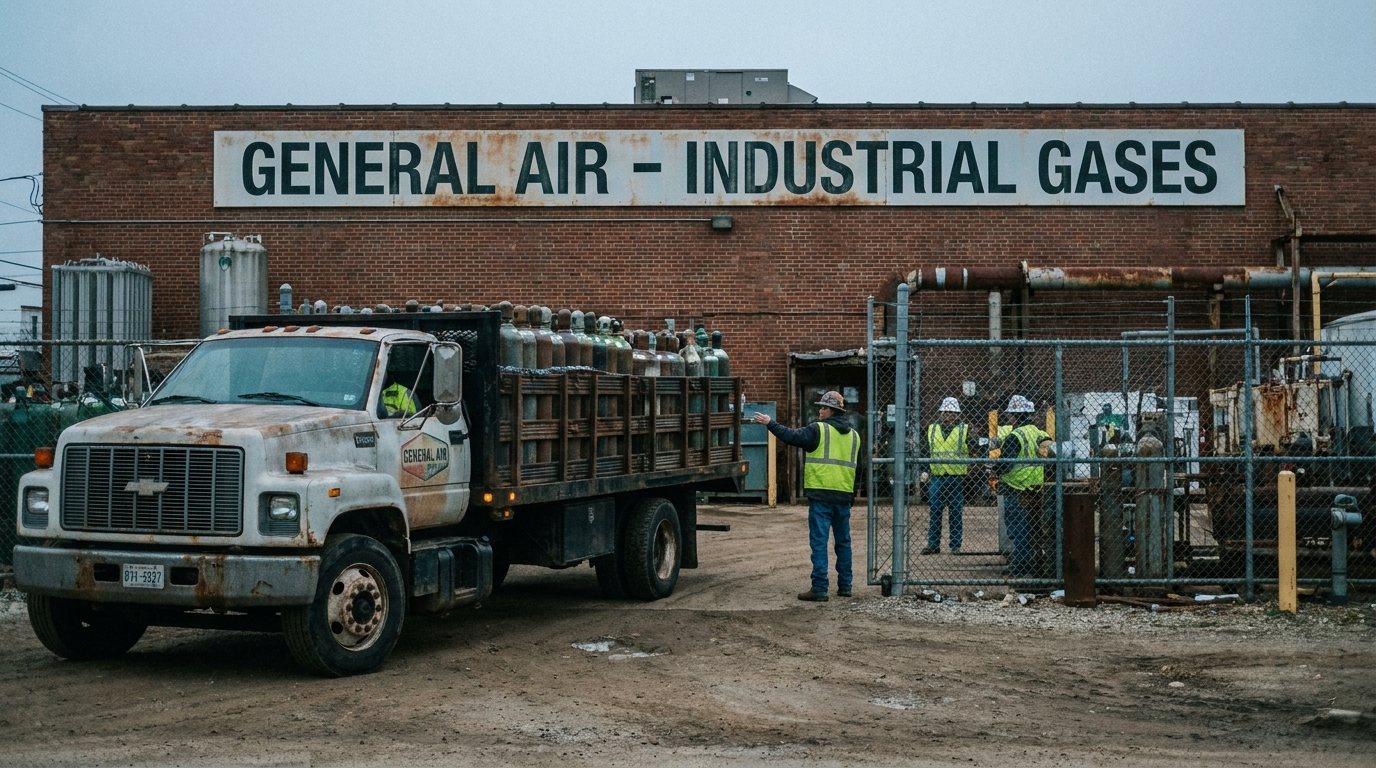
In 1969, Gene Armstrong took on a small gas and welding supply distributorship in Denver. The first store opened the following year with three employees. Fifty-five years later, General Air runs nine locations across Colorado, from Fort Collins in the north to Pueblo in the south, and employs more than 190 people, according to the company's own history and careers pages. The growth was almost entirely organic, one Front Range city at a time, not a string of bolt-on acquisitions chasing a national footprint.
That distinction matters more in this industry than in almost any other product category MDM tracks.
The sector consolidated into three giants. General Air didn't join
Packaged industrial gas distribution spent the last three decades getting rolled up. Airgas built the largest distribution network in the business through more than 500 acquisitions before Air Liquide bought it for $13.4 billion in 2016, folding roughly 1,400 U.S. distribution points into a French parent company. Two years later, Linde AG and Praxair merged into Linde plc, a $33 billion-revenue combination that is now the largest industrial gas supplier in the world by market share, so dominant that regulators forced it to sell off North and South American assets just to clear the deal.
Against that backdrop, a 190-employee distributor with nine branches in one state looks small. It also looks like the exception the consolidation wave was supposed to erase. Independent regional gas and welding distributors were the raw material Airgas and Linde bought up. General Air is one of the ones that said no, decade after decade, while its neighbors sold.
Growth by branch, not by binder
| Year | Milestone |
|---|---|
| 1969-70 | Gene Armstrong starts the business; first Denver store opens |
| 1972 | Boulder location added |
| 1978 | Fort Collins expansion |
| 1985 | BevCO acquisition (beverage-gas line) |
| 1992 | Greeley store opens |
| 1995 | Commerce City fill plant launches |
| 2007 | Pueblo expansion; company adopts partial ESOP |
| 2010 | Silverthorne location |
| 2018 | Aurora store opens |
| 2022 | Dedicated welder repair facility opens |
The timeline reads like a map, not a spreadsheet. Almost every entry is a new branch in a Colorado city General Air didn't already serve, or a capability layered onto branches it already had (the Commerce City fill plant, the welder repair shop). The one acquisition on the list, BevCO in 1985, extended the company into beverage-grade CO2 rather than buying a competitor's customer list in an adjacent state. Compare that to Airgas's five-hundred-plus deal count and the strategic choice becomes obvious: General Air chose depth in one market over breadth across many.
The unique insight: an ESOP instead of an exit
Here is the part that would not show up on the company's About page in so many words. In 2007, with the business three generations into Armstrong family leadership, General Air became partially employee-owned through an ESOP. That year is not incidental. It's roughly the same window in which private-equity roll-ups and strategic acquirers were paying premium multiples for exactly this kind of regional gas distributor. Family-owned businesses that size routinely sell at that inflection point, either to a strategic buyer like Airgas or to a financial sponsor.
General Air instead used the ESOP to keep ownership close to the people running the branches, without giving up the family governance that had defined the company since 1969. The business describes it as extending "our family" to employees rather than as a succession or liquidity mechanism, but the practical effect is the same one that keeps founder-led companies out of PE portfolios: the people who show up to deliver cylinders and service welders have a direct stake in the outcome, and the family retains control without needing to sell to get liquidity for the next generation. In a vertical where multinational ownership is now the default, that's the strategic choice worth naming plainly. It's a hybrid ownership model, family plus employee equity, that none of the sector's dominant players use, because none of them are still independent enough to.
What the model is actually betting on
The bet is that service density beats geographic reach in gas and welding supply, a category where next-day cylinder refills, on-site welder repair, and safety consulting matter more to a shop floor customer than being able to say you operate in all fifty states. General Air's 2022 welder repair facility and its long-standing dry ice blasting and cylinder tracking services are investments in serving the same customers deeper, not wider. National recognition followed that discipline rather than scale: the company has picked up Top Workplace honors from USA Today and the Denver Post since 2020, expanding to national recognition in 2023, per its careers page.
The trade-off is real. Staying regional means General Air will never have Linde's purchasing leverage on cylinders or Air Liquide's balance sheet for a downturn. It also means the company answers to nobody outside Colorado for how it treats a branch, a customer, or an employee, which is a different kind of durability than a balance sheet provides.
Every branch, every fill plant, every welder repair bay in this story runs on a catalog and a cylinder count somewhere behind the counter. That unglamorous back office, as much as any founding story, is what actually held a 55-year-old regional distributor together.