
Giant Eagle: The Rust Belt Grocer Built by Merging Rivals
Giant Eagle formed from two rival Pittsburgh grocers in 1931, then spent a century buying up competitors before agreeing to be bought by Kroger itself.
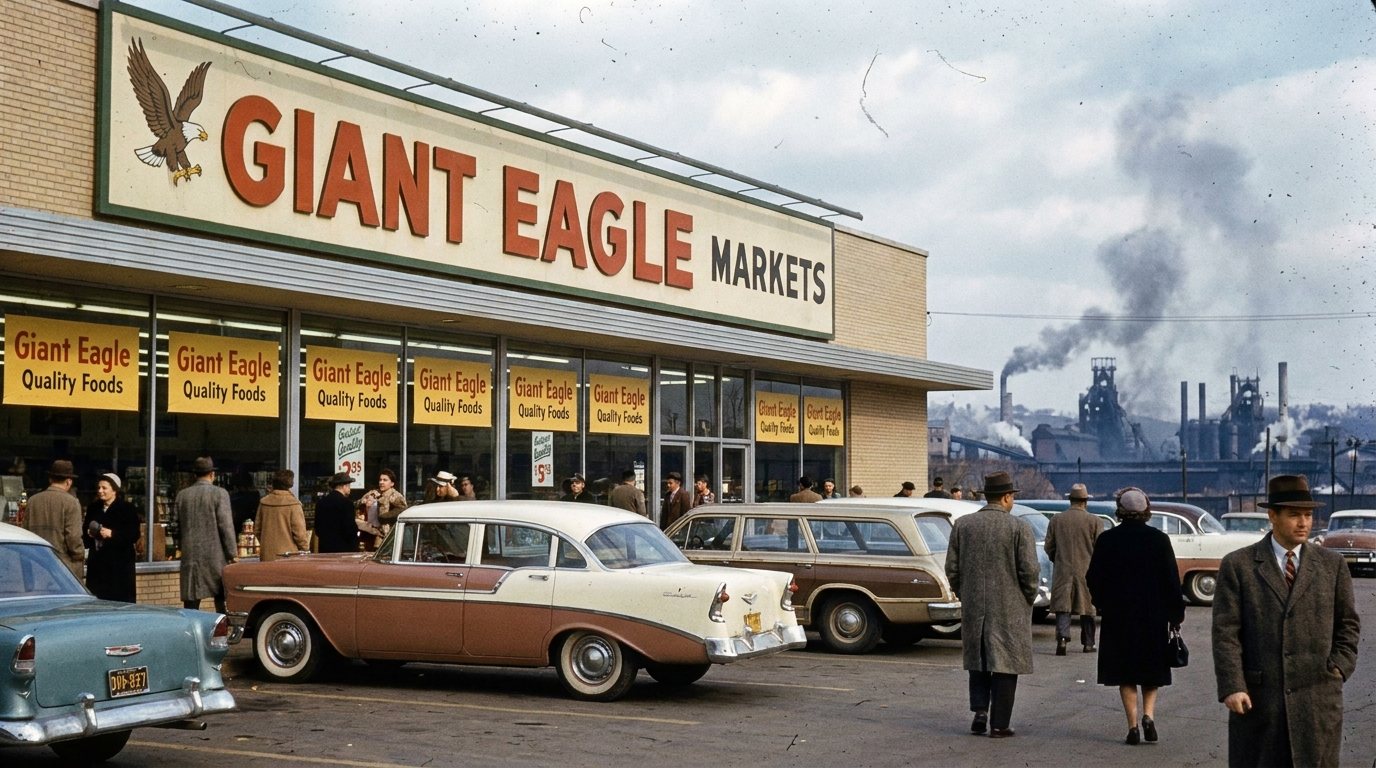
Part of Retailer Playbooks — history-first profiles of every company on the NRF Top 100 Retailers list.
Giant Eagle lands at #48 on the NRF Top 100 Retailers 2026, the National Retail Federation's annual ranking compiled with Kantar, with $10.63 billion in 2025 U.S. retail sales. It is the quiet giant of the Rust Belt grocery map, a chain most Americans outside Pennsylvania and Ohio have never shopped but that has spent nearly a century absorbing the stores of the ones they did.
Two grocers, one name
Giant Eagle did not start as a company with a mascot and a marketing plan. It started as a truce. In 1931, two competing Pittsburgh-area grocery operations, Eagle Grocery, built after World War I by the Goldstein, Porter, and Chaits families, and OK Grocery, founded around the same era by the Moravitz and Weizenbaum families, merged rather than keep fighting each other for the same corner-store customers. The combined company incorporated that August, and the first store carrying the joint name opened in 1936, per Wikipedia. The name itself is a fossil of that deal: half of one grocer's identity welded to half of the other's. It is a pattern the company would repeat, in one form or another, every decade that followed.
For its first three decades, Giant Eagle stayed put. It rode out the Depression and World War II as a strictly western Pennsylvania operation, growing store by store rather than region by region. The bigger structural move came in 1968, when the company bought a Lawrenceville warehouse that Kroger had vacated, a small footnote at the time that reads differently now that Kroger is the company buying Giant Eagle back.
The Shapira decades
David Shapira joined the company in 1971 and became CEO and president in 1980, beginning more than four decades in which a member of his family ran Giant Eagle, according to Wikipedia's profile of Shapira. Under that leadership, Giant Eagle finally left Pennsylvania. In the 1980s it bought the Tamarkin Company's wholesale business and its Valu-King stores around Youngstown, Ohio, converting them to the Giant Eagle banner and giving the chain its first real foothold outside home territory. Gas retailing followed in 1995, an early bet on fuel as a loyalty and margin play that most supermarket chains didn't take seriously for another decade.
The Phar-Mor bet
Not every expansion was a store acquisition. In the 1980s, the Shapira family financed Mickey Monus, a young entrepreneur who wanted to build a deep-discount drugstore chain called Phar-Mor. Giant Eagle became Phar-Mor's largest shareholder as it grew into a national chain during its heyday. Then Monus was convicted of embezzling from the company, and Phar-Mor collapsed into what was, at the time, one of the largest corporate frauds in American history. Giant Eagle absorbed the loss as an investor, then turned around and bought Phar-Mor's Youngstown-area store assets out of bankruptcy court, converting wreckage back into square footage it could actually operate. It is the closest thing to a near-death chapter in the company's history, and it happened to someone else's balance sheet as much as its own.
Buying the Rust Belt, one struggling chain at a time
The pattern that defines Giant Eagle's next twenty years is consolidation of exactly the kind that put it on the Phar-Mor trade in the first place: find a regional grocer that's losing the fight, and buy it. Riser Foods went for $403 million in 1997. Rini-Rego Stop-n-Shop's 53 Cleveland-area stores were converted the following year. Big Bear's Columbus locations came in 2004, and 18 Tops Markets stores in northeast Ohio followed in 2006. Each deal did the same job: turn a competitor's closing chapter into density on Giant Eagle's map across Pennsylvania, Ohio, West Virginia, Maryland, and eventually Indiana.
The company also built rather than bought. Market District, its upscale food-hall-style format, opened its first two locations in Shadyside and Bethel Park in June 2006, a direct answer to Wegmans and Whole Foods rather than to the discount grocers Giant Eagle had spent the prior decade swallowing. On the convenience side, a 1985 Guttman Oil venture called Cross Roads and Giant Eagle's own 1995 fuel stations merged in 2003 into GetGo, a name that is, fittingly, another two-company mashup, this one blending "Giant Eagle" and "Guttman Oil," according to Wikipedia's GetGo history. Giant Eagle bought out Guttman's remaining stake in 2005 and grew GetGo to roughly 275 stores, including a 2018 purchase of Indiana's Ricker's chain.
The unwind
The unique thread running through Giant Eagle's history, one the company's own materials don't spell out, is that it has always grown by merging with or swallowing someone else, and its final chapters run that logic in reverse. In March 2023, the board removed Laura Shapira Karet as chairman and CEO, ending 55 years in which a Shapira had run the company and installing, for the first time, leaders from outside the five founding families. In August 2024, Giant Eagle agreed to sell GetGo, the convenience chain it had spent nearly two decades building, to Alimentation Couche-Tard, the parent of Circle K, for roughly $1.57 billion; the deal closed in June 2025. Then on July 1, 2026, Kroger, the same chain whose vacated Lawrenceville warehouse Giant Eagle picked up in 1968, announced a deal to acquire Giant Eagle itself, in a transaction expected to close in 2027.
A company that spent ninety-five years turning other grocers' hard times into its own square footage is, in its final independent chapter, becoming someone else's square footage. That is not a decline story. It is the same playbook, running the other direction.
Giant Eagle's history is really the history of the unglamorous machinery behind the shelf: warehouses, wholesale contracts, and the store banners that outlive the families who built them.