
Good Neighbor Pharmacy: A Wholesaler's Bet on Independents
How a 19th-century drug wholesaler's franchise plan became Good Neighbor Pharmacy, the co-op banner behind 3,400 independent U.S. pharmacies.
Part of Retailer Playbooks — history-first profiles of every company on the NRF Top 100 Retailers list.
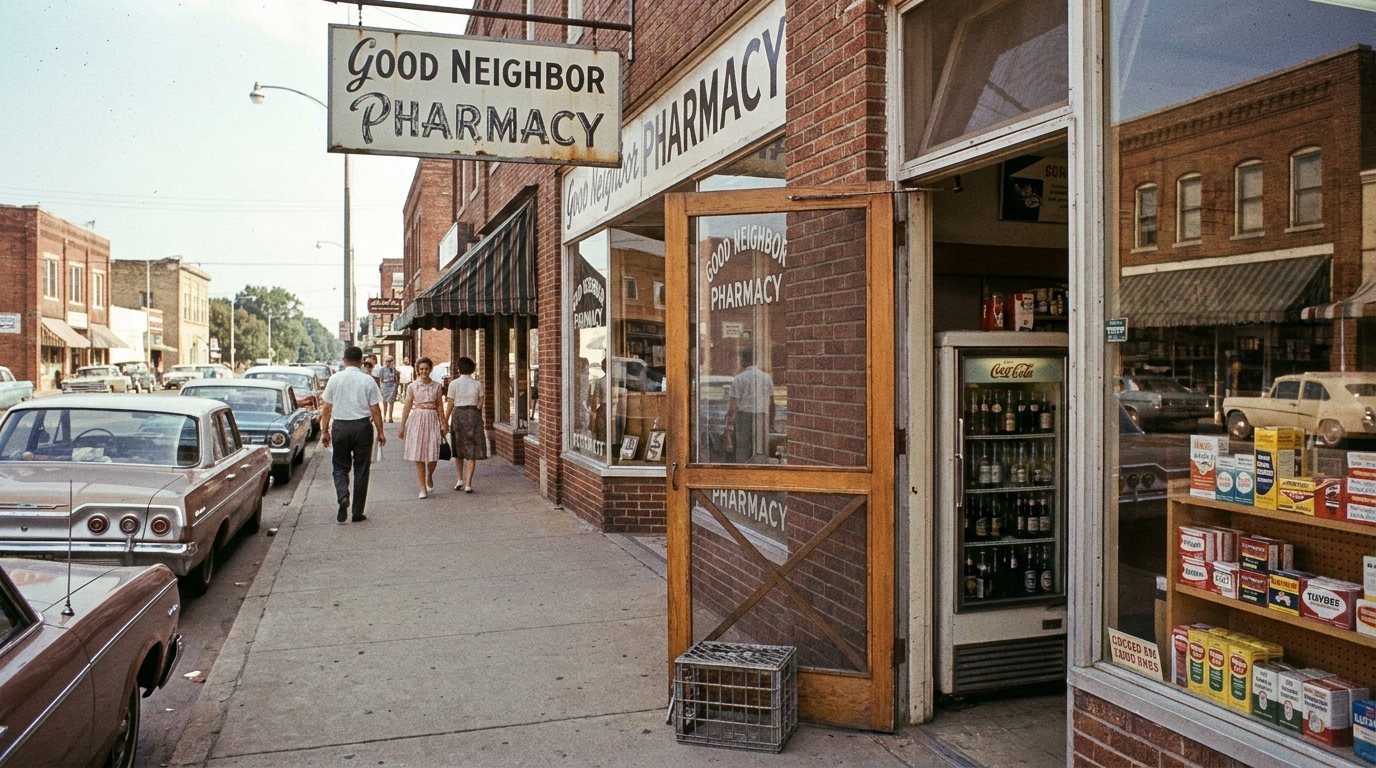
Good Neighbor Pharmacy lands at #50 on NRF's Top 100 Retailers 2026 list, credited with $9.74 billion in 2025 U.S. retail sales. That number is unusual for the list, because Good Neighbor Pharmacy does not own a single one of the stores that generated it. It is a brand, a buying group, and a set of services licensed to more than 3,400 independently owned pharmacies across the country, sponsored by the pharmaceutical distributor now called Cencora. To understand the number, you have to understand the wholesaler behind it.
A drugstore in Kansas, a drug company in New Jersey
The company's roots split into two branches that took a century to reconverge. In 1871, a 21-year-old French immigrant named Lucien Napoleon Brunswig opened a retail drugstore in Atchison, Kansas. He soon shifted into wholesale drug distribution in Fort Worth, Texas, where annual sales hit $350,000 by 1883, and by 1903 he had relocated his growing operation to Los Angeles, expanding branches into San Diego, Phoenix, and Tucson as the American Southwest filled in behind him, according to FundingUniverse's history of Bergen Brunswig.
The eastern branch started later and smaller. In 1947, Emil P. Martini founded the Bergen Drug Company in Hackensack, New Jersey, naming it for the county. Two decades on, his son Emil P. Martini Jr. went shopping for the western Brunswig operation, and in May 1969 he closed the purchase, merging the companies into Bergen Brunswig Corporation.
The plan for the independents
Once merged, Bergen Brunswig spent the 1970s buying up regional distributors, and by the 1980s it needed a way to keep its most vulnerable customers loyal: the independently owned drugstores being squeezed by chain expansion. The company's answer was the Good Neighbor Pharmacy plan, built specifically to serve "the particular needs of independent pharmacies," per FundingUniverse. It let a wholesaler's customers borrow scale, marketing, and a shared identity without selling their stores.
That structure is the whole story of what Good Neighbor Pharmacy still is today. The pharmacies that fly the banner are independently owned and operated; Cencora, the distributor descended from Bergen Brunswig, sponsors the network and owns the trademark, according to Wikipedia's entry on Good Neighbor Pharmacy. A pharmacist joins to get a national buying group, shared marketing, and operational support, and keeps the storefront that their community already knows.
Bergen Brunswig itself didn't survive as an independent company much longer than that plan took to mature. In 2001, AmeriSource Health Corporation, a wholesaler formed through a 1988 management buyout of Alco, acquired Bergen Brunswig outright and took the combined name AmerisourceBergen, a deal that produced $49.6 billion in combined sales by 2003, per FundingUniverse's history of AmeriSource. The Good Neighbor Pharmacy brand rode along as one of the acquired company's most durable assets. In August 2023, AmerisourceBergen renamed itself Cencora and began trading under the ticker COR, closing out more than half a century of name changes without ever touching the pharmacy network's own name, per Wikipedia's history of Cencora.
What the NRF number is actually measuring
Here's the detail that doesn't show up on any About page: Good Neighbor Pharmacy is not really competing for a spot on the NRF Top 100 the way a chain like Walgreens or Kroger is. It is a wholesaler's customer-retention program, wearing a retail banner, and its "sales" figure is the retail output of thousands of separate small businesses that never sold equity to Cencora. They just buy inventory from it. Cencora doesn't need to own the real estate, hire the pharmacists, or absorb the local liability; it needs the store to keep ordering from Cencora trucks instead of a rival wholesaler's, and a shared brand with a national ad budget behind it is a cheaper way to buy that loyalty than acquisition.
This is not a quirk unique to Cencora. McKesson runs the same play through Health Mart, a franchise that traces back to 1982 under FoxMeyer, was bought by McKesson in 1996, and has since grown past 5,000 member stores, per Wikipedia's entry on Health Mart. Cardinal Health runs its own version. Every major U.S. drug wholesaler, in other words, sponsors a competing banner aimed at the same shrinking population of independent pharmacy owners, because the alternative is watching those owners get bought by a chain, retire without a successor, or drift toward a rival's distribution contract. The banners compete with each other for loyalty the way chains compete for customers, except the customer here is the pharmacist, not the shopper.
Why the model has held up
It has worked, at least by the metrics that matter to a pharmacy owner. Good Neighbor Pharmacy took the top overall score in J.D. Power's National Pharmacy Studies in 2010 and 2011, and Newsweek ranked it #1 for brick-and-mortar pharmacy and drugstore customer service in both 2019 and 2020, per the Wikipedia entry cited above. Those wins land in a category where independents are competing directly against companies with vastly larger footprints and marketing budgets. The network also runs ThoughtSpot, an annual gathering in Orlando and Las Vegas where pharmacy owners trade notes, which functions as the trade-show version of what a corporate retailer would call a franchisee convention.
None of this makes Good Neighbor Pharmacy a normal retail chain, and it was never built to be one. It was built as an insurance policy for a wholesaler that needed its smallest customers to survive, and a banner that let those customers look bigger than they were. Ninety years after Lucien Brunswig opened a drugstore in a Kansas rail town, the company his firm eventually became is still selling the exact same thing: a way for a small operator to look, buy, and market like a chain, without giving up the counter where a pharmacist knows a customer's name.
Every retailer on this list runs on some version of unglamorous infrastructure, whether it's a supply chain, a catalog, or in this case a distributor's own franchise plan for keeping small stores in business.