
Gordon Food Service: The Distributor That Also Owns the Storefront
Gordon Food Service made MDM's 2026 Food & Beverage list while staying private. Here is the operating bet that sets it apart from Sysco and US Foods.
Part of Distributor Playbooks — strategy teardowns of every company on the MDM Top Distributors lists.
Gordon Food Service shows up on the 2026 MDM Top Distributors list in the Food & Beverage category, the annual ranking Modern Distribution Management runs across 20 verticals of North American distribution. What the list can't fully capture is the stranger fact underneath the placement: GFS is the only broadline foodservice distributor of its size that also runs a retail chain the public can walk into. That combination, not just its scale, is the thing worth studying.
A butter-and-egg route that became a $23 billion company
Isaac Van Westenbrugge started the business in 1897 with $300 borrowed from his brother, delivering butter and eggs door to door in Grand Rapids, Michigan. Ben Gordon married into the family in 1916, and in 1942 he and his brother Frank renamed the operation Gordon Food Service. Eight decades later it is, per Forbes, the 15th-largest privately held company in the United States, generating an estimated $23 billion in FY2024 revenue with about 20,000 employees under CEO Rich Wolowski, still headquartered in Wyoming, Michigan. Wikipedia's sourced overview puts it more bluntly: GFS is the largest family-managed foodservice distributor in North America, full stop.
That last distinction matters more than it sounds. The two companies GFS is most often benchmarked against, Sysco and US Foods, are both public companies answering to shareholders and, in US Foods' case, born out of a 2007 private-equity buyout before its 2016 IPO. GFS took the opposite path through the same decades: no IPO, no leveraged buyout, no activist board seat. In a sector that consolidated hard around public capital and roll-up economics, a family-run distributor holding a top-tier national footprint is the exception, not the rule.
The moat nobody else in broadline foodservice bothered to build
Most broadline distributors are pure B2B. They sell cases of frozen chicken and paper goods to restaurants, hospitals, and school cafeterias, and the truck never stops anywhere the public can see it. GFS built a second business on top of that one: retail stores anyone can walk into, no membership card required.
The first cash-and-carry location opened in 1979. It became GFS Marketplace in 1992 and Gordon Food Service Store in 2014. Today that footprint is more than 175 stores across 13 states, selling the same restaurant-grade product the company's trucks deliver to commercial kitchens, at prices anyone can pay. Costco makes you join. Restaurant Depot makes you prove you're in the trade. GFS just opens the door.
The strategic logic is straightforward once you see it: the stores turn every neighborhood location into a demand sensor and a marketing channel that Sysco and US Foods simply don't have, because neither company operates a public storefront at any real scale. A GFS store tells the company in real time which proteins move, which regional preferences shift, and which private-label items earn repeat trips, all before that intelligence ever reaches the wholesale side. It also means GFS's brand lives outside the B2B sales call. Home cooks and small caterers know the name the way they'd know a grocery chain, which is not something a pure institutional distributor can say.
The August 2025 opening in Trotwood, Ohio pushes the model a step further. Reporting from the Dayton Business Journal describes the new location as reviving a struggling shopping center while housing what the paper calls a rare commissary for regional distribution inside the retail box itself. Retail and wholesale infrastructure, under one roof, in a single project. That is not a format Sysco or US Foods runs anywhere.
The infrastructure most customers never see
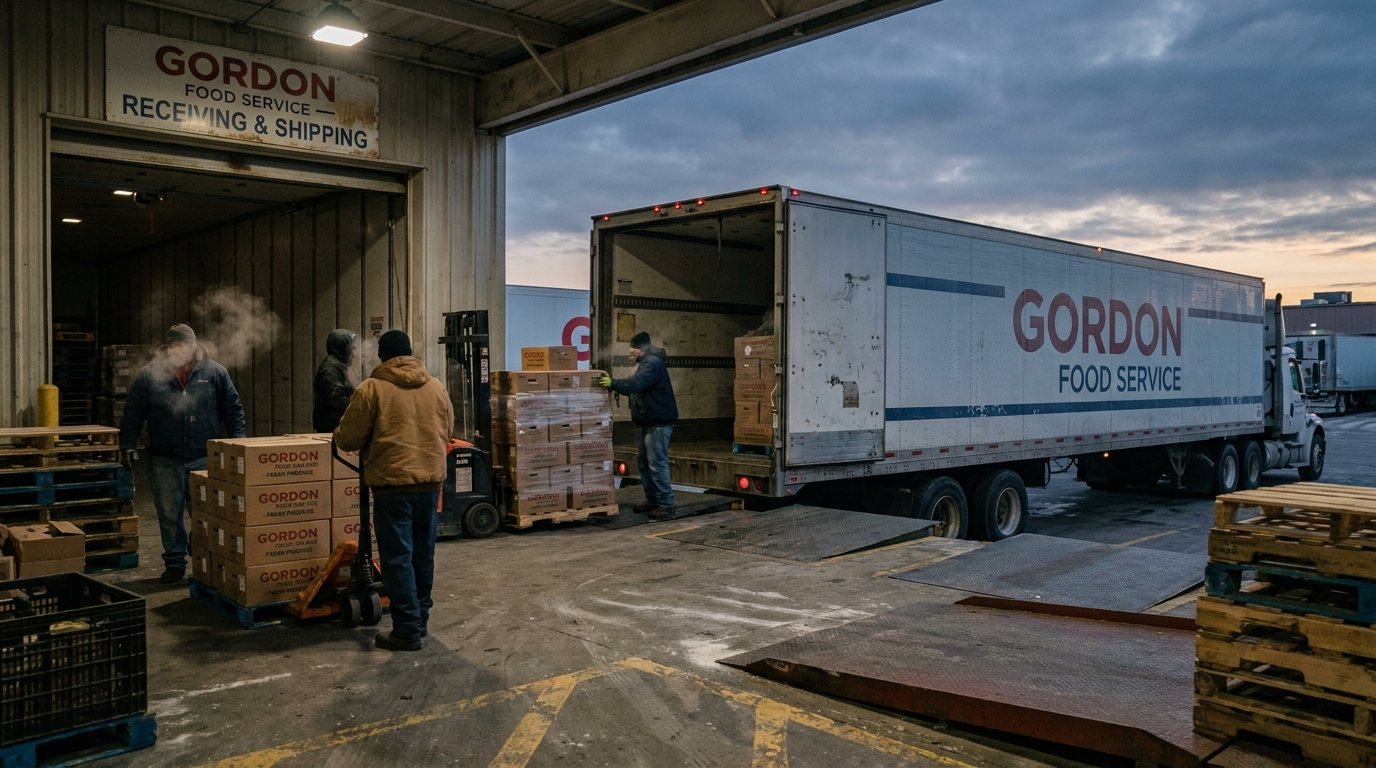
Behind the storefronts sits the part of the business that actually keeps hospitals, colleges, and national restaurant chains stocked: 14 distribution centers in the US and nine more in Canada, following GFS's 1996 expansion north of the border, per Wikipedia. That network serves more than 100,000 customers spanning independent restaurants, long-term care facilities, hospitals, K-12 and higher ed, and regional and national chains. It is the unglamorous majority of the revenue, and it is also the part every competitor is trying to match on route density and case fill rate.
Not every bet has landed. GFS acquired the school-fundraising business Market Day in 2013 and shut it down two years later, a reminder that adjacency plays don't always survive contact with a distributor's core competency. And in 2024, GFS became a founding partner, alongside Florida Blue Foundation and AdventHealth, of the Culinary Health Institute in Orlando, an experiment in food-as-medicine programming that extends the company's reach into healthcare nutrition well past the loading dock.
The tension worth naming
Running a consumer retail chain inside a wholesale distribution company is genuinely hard to staff, merchandise, and finance well, and it dilutes management focus that a pure-play competitor doesn't have to spend. GFS has clearly decided the demand signal and brand halo are worth that cost. Whether that trade-off keeps paying off as e-commerce reshapes both grocery and foodservice buying is the open question for the company's next decade, not the last one.
MDM's list ranks distributors by revenue and reach, but the numbers only describe the truck fleet and the balance sheet. What actually separates a distributor over the long run is usually a structural choice like this one: whether to stay purely wholesale, or to build the one channel that lets you see the customer directly.