
Grocery Outlet: The Discount Chain Built on Other Companies' Losses
How a 1946 Army-surplus food stall in San Francisco became Grocery Outlet, the closeout grocer that turns retail's failures into its inventory strategy.
Part of Retailer Playbooks — history-first profiles of every company on the NRF Top 100 Retailers list.
Grocery Outlet lands at #91 on the NRF Top 100 Retailers 2026 list, with $4.69 billion in 2025 U.S. retail sales. It is one of the few chains on that list still run, store by store, the way it started: by couples who bet their own savings on a single location.
A stall of surplus cans in postwar San Francisco
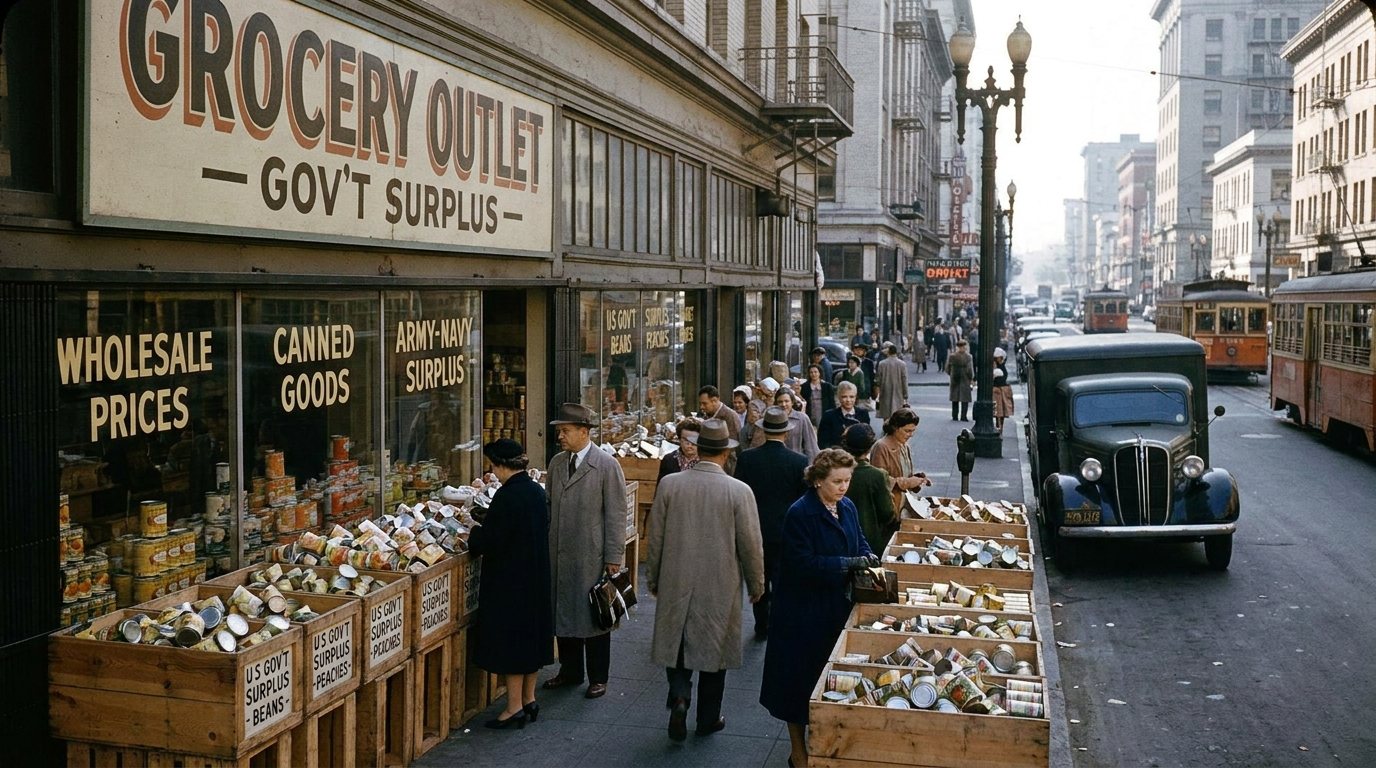
James Read opened his business on June 11, 1946, buying up U.S. government surplus food and reselling it out of vacant storefronts around San Francisco, according to the company's own account reflected on Wikipedia. He called it Cannery Sales. The premise was simple and of its moment: World War II had left the country's supply chain full of cases that no longer had a clear buyer, and a man willing to find and move them cheaply could build a business on the difference.
That premise turned out to be durable in a way Read likely didn't anticipate. In 1970, Cannery Sales acquired a company called Globe of California and rebranded as Canned Foods Warehouse, sharpening its focus on closeouts and discontinued goods rather than pure surplus. Three years later, in 1973, the company opened its first store in Redmond, Oregon, run not by a corporate manager but by an operator who owned a piece of the outcome. That structure, more than any single product, is the thing that made the chain scale.
The bet that isn't a franchise, exactly
Grocery Outlet calls its operators independent operators, and the label undersells how unusual the arrangement is inside grocery retail. Most stores are run by local husband-and-wife teams who invest their own capital, buy inventory from the parent company's centralized sourcing operation, and keep a large share of what the store earns. Corporate handles buying, real estate, and the closeout deal flow; the operator handles the store, the hiring, and increasingly the local assortment, stocking what sells in that neighborhood rather than what a regional planogram dictates.
It is a hybrid few competitors have replicated at this scale: not a franchise in the legal sense, but close enough in incentive that operators behave like owners rather than employees. That incentive alignment is a large part of why a chain built on erratic, opportunistic buying has managed decades of consistent unit growth instead of the inventory chaos you'd expect from a business that doesn't know next month's assortment in advance.
James Read died in 1982, and his sons Steven and Peter took over the company. In 1987 they renamed it Grocery Outlet, the name it has carried since. The 100th store opened in 1995, by which point the closeout model and the operator structure had proven they could travel well beyond the Bay Area.
Buying what everyone else couldn't sell
The clearest illustration of what Grocery Outlet actually is came in 2001, a brutal year for a certain kind of dot-com ambition. Webvan, the online grocery delivery company that had burned through roughly a billion dollars in venture funding, collapsed. Wine.com's original incarnation folded the same year. Grocery Outlet bought inventory out of both liquidations.
That single year is a useful lens on the whole company. Grocery Outlet's core competency isn't merchandising in the traditional sense. It's balance-sheet arbitrage against the rest of retail and manufacturing: overproduced private-label runs, packaging changeovers, discontinued SKUs, and yes, the wreckage of failed retailers, all get channeled into stores that are built to sell them fast at a steep discount. The company doesn't create demand for new products the way a traditional grocer does. It absorbs the excess that the rest of the industry's forecasting gets wrong, and it has built forty years of store growth on the fact that American retail and CPG manufacturing reliably overshoot demand somewhere every quarter.
The chain's own expansion has not been immune to that same forecasting problem. A push into Texas in 2003 was wound down by 2004, an acknowledgment that the operator-plus-closeout model didn't automatically travel to a market with different shopping habits and supply chains. The company took the lesson: subsequent growth stayed concentrated in the West before pushing more cautiously east.
Going public without changing the store
Berkshire Partners invested in Grocery Outlet in 2009, and Hellman & Friedman acquired the company from Berkshire in 2014. The private-equity ownership didn't touch the operator model, which is notable on its own, since that structure is the kind of thing a financial buyer might typically want to convert into something more centrally controlled. Instead, Grocery Outlet went public on Nasdaq under the ticker GO on June 20, 2019, still running on the same independent-operator backbone that had carried it since Redmond in 1973.
By 2024, the chain had grown to roughly 480 locations across ten states, still weighted heavily toward the West Coast where it began. The company's more recent chapter has been a harder one: in early 2026, CEO Jason Potter announced the closure of 36 underperforming stores, with two-thirds of them in the eastern U.S., and called the prior quarter's results "unacceptable." It's a reminder that the model's biggest strength, giving local operators real ownership over assortment and execution, is also the hardest thing to replicate quickly in new geography, where the chain hasn't yet built the deep bench of operator talent that took decades to develop out west.
The unusual thing about Grocery Outlet's history is how little the core mechanism has changed since 1946. A company still finds the surplus, still hands the store to someone who owns the outcome, and still lets that person decide what the shelf actually needs. Everything else, ticker symbol included, is downstream of that.
Grocery Outlet's whole business is a bet that someone, somewhere in the supply chain, will always overproduce, mislabel, or discontinue something worth reselling. That's not a footnote to American retail. It's the same unglamorous plumbing, catalogs, product data, and mismatched inventory, that most of the industry spends its energy trying to prevent.