
Harbor Freight Tools: How a Surplus Catalog Built a Retail Giant
Harbor Freight Tools ranks #54 on NRF's Top 100 with $8.20B in 2025 U.S. sales. Here's how a 1977 mail-order surplus business became a 1,600-store chain.
Part of Retailer Playbooks — history-first profiles of every company on the NRF Top 100 Retailers list.
Harbor Freight Tools ranks #54 on the National Retail Federation's Top 100 Retailers 2026 list, with $8.20 billion in 2025 U.S. retail sales. It got there without a single share traded on any exchange, without a name-brand power tool on its shelves, and without ever really shaking the "cheap tools" reputation it built on purpose. That reputation, and the decades-long project of managing it, is the real story.
A Teenager, His Father, and a Warehouse Full of Returns
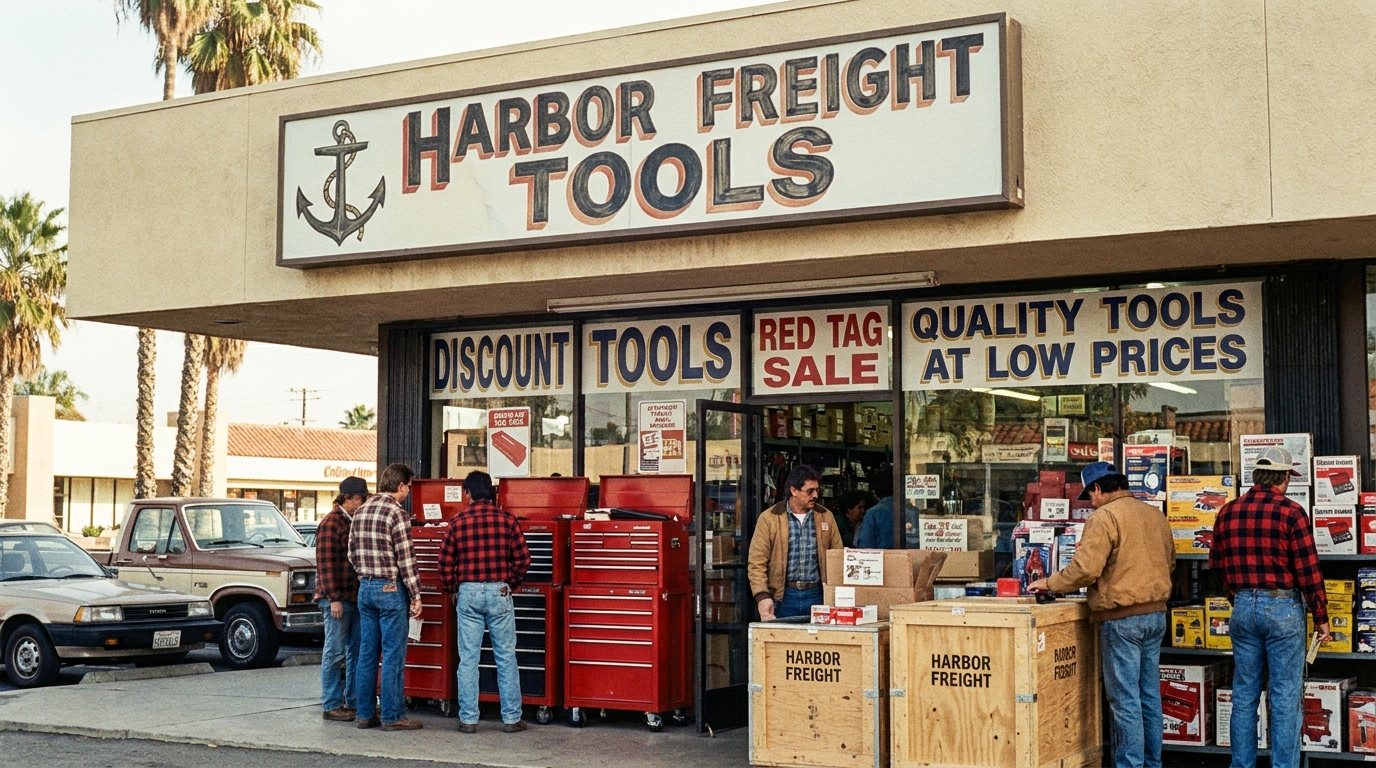
In 1977, Eric Smidt was a teenager working alongside his father Allan Smidt out of a small warehouse in North Hollywood, California. The business they started was not a tool store. It was a mail-order operation dealing in liquidated and returned merchandise, the kind of closeout inventory that manufacturers and other retailers wanted off their books at any price, according to Harbor Freight's own company history and a Forbes profile of Eric Smidt. Tools happened to be a category that moved well through that channel, and the surplus catalog slowly became a tool catalog.
That origin matters more than it looks like it should. Most tool retailers start with a hardware counter and expand outward. Harbor Freight started with a spreadsheet of liquidated pallets and worked backward into a retail identity. The company's entire cost structure, and its willingness to sell a wrench for a fraction of what a hardware store charges, traces to that founding logic: buy cheap, sell cheap, make it up in volume and repeat purchases.
From Catalog to Storefront
The mail-order business ran for five years before Harbor Freight opened its first physical store, in Lexington, Kentucky, in 1982, per the company's timeline. Eric Smidt became company president in 1985, at 25, and was promoted to CEO in 1999, a role in which he remains the company's sole owner today, according to Wikipedia's account of the company and Forbes.
The store rollout that followed took decades to compound. Harbor Freight now operates more than 1,600 retail locations across 48 states and employs over 30,000 people, generating close to $9 billion a year. It moved its headquarters from Camarillo to Calabasas, California in 2010, but the ownership structure never changed: no IPO, no private equity recapitalization, no public filings. It is, by revenue, one of the largest privately held retailers in the country, still controlled by the family that started it with a truckload of returned merchandise.
The Bet Nobody Else in Tools Made
Here is the part of the Harbor Freight story that does not show up on the About page: walk into a Harbor Freight and you will struggle to find a single tool from DeWalt, Milwaukee, Makita, or any of the brand names that dominate the aisles at Home Depot or Lowe's. That absence is not an oversight. It is the whole strategy.
Harbor Freight sells almost exclusively through its own house brands, roughly 50 of them, including Pittsburgh, Bauer, Chicago Electric, Central Machinery, Badland, and Hercules, sourced directly from manufacturers rather than licensed from established tool companies. Competing tool retailers build their assortments around name brands and compete on service, financing, and shelf placement within that shared set of suppliers. Harbor Freight opted out of that game entirely. By owning its entire brand portfolio, it controls both ends of the transaction: what a product costs to make and what story gets told about it on the shelf. No power-tool manufacturer can squeeze Harbor Freight's margins the way a De Walt or a Bosch can squeeze a big-box hardware chain, because there is no De Walt or Bosch account to protect.
That structure also let Harbor Freight solve a problem most discount retailers never solve cleanly: how do you sell both a $3 clearance-bin tool and a tool a working tradesperson trusts on a job site, under one roof, without either one undercutting the other's credibility? The house-brand ladder is the answer. Pittsburgh and Central Machinery sit at the bottom of the price ladder, doing the volume, closeout-adjacent business the company was built on. Hercules, introduced as a premium in-house line, sits at the top, aimed at professional buyers willing to pay more for a tool carrying Harbor Freight's own name rather than a value brand's. Because the company owns every rung of that ladder, it can let a customer trade up over years of purchases without ever sending them to a competitor's brand to do it.
Still Mailing Coupons in 2026
The other tell that Harbor Freight never fully left its catalog roots: it is one of the last major retailers still mailing millions of printed coupon flyers to households, decades after the rest of retail moved that spend to email and apps. The tactic reads as nostalgic, but it is a direct descendant of the original 1977 mail-order model, run at national scale instead of warehouse scale. A company that began by mailing surplus-goods catalogs to strangers never really stopped believing that a printed piece of paper with a price on it, delivered to a mailbox, is one of the most efficient customer-acquisition tools it owns.
Harbor Freight has also used its scale to fund a specific piece of the trades ecosystem it depends on. Through the Smidt Foundation and its Harbor Freight for Schools skilled-trades initiative, the company has awarded more than $10 million to teachers and schools supporting vocational education, according to the company's own history page. It is a philanthropic bet that the pipeline of mechanics, welders, and electricians who buy its tools needs tending at the classroom level, not just the checkout counter.
Every retailer on the NRF list has a version of this trade-off: how much of the original founding logic to keep, and how much to modernize away. Harbor Freight kept almost all of it, from the liquidation instincts to the mailbox marketing, and simply scaled the machine underneath.