
True Value: The Hardware Co-op That Came Back Home
True Value ranks #67 on NRF's 2026 Top 100 with $6.47B in sales. The story behind it runs through a merger disaster, private equity, and a 2024 bankruptcy.
Part of Retailer Playbooks — history-first profiles of every company on the NRF Top 100 Retailers list.
True Value comes in at #67 on the National Retail Federation's Top 100 Retailers 2026 list, compiled with Kantar, with $6.47 billion in 2025 U.S. retail sales. Behind that number sits one of the odder full-circle stories in American retail: a hardware cooperative that got merged into near-collapse, spent six years owned by a private equity firm, filed for bankruptcy, and ended up back in cooperative hands anyway.
A Salesman's Bet on Chicago
John Cotter started in hardware at age 12, sweeping floors in a St. Paul store. By the mid-1940s he was running his own store and had noticed something: the sharpest, busiest hardware stores in any given town tended to belong to dealer-owned cooperatives, not chains. In 1947 he met Bill Stout, general manager of American Hardware, at a cooperative convention. The two studied hardware distribution across the Midwest and settled on Chicago as the spot for a new dealer-owned wholesaler.
Cotter recruited 12 hardware dealers, each putting up $1,500 for cooperative shares, and Cotter & Company opened for business in January 1948 out of a rented Chicago warehouse. The pitch was blunt: bare-bones overhead, competitive pricing, and merchandising help, in exchange for dealers buying in as owners rather than customers. It worked. By 1960 Cotter's cooperative had roughly a thousand dealer-members stretching from Denver to Appalachia, according to Wikipedia's history of the company.
Buying a Name for $2,500
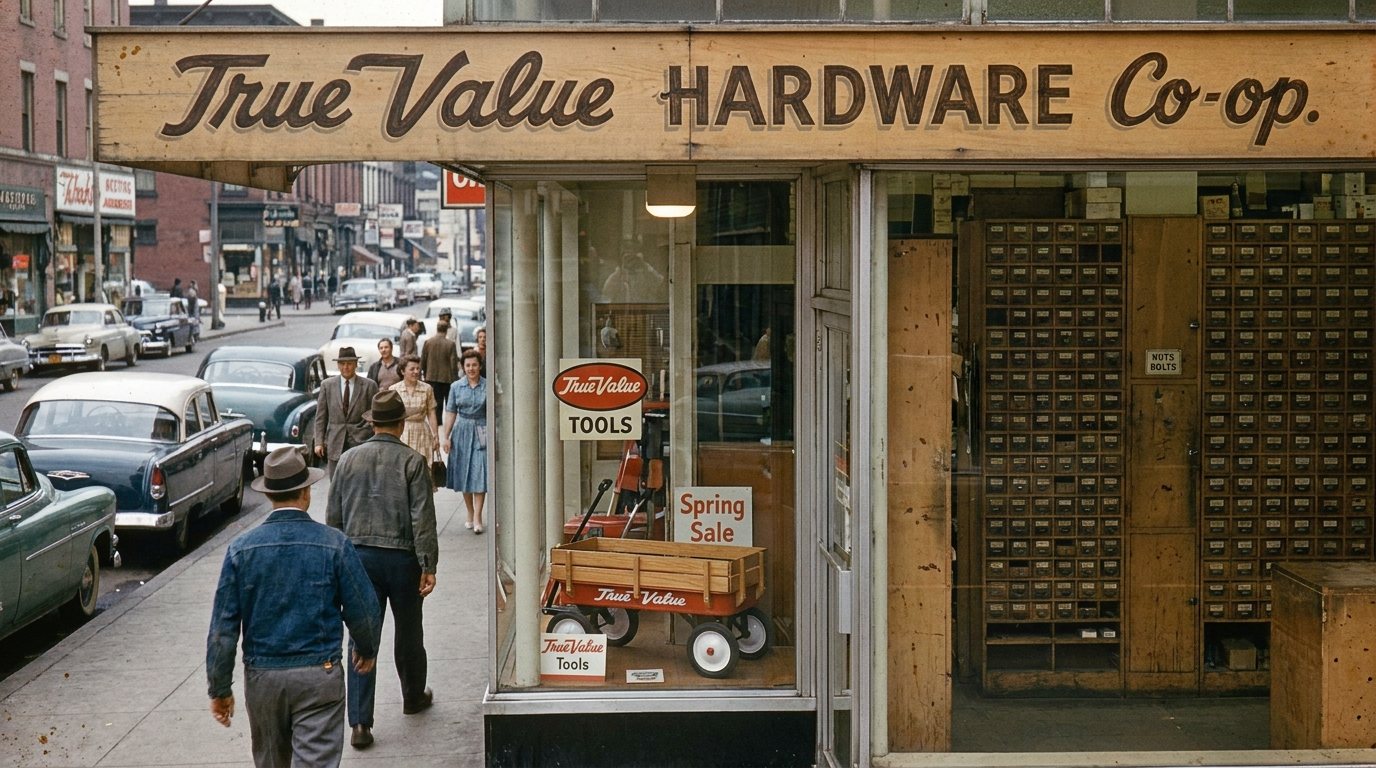
The "True Value" name itself predates Cotter's company by 16 years. Hibbard Spencer Bartlett & Company, an older Chicago hardware wholesaler, coined it in 1932 as a private label for hand tools. By 1960, Cotter & Company had grown past Hibbard's in sales volume, and when Hibbard's board decided to exit the hardware business in 1962, Cotter bought the entire operation for $2.5 million. Tucked inside that deal, almost as an afterthought, was the True Value trademark itself, priced separately at $2,500.
That $2,500 line item turned out to be the whole ballgame. Cotter & Company rolled the True Value name out across its dealer network as a unifying retail brand, something the cooperative itself had never had. It is a reminder that a great brand name and the company that eventually makes it famous are often two entirely different entities, and that the second one can pick up the first for pocket change if it's paying attention.
Scale, Then a Billion Dollars
Through the 1960s and 70s Cotter & Company kept acquiring smaller regional wholesalers, Walter H. Allen Co., Great Western Hardware, Northern Hardware among them, absorbing their dealer networks into the True Value fold. By the late 1970s the cooperative counted 3,687 member dealers across all 50 states. In 1979 it crossed $1 billion in annual sales, a scale that put it in direct competition with Ace Hardware for the title of America's dominant hardware cooperative.
The Merger That Nearly Ended It
By the mid-1990s, big-box home centers were reshaping hardware retail, and Cotter & Company saw a merger with ServiStar Coast to Coast Corporation as the way to compete on scale. On July 1, 1997, the two combined into TruServ Corporation, an entity with $4.5 billion in sales and 10,500 stores, the largest hardware wholesaler in the industry.
It did not go well. In 2000, TruServ discovered accounting irregularities of roughly $100 million buried in its books. The company took a massive write-down, its stock cratered, and by 2001 TruServ had defaulted on $200 million in revolving debt. More than 2,100 dealer-members left the cooperative during the crisis, and the SEC opened an investigation in 2002. TruServ survived, restructured, and eventually renamed itself True Value Company in 2005, but the episode cost the co-op a decade of momentum and roughly a fifth of its peak store count for good.
From Cooperative to Private Equity to Bankruptcy
For over a decade after 2005, True Value operated as a straightforward dealer-owned cooperative again. That changed in 2018, when private equity firm ACON Investments bought a 70% controlling stake, converting True Value from a member-owned co-op into an investor-owned company for the first time in its 70-year history.
The timing was rough. Rising inflation and interest rates squeezed the company's liquidity, and on October 14, 2024, True Value filed for Chapter 11 bankruptcy. Rather than liquidating, the company found a buyer in its longtime rival: Do it Best, the Fort Wayne cooperative built from Hardware Wholesalers Inc., founded in 1945, and Our Own Hardware, the merger that gave True Value's own founder his original inspiration decades earlier. Do it Best acquired True Value's inventory, brand rights, and a paint manufacturing facility out of bankruptcy for $153 million, according to Wikipedia's entry on Do it Best, adding over 4,500 True Value stores to its network and pushing the combined cooperative past 8,000 locations served worldwide.
| Year | Event |
|---|---|
| 1948 | Cotter & Company founded in Chicago as a dealer-owned wholesaler |
| 1962 | Cotter buys Hibbard Spencer Bartlett, including the True Value trademark, for $2,500 |
| 1979 | Cotter & Company crosses $1 billion in sales |
| 1997 | Merger with ServiStar Coast to Coast forms TruServ Corporation |
| 2000-02 | Accounting scandal, debt default, SEC investigation |
| 2018 | ACON Investments buys 70% stake, ending cooperative ownership |
| 2024 | Chapter 11 bankruptcy; Do it Best acquires the company for $153 million |
The Part the About Page Won't Tell You
The tidy version of this story is "hardware co-op survives adversity." The more interesting version is that True Value's 2018 conversion to private equity ownership, meant to stabilize the company with fresh capital, is what set up the conditions for its 2024 bankruptcy, and that its rescue came not from a financial sponsor but from Do it Best, a cooperative built on the exact ownership model John Cotter bet on in 1947. The company that ACON took private in 2018 ended up back in dealer hands in 2024, just under a different roof. Seven decades after Cotter decided the co-op model beat the alternatives, the market reached the same conclusion twice.
Every hardware store that still carries the True Value sign today is a small monument to a distribution model built on shared ownership, one that outlasted a merger scandal, a private equity chapter, and a bankruptcy filing, and that keeps proving itself against whatever periodically threatens to replace it.