
Sherwin-Williams: The Paint Maker That Became Its Own Retailer
How Sherwin-Williams survived a hostile 1970s takeover threat and built 4,853 company-owned stores instead of chasing shelf space at Home Depot.
Part of Retailer Playbooks — history-first profiles of every company on the NRF Top 100 Retailers list.
Sherwin-Williams sits at #39 on NRF's Top 100 Retailers 2026 list, with $12.60 billion in 2025 U.S. retail sales, a number that only tells part of the story since the company also manufactures nearly everything it sells. Most retailers on the NRF list buy inventory from someone else and sell it. Sherwin-Williams invented the can, patented the way it closes, and then built the store that sells it. That triple identity, chemist, manufacturer, retailer, is the whole plot.
A $2,000 Bet on the Cuyahoga
Henry Sherwin put his life savings, $2,000, into an Ohio paint-supply partnership in 1866. Four years later he dissolved it and started over with Edward Williams and a third partner, A.T. Osborn, buying a factory on the Cuyahoga River in Cleveland in 1873 to make paste paints, oil colors, and putty, according to FundingUniverse's company history. Painters at the time mixed their own paint from raw pigment and oil every morning. It was slow, inconsistent, and wasteful.
Sherwin-Williams solved that problem twice. In 1877 the company developed what FundingUniverse describes as the first patented reclosable paint can, letting customers seal and store leftover paint instead of tossing it. In the 1880s it launched SWP, Sherwin-Williams Paint, the first ready-mixed paint to win real public acceptance. The partnership incorporated formally in 1884, and that same period brought Inside Floor Paint, an early bet that different surfaces deserved different formulas rather than one all-purpose can.
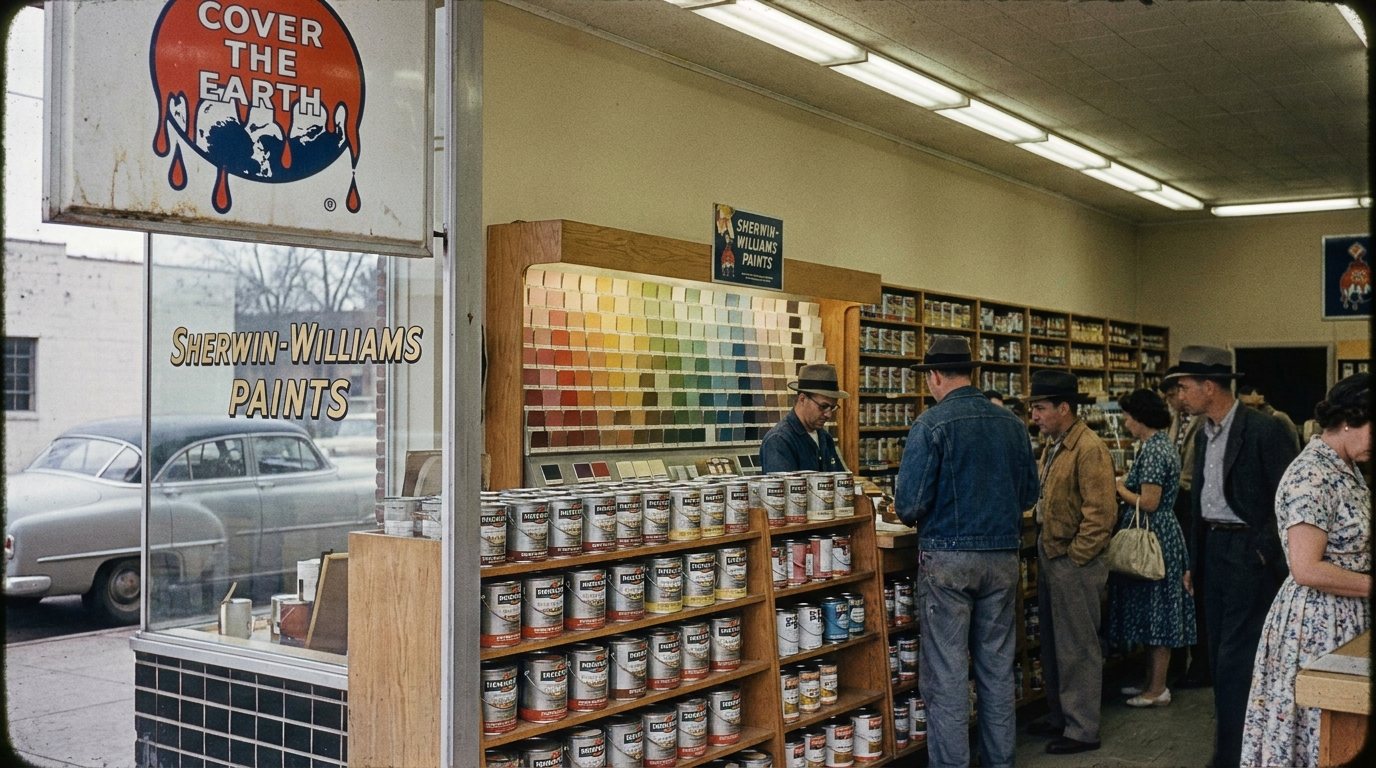
Cover the Earth
By 1888 the company had outgrown residential paint alone, opening a Chicago plant to supply the Pullman rail-car company and farm-implement makers. The famous Cover the Earth globe-and-paint-bucket trademark arrived in 1905 and has anchored the brand ever since. Under second president Walter Cottingham, the company went public in 1920, raising $15 million in preferred stock to fund acquisitions including Martin-Senour, and by the early 1920s Sherwin-Williams was the largest coatings maker in the United States, per Wikipedia.
The chemistry kept compounding. Under third president George Martin, the company developed nitrocellulose lacquer and synthetic enamel that cut automotive paint drying time from 21 days to a few hours, a change that mattered enormously to Detroit's assembly lines. In 1941, Kem-Tone, a water-based interior paint, hit the market. It was significant enough that the American Chemical Society named it a National Historic Chemical Landmark in 1996.
The Decade That Almost Ended the Company
The 1970s nearly finished what a century of invention had built. By 1977 Sherwin-Williams posted an $8.2 million loss on $1 billion in sales and suspended its dividend, according to Encyclopedia.com's business history. Long-term debt had gone from zero in 1967 to $242 million by 1978. A wounded, dividend-less public company with a depressed stock price is exactly the kind of target conglomerates hunted in that era, and by 1978 Gulf + Western Industries had quietly accumulated 13.47 percent of Sherwin-Williams stock.
John Breen took over as CEO in January 1979 and moved fast. He talked Gulf + Western chairman Charles Bluhdorn into selling out of the position by framing it as dead weight rather than a bargain. Internally he shuffled management, decentralized decision-making, and cut roughly 1,000 slow-selling products. Earnings jumped 57 percent in the first half of 1980 versus the prior year, and by 1985 sales had nearly doubled to $2.17 billion.
The Store Is the Strategy
Here is the part of the Breen-era recovery that doesn't get told as often as the takeover fight, and it's the real key to why Sherwin-Williams still shows up on a retailer ranking rather than fading into a private-label supplier line. Through the 1980s, discount chains and home-decorating retailers were consolidating around one or two national paint suppliers instead of stocking dozens of regional brands, per Encyclopedia.com. Sherwin-Williams read that consolidation correctly and made an unusual choice for a manufacturer: rather than compete for shelf space inside someone else's big-box store, it doubled down on running its own.
That bet is why the company operates 4,853 Paint Stores Group locations today, a footprint built specifically around professional painters and contractors who need job-lot color matching, account credit, and a counter person who knows the difference between an eggshell and a satin finish. Home Depot and Lowe's sell paint to homeowners doing a weekend project. Sherwin-Williams built a parallel channel that sells to the person painting houses for a living, and it owns every link in that chain from the resin plant to the register. Most companies on the NRF Top 100 either manufacture or retail. Sherwin-Williams does both, on purpose, as a structural choice made under duress in the early 1980s, and that choice is the reason it survived as an independent company at all.
Scaling the Model
The company kept building on that dual identity. In 2004 it added Duron and Paint Sundry Brands. In 2016 it closed its largest deal ever, an $11.3 billion acquisition of Valspar that brought Dutch Boy, Minwax, and Valspar's own retail relationships into the fold, per Wikipedia. A 2022 purchase of Sika's European industrial coatings business extended the same logic overseas. Today Sherwin-Williams runs three segments, Paint Stores, Consumer Brands, and Performance Coatings, out of Cleveland, with roughly 64,000 employees and $23.6 billion in global revenue.
The through-line from 1866 to now is that Sherwin-Williams never stopped controlling its own shelf. Every retailer eventually has to decide whether to own the last mile to the customer or rent it from somebody else. Sherwin-Williams decided that a century and a half ago and has been proving the math on it ever since.
This profile is part of Anglera's Retailer Playbooks series, a look at the companies whose catalogs, supply chains, and store networks quietly run American retail.