
Health Mart: The Pharmacy Franchise That Outlived Its Parent
Health Mart survived FoxMeyer's 1996 bankruptcy and an ERP disaster to become the largest independent pharmacy franchise in the US, per NRF's 2026 Top 100.
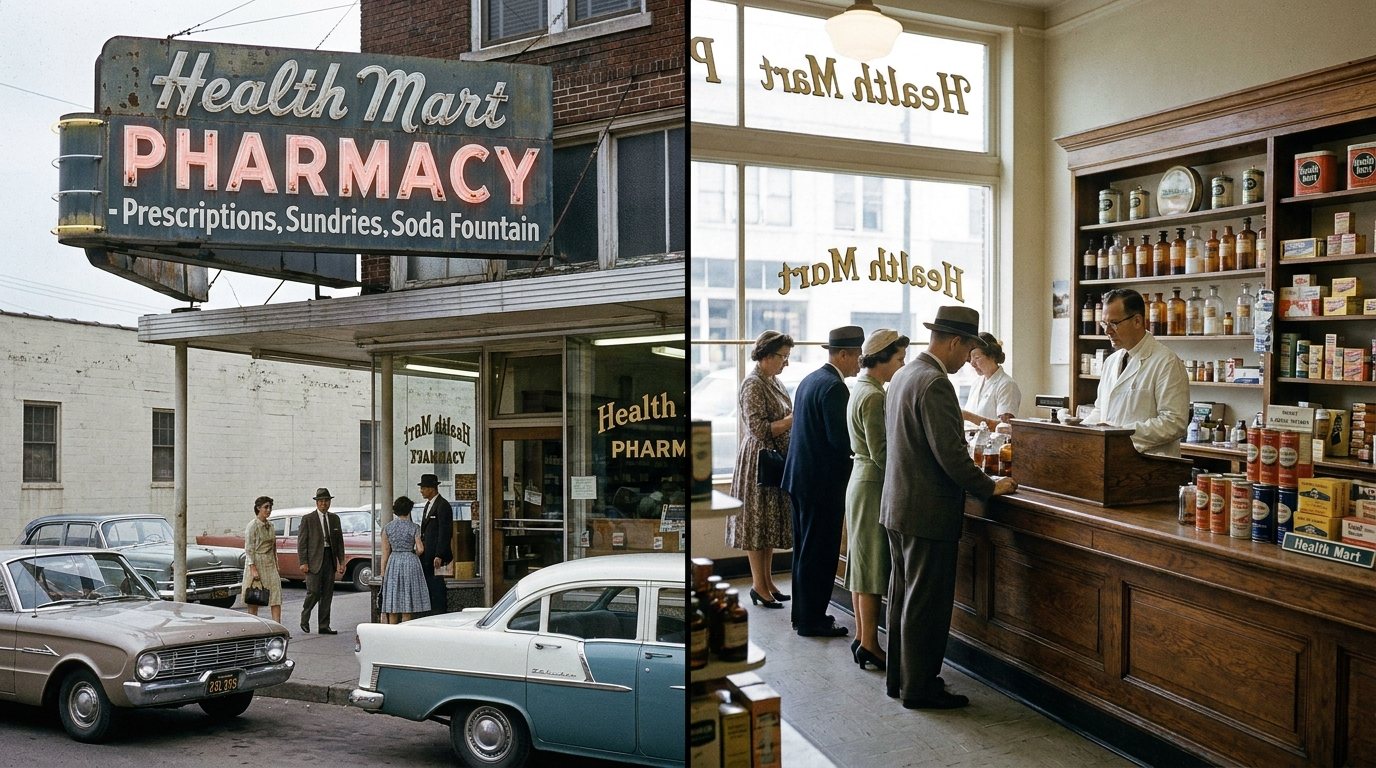
Part of Retailer Playbooks — history-first profiles of every company on the NRF Top 100 Retailers list.
Health Mart lands at #42 on the NRF Top 100 Retailers 2026, the National Retail Federation's annual ranking compiled with Kantar, with $12.25 billion in 2025 U.S. retail sales spread across more than 5,000 independently owned pharmacies. That number is unusual for this list. Health Mart does not own a single one of its stores. It is a banner, a supply chain, and increasingly a negotiating bloc for pharmacists who own their own businesses. The story of how it got that way runs through one of the most spectacular corporate collapses in American distribution history.
A wholesaler with German roots
The lineage starts in 1852, when Christian F. G. Meyer, an immigrant from Hanover, began selling drugs on horseback out of Fort Wayne, Indiana. Within a few years his brother John joined him, and by 1865 the operation had outgrown retail entirely. Meyer moved the business to St. Louis, betting correctly that the city would become, in his words, "one of the greatest distributing markets in America." Incorporated in 1889 as Meyer Brothers Drug Company, the firm grew into what Wikipedia's history of the company calls the largest independent wholesale drug house in the United States by the early 1900s, serving customers across the Western Hemisphere.
That 129-year run as an independent company ended in July 1981, when Fox Meyer Health Corporation acquired Meyer Brothers and folded it into a national wholesale drug network. FoxMeyer was itself a product of decades of consolidation among regional drug wholesalers, a business built on thin margins and enormous volume. In 1982, FoxMeyer created Health Mart as a franchise banner, letting independent pharmacies that bought through its distribution network share a common name, marketing, and private-label line while keeping their local ownership intact. The idea was simple: give the mom-and-pop pharmacist some of the brand recognition and buying leverage of a chain without asking them to sell out.
Scaling into the 1990s, then the wheels come off
The banner grew fast. It hit 400 stores after National Intergroup bought FoxMeyer in 1986, then 800 by 1994 as FoxMeyer rolled out FoxCare, a managed-care pharmacy initiative aimed at insurers and health plans. FoxMeyer was, by the mid-1990s, a roughly $5 billion wholesaler chasing efficiency the same way its rivals were: through massive, centralized automation.
That bet is what killed it. FoxMeyer committed to a "big bang" enterprise resource planning rollout, an SAP R/3 system paired with ambitious new warehouse automation, implemented all at once rather than in phases. Wikipedia's account of the failure, filed under enterprise case studies in organizational change, describes a company with "unrealistic expectations" that put its workforce under punishing deadline pressure and then, when problems surfaced, "tried to minimize problems by ignoring them," which "hindered organizational learning." The automated warehouses could not keep pace with order volume, inventory and billing broke down, and FoxMeyer Drug Company filed for Chapter 11 bankruptcy in August 1996. It remains a textbook case taught in operations and information-systems courses precisely because the failure was not a niche software bug. It was a strategic overreach with a real body count: one of the largest pharmaceutical distributors in the country.
McKesson Corporation bought FoxMeyer's assets, including the Health Mart franchise, for $400 million that October. And here is the detail worth sitting with: the arm of the business that collapsed was the centralized one, the wholesaler trying to run everything through a single automated brain. The arm that survived, changed owners, and kept operating with barely a hiccup was the decentralized one, thousands of independently owned storefronts that never depended on FoxMeyer's warehouse software to fill a prescription. Health Mart's franchise structure was not what FoxMeyer bet the company on. It turned out to be the more durable asset in the wreckage.
The quiet years, then the rebuild
McKesson did not treat its new pharmacy banner as a priority at first. Health Mart shrank to 262 stores by 2004, a fraction of its 1990s peak, as McKesson focused on distribution rather than franchising. Then, in July 2006, McKesson relaunched Health Mart with a new franchising model, new logo, and new store design built around managed-care services rather than just retail dispensing. The bet paid off fast: by April 2007 the network had grown to 1,280 stores and won Drug Topics' "Chain of the Year."
| Year | Milestone |
|---|---|
| 1852 | Christian Meyer founds a drug wholesaling business in Fort Wayne, Indiana |
| 1981 | FoxMeyer Health Corporation acquires Meyer Brothers Drug Company |
| 1982 | FoxMeyer launches the Health Mart franchise banner |
| 1996 | FoxMeyer files Chapter 11; McKesson buys the company and Health Mart for $400 million |
| 2006 | McKesson relaunches Health Mart with a new franchise model |
| 2015 | Health Mart opens its 4,000th store |
| 2018 | Health Mart Atlas launches as a pharmacy services administrative organization |
Growth kept compounding through the 2010s: 2,500 stores across all 50 states by 2010, more than 3,100 member stores by 2013, a 4,000th store in 2015. In 2018, Health Mart launched Atlas, a pharmacy services administrative organization, or PSAO, that negotiates reimbursement contracts with pharmacy benefit managers on behalf of member stores. That is arguably a bigger deal than it sounds. Independent pharmacies' central business problem for the last two decades has not been foot traffic or brand recognition. It has been PBMs squeezing reimbursement rates below what it costs to fill a prescription. A common storefront banner cannot fix that. Collective negotiating leverage can. Health Mart's most important product today may not be the sign above the door but the contract terms Atlas can get that a single-store owner never could alone.
Health Mart supported COVID-19 testing and vaccination efforts in 2020, and today counts more than 5,000 member pharmacies, with Crystal Lennartz named president in December 2023.
Sources
- Health Mart – Wikipedia
- Meyer Brothers Drug Company – Wikipedia
- McKesson Corporation – Wikipedia
- Big bang adoption – Wikipedia
- Health Mart official site
Health Mart's whole existence is a reminder that behind every prescription label is a supply chain fight over data, contracts, and who controls the terms of a sale, the same unglamorous infrastructure question that runs under all of American retail.