
H-E-B: How a $60 Grocery in Kerrville Became a Texas Institution
H-E-B ranks No. 16 on the NRF Top 100 with $44.16B in 2025 sales. Here is how a Kerrville dry goods store became the retailer Texans will not let go.
Part of Retailer Playbooks — history-first profiles of every company on the NRF Top 100 Retailers list.
H-E-B lands at No. 16 on NRF's Top 100 Retailers 2026, the National Retail Federation's annual ranking compiled with Kantar, with $44.16 billion in 2025 U.S. retail sales. That number belongs to a chain that still has not opened a store outside Texas and northern Mexico. To understand how a company that refuses to leave home outsells national chains twice its geographic footprint, you have to go back to a $60 loan and a sick husband.
A store built on a doctor's bad news
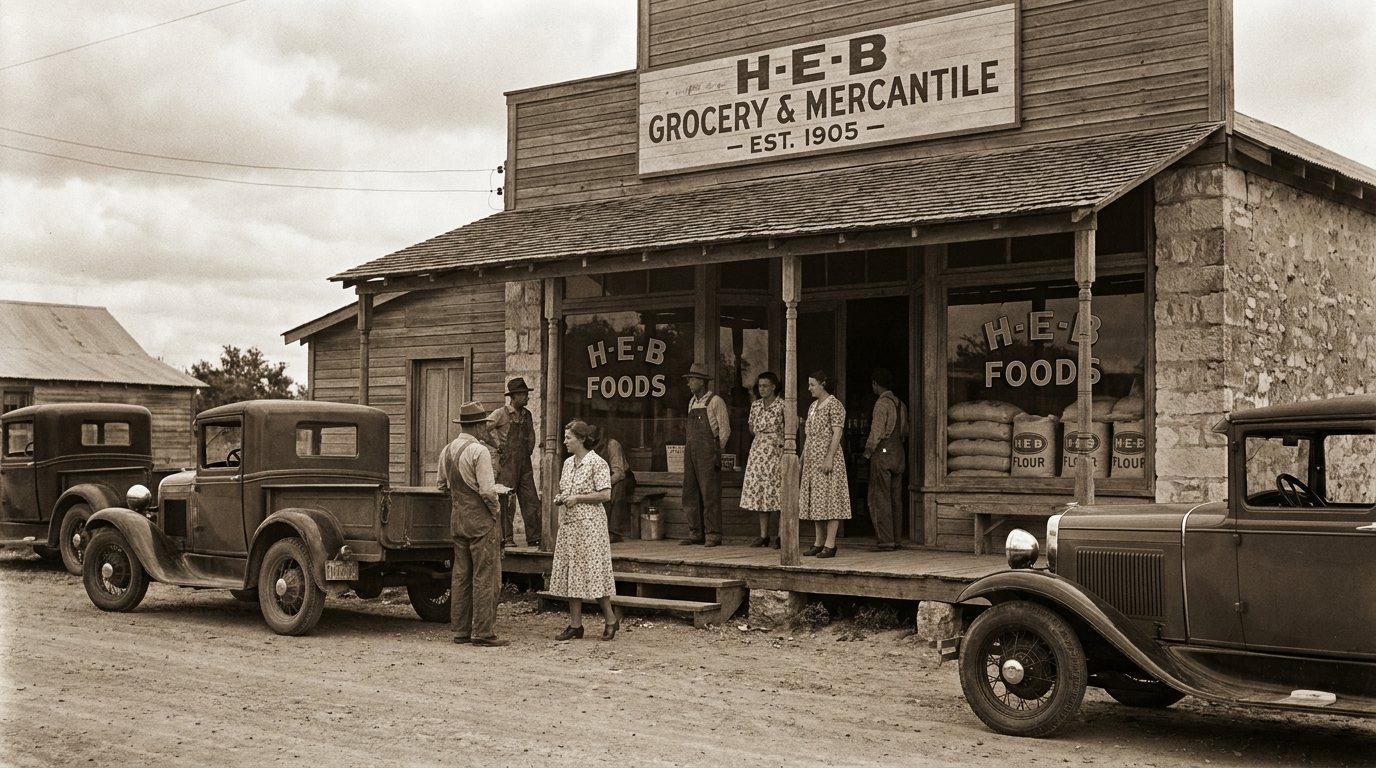
Charles Butt moved his family from Memphis to Kerrville, Texas in 1904 chasing a folk remedy of the era: dry Hill Country air for his tuberculosis. The move solved little for his health, so his wife Florence opened the C.C. Butt Grocery Store on November 26, 1905, investing $60 into the ground floor of their rented house, according to Wikipedia's history of the company. The Butts sold food on credit and delivered it by baby carriage until they could afford a wagon. Florence's real innovation was subtler than the store itself: she arranged daily train shipments of fresh-baked bread from San Antonio at a time when buying rather than baking your own bread carried a whiff of social shame, according to FundingUniverse's company history. She sold the idea as a convenience worth paying for, and customers agreed.
Florence's youngest son, Howard Edward Butt, came home from Navy service after World War I and took the business in a direction his mother had not tried: aggressive, repeated expansion. His first four attempts to open Central Texas locations failed. He kept going anyway, moving the store to a busier downtown Kerrville corner, installing the town's first in-store meat market and delicatessen, and in December 1921 mailing customers handwritten postcards announcing a new idea: cash-and-carry. No more running a tab. Customers paid cash, bagged their own groceries, and carried them home themselves, and the store passed the savings on in lower prices. The renamed C.C. Butt Cash and Carry opened New Year's Day 1922 and, per FundingUniverse, was "an instant hit."
The name, the Depression, and a hurricane
Howard folded his mother's initials and his own into the name that stuck: H-E-B. Through the late 1920s he picked up Piggly Wiggly franchise rights and pushed the chain south into the Rio Grande Valley, and by 1931 the company ran 24 stores. Grocery is one of the few businesses that gets a pass during a depression, since people stop buying almost everything before they stop buying food, and H-E-B used the Depression years to keep expanding while competitors retrenched.
In 1933 a hurricane tore through the Rio Grande Valley and wrecked stores and warehouses across the region. H-E-B's Piggly Wiggly location in Harlingen was, by the company's own telling and corroborated in the FundingUniverse history, the only grocery store in its area to reopen immediately after the storm. That instinct, that a grocery store's job during a disaster is to be open when nothing else is, shows up again nine decades later: H-E-B's 2025 Central Texas flood response included a $5 million commitment, following a similar playbook after Hurricane Harvey in 2017, when the company gave $100,000 directly and ran a $1 million customer donation campaign, per Wikipedia. It is a pattern, not a one-off act of charity: keep the supply chain moving when everyone else's has stopped, then write the check afterward.
Charles Butt and the trip that built Central Market
Howard's son Charles took over as president in 1971, when the company did $250 million a year in sales, a Wharton graduate stepping into a business his grandmother had started with $60. He restructured management, recruited grocery executives from outside the family, and dropped the chain's old bans on Sunday sales and alcohol. By 2006 sales had reached $13 billion.
The more interesting move came from research, not retrenchment. In the late 1980s Charles commissioned teams to study food retailers in London, New York, and Atlanta, looking for something H-E-B was not yet doing. What came back was Central Market, a 60,800-square-foot store that opened in Austin in 1994 and did the opposite of what a supermarket is supposed to do: it dropped the one-stop-shop premise entirely, stocked no detergent or packaged cereal, and built the entire format around fresh, perishable, and imported goods. It is easy to read Central Market today as a lifestyle-grocery bet that paid off. The less obvious read is that it was H-E-B choosing to compete with Whole Foods, a Texas company, before Whole Foods had scaled nationally, by out-researching its own home-turf blind spot instead of just matching a rival format store for store.
H-E-B's other quiet advantage is vertical integration most shoppers never notice: the company runs its own bakeries, dairy and milk processing, tortilla plants, and one of the largest milk and bread facilities in the Southwest, all built up starting in 1936 when the company bought its first canning operation. Private-label lines like Hill Country Fare and Mootopia are downstream of factories H-E-B owns, not contracts H-E-B signs, which is a different cost structure than most grocers run.
Staying home on purpose
H-E-B tried leaving Texas exactly once, opening H-E-B Pantry stores in Louisiana starting in 1996. The format was discontinued by 2003. The company's other expansion, into Monterrey, Mexico in 1997, worked, and by 2012 had crossed $1 billion in annual sales there by stocking almost entirely Mexican-made products rather than exporting a Texas assortment across the border.
The unique insight in H-E-B's record is not that it stayed regional. Plenty of grocers stay regional and fade. It is that H-E-B used its regional focus as a research advantage, sending teams abroad to study formats it did not yet run, then building something (Central Market, Mi Tienda for Hispanic-focused markets, Joe V's Smart Shop as a discount banner) tailored enough to a specific Texas shopper that a national chain's average-everywhere assortment could not match it. Depth beat geographic reach.
Every one of those formats, from a $60 dry-goods counter to a five-banner regional empire, still runs on the same unglamorous machinery: a catalog of what is on the shelf, a supply chain that knows where it is, and a store that can open the morning after the storm.