
Hobby Lobby: The Frame Shop That Built a Debt-Free Empire
Hobby Lobby survived a 1985 near-collapse and built the largest privately owned crafts retailer by refusing debt and buying up idle big-box real estate.
Part of Retailer Playbooks — history-first profiles of every company on the NRF Top 100 Retailers list.
Hobby Lobby lands at #62 on NRF's Top 100 Retailers 2026 list, with $7.26 billion in 2025 U.S. retail sales. That figure comes from a company that started as a $600 loan to make miniature picture frames in a garage, and that once lost $1 million in a single year chasing a business it didn't understand. The recovery from that mistake, more than the founding itself, is the reason Hobby Lobby exists today at more than a thousand stores.
A stock boy's side hustle
David Green's retail education started young. He worked as a stock boy at a McClellan's five-and-dime in Altus, Oklahoma, then rose to store manager at TG&Y, a regional variety chain. There he met Larry Pico, and the two noticed shoppers wanted frames for the cheap canvas art flooding dime stores. In 1970 they borrowed $600 from a bank and started making miniature picture frames out of Pico's garage under the name Greco Products, according to an account of the company's founding published by Encyclopedia.com.
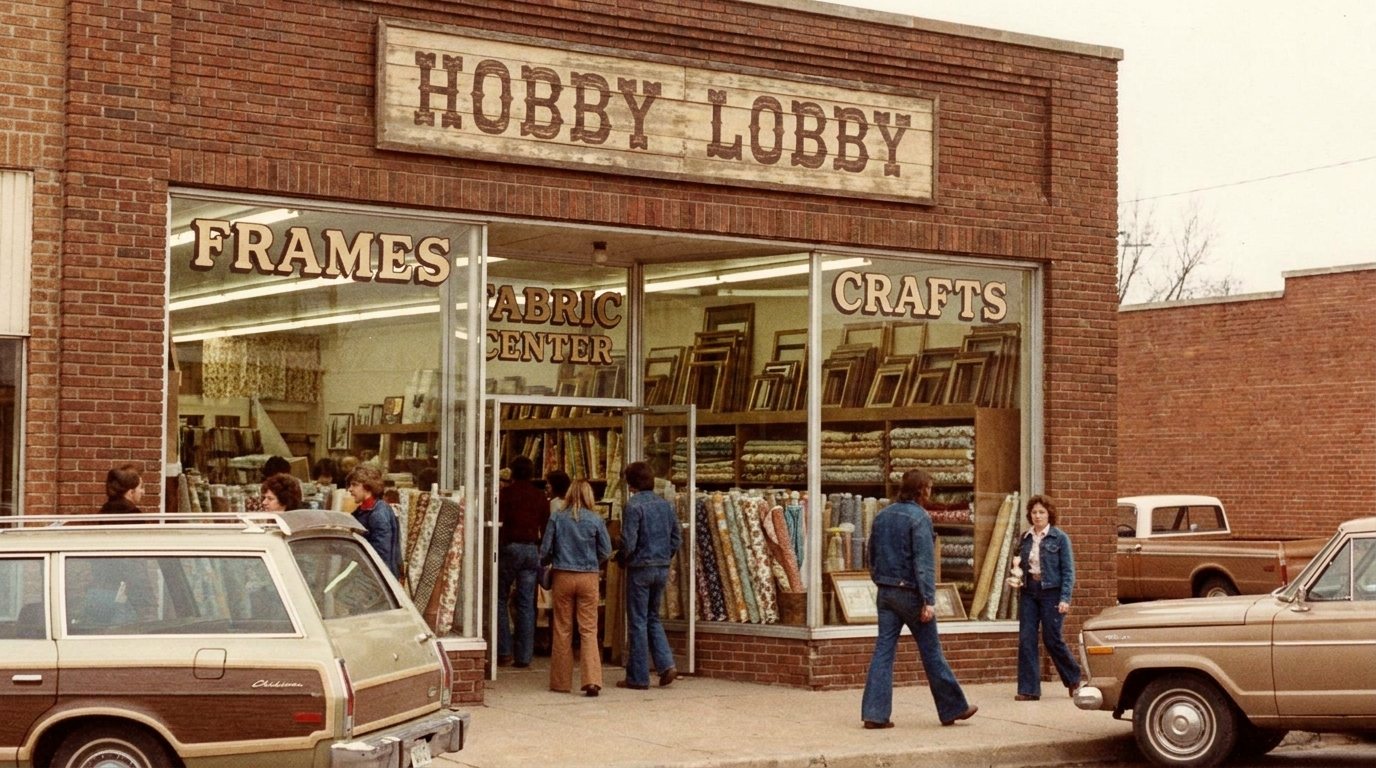
Green kept his TG&Y paycheck for three years while the side business grew. Barbara Green and their sons assembled frames at home, and the family later contracted with an Oklahoma City Cerebral Palsy Center to have workers assemble frames at ten cents apiece. On August 3, 1972, the Greens opened their first retail storefront: a 300-square-foot arts-and-crafts shop in northwest Oklahoma City, per Wikipedia's history of the company. That tiny store is the one Hobby Lobby's own corporate history page still points to as the beginning, calling itself "the largest privately owned arts-and-crafts retailer in the world" today, per Hobby Lobby's own account of its founding.
The oil-bust lesson that built the company's real DNA
Growth through the late 1970s was steady but unspectacular: a second Oklahoma City store in 1975, expansion into Tulsa in 1976, seven locations by 1982. Then, riding Oklahoma's oil boom, management made a bet that nearly ended the company. Hobby Lobby diversified hard into furniture, fine art, cookware and luggage in the mid-1980s, chasing higher-margin categories outside its expertise.
The oil economy collapsed, and the diversification collapsed with it. For 1985, Hobby Lobby posted $25 million in sales and lost $1 million, according to the Encyclopedia.com history. Green's response defined the company going forward: he shuttered every non-core product line, refinanced, and rebuilt around hobby and craft materials exclusively. He also drew a permanent lesson from the episode about debt and expansion pace, one the company has followed for four decades since: grow only as fast as retained earnings allow, and never let a single bad category bet threaten the whole business.
The real estate arbitrage nobody names as the moat
Ask a casual observer what makes Hobby Lobby different and most will mention the Sunday closures or the Christian holiday newspaper ads the company began running in 1997. Those are real and distinctive. But the quieter, more durable advantage is a real estate strategy that gets almost no attention outside industry circles: instead of building new stores, Hobby Lobby has spent decades buying or leasing abandoned big-box buildings, according to the Encyclopedia.com history, entering markets fast and cheap by taking over space that former Kmarts, grocery chains, and other failed retailers left behind.
Combined with a debt-averse balance sheet and a decision to skip barcode scanning in favor of weekly manual inventory counts (Green's stated belief was that counting stock by hand made employees know their departments better), the company built a cost structure that competitors leasing at market rate and carrying acquisition debt struggle to match. That combination, patient capital plus opportunistic real estate, is the unique insight here: the religious branding gets the headlines, but the occupancy-cost discipline is what actually let Hobby Lobby out-survive craft-retail rivals that leaned harder on debt and new construction.
The scoreboard, decade by decade
| Year | Move | Why it mattered |
|---|---|---|
| 1970 | $600 garage loan starts Greco Products | Frame-making side business while Green kept his day job |
| 1972 | First 300 sq ft store opens in Oklahoma City | Retail concept is born |
| 1985 | Diversification bet fails; $1M loss on $25M sales | Forces the return to core crafts focus and debt aversion |
| 1992 | Chain reaches 50 stores in seven states | First proof the recovered model scales |
| 1997 | Company begins religious holiday newspaper ads | Values-driven branding becomes a public signature |
| 2005 | ~370 stores, ~$1.5B sales, #3 behind Michaels and Jo-Ann | Established as a major national player |
| 2025 | 1,057+ stores across 48 states | Among the largest privately held retailers in the country |
A family business that stayed a family business
Green resisted going public even as the chain scaled into the billions, telling associates that how the profits were spent mattered more than accumulating them, per the Encyclopedia.com account. That decision kept capital allocation entirely in family hands. Steve Green now serves as president, and the founding brother-in-law's namesake, Mardel Christian & Educational Supply, still operates as an affiliated chain alongside Hobby Lobby out of the same Oklahoma City complex, which today spans more than 12 million square feet of manufacturing, distribution, and office space per Hobby Lobby's own history page.
None of that scale happened on schedule. In 1999, the company projected 1,100 stores by 2003, a target it didn't hit for another two decades. The lesson embedded in Hobby Lobby's history isn't that ambition failed, it's that the company treated a missed forecast as a footnote rather than a crisis, because the balance sheet never depended on hitting it.
Retail history is full of chains that grew fast on someone else's money and shrank just as fast when the terms changed. Hobby Lobby's version of the story is the opposite: a business that got burned once for growing beyond its knowledge, and built every decision afterward around not doing that again.