
IKEA: How a Boycotted Swedish Startup Built Global Retail
IKEA ranks No. 83 on NRF's Top 100 Retailers 2026 list. The history behind the flat-pack idea, a 1950s industry boycott, and a global retailer.
Part of Retailer Playbooks — history-first profiles of every company on the NRF Top 100 Retailers list.
IKEA lands at No. 83 on the National Retail Federation's Top 100 Retailers 2026 list, with $5.30 billion in 2025 U.S. retail sales, compiled by NRF with Kantar. That figure is a rounding error against IKEA's roughly $50 billion in worldwide revenue. The company that ranks modestly in America is the same one that invented how most of the world now buys a bookshelf, and the path from a Swedish farm shed to that outcome runs through a boycott, a factory shortage, and a teenager who started out selling matches by the box.
A Farm Kid Who Sold Everything Except Furniture
Ingvar Kamprad founded IKEA on July 28, 1943, when he was 17 years old, registering the business at his uncle's kitchen table on the family farm, Elmtaryd, in the Swedish province of Småland, according to the IKEA Museum. The name is an acronym: his initials plus Elmtaryd and Agunnaryd, his home village. Kamprad had been trading since childhood. He was reportedly reselling matches purchased in bulk from Stockholm by age seven, later branching into fish, seeds, Christmas decorations, and pens, per Wikipedia's account of his life.
IKEA itself started as a mail-order catalog business selling pens, wallets, and stockings, not furniture. Furniture entered the catalog only in 1948, five years in, after Kamprad noticed a local competitor doing well with it and recognized that Småland's dense cluster of small furniture workshops gave him a supply nobody else was using efficiently, according to the IKEA Museum's account of the company's founding.
The Boycott That Built the Supply Chain
The industry noticed. When Kamprad opened his first physical showroom in Älmhult in 1958, established furniture dealers moved against him. IKEA was banned from Sweden's leading furniture trade fair, competing dealers pressured IKEA's suppliers into a boycott, and some suppliers who kept working with Kamprad had to ship goods under neutral, unmarked names to avoid retaliation, according to the IKEA Museum. A design critic of the era, Bo Lagercrantz, called what Kamprad had started a "healthy price war," while questioning whether the quality could hold at those prices.
Here is the part that rarely makes it into the retrospectives: the boycott is arguably what made IKEA IKEA. Locked out of Sweden's normal furniture-manufacturing relationships, Kamprad built his own supply network from scratch, sourcing unfinished components from sawmills, door factories, and textile mills rather than from furniture makers at all, per FundingUniverse's company history. By 1990 that had scaled into roughly 1,500 suppliers across 45 countries. Most retailers build a supply chain to serve a design. IKEA built a design to survive a supply chain it was forced to invent, and that inversion, sourcing raw components from unrelated industries and engineering furniture around what was cheap to buy and ship, is the actual foundation of its low-price model. The flat-pack format that IKEA is famous for wasn't primarily a design flourish. It was a logistics answer: as Kamprad put it, the point was to avoid "transporting and storing air."
From Älmhult to a Global Showroom Format
The Älmhult store that opened in 1958 was itself a bet nobody in furniture retail had tried: a 6,500-square-meter building where customers browsed a full showroom, selected flat-packed goods for immediate pickup, and could still order from the catalog, per the IKEA Museum. Self-service, cash-and-carry furniture shopping did not really exist before this. IKEA opened its first store outside Sweden near Oslo in 1963, then expanded through Denmark, Switzerland, and Germany over the following decade. By the mid-1970s it ran roughly ten stores across five countries with about 1,500 employees, according to FundingUniverse.
A Rocky Landing in North America
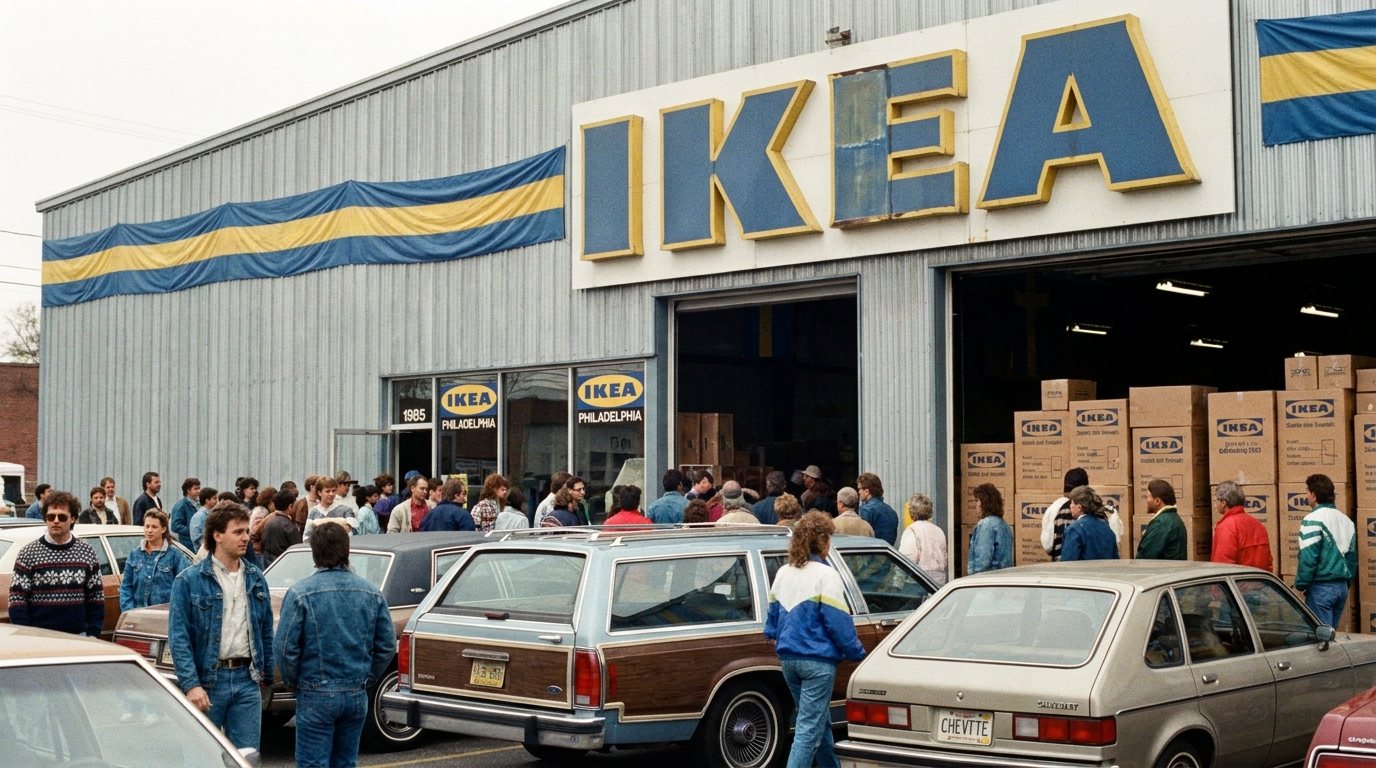
Canada came first, in 1976. The United States followed in 1985 with a store outside Philadelphia, and by the company's own telling, the debut was messy: the IKEA Museum's history of the North American expansion describes "early missteps in Canada" and a "chaotic debut in Philadelphia" before IKEA found real footing in the U.S. market. FundingUniverse notes that American shoppers turned out to be more receptive to IKEA's self-assembly, self-service concept than many of the more conservative European markets IKEA had already cracked, and that the Canadian experience gave IKEA a dry run for adapting Scandinavian retail habits to North American shopping expectations.
By 1997, IKEA had grown to $5.86 billion in global sales across more than 140 stores in about 30 countries, per Wikipedia. Kamprad stepped back from IKEA's board in 2013 at age 87, handing leadership to his sons, and died in January 2018 at 91. Today IKEA operates roughly 500 stores in 60 countries, generating about €44.6 billion in annual revenue, and its ownership still runs through the foundation structure Kamprad built to keep the company independent for the long haul.
Retail's Unglamorous Engine
IKEA is a reminder that the parts of retail nobody photographs, a boycotted supplier list, a component sourced from a door factory instead of a furniture maker, are often what decide who wins. This series will keep tracing those threads through the companies on NRF's list.