
Michaels: How a Failed Five-and-Dime Built a Craft Empire
Michaels ranks #84 on NRF's 2026 Top 100 Retailers list with $5.29B in U.S. sales. Its five-decade history is a case study in absorbing failed rivals' stores.
Part of Retailer Playbooks — history-first profiles of every company on the NRF Top 100 Retailers list.
Michaels comes in at #84 on the National Retail Federation's Top 100 Retailers 2026 list, compiled with Kantar, on the strength of $5.29 billion in 2025 U.S. retail sales. That places the country's largest arts-and-crafts chain in the company of specialty retailers many times its age. Michaels earned its spot the hard way, through five decades of buyouts, near-misses, and a habit of showing up exactly when a competitor went out of business.
A five-and-dime with nothing left to lose
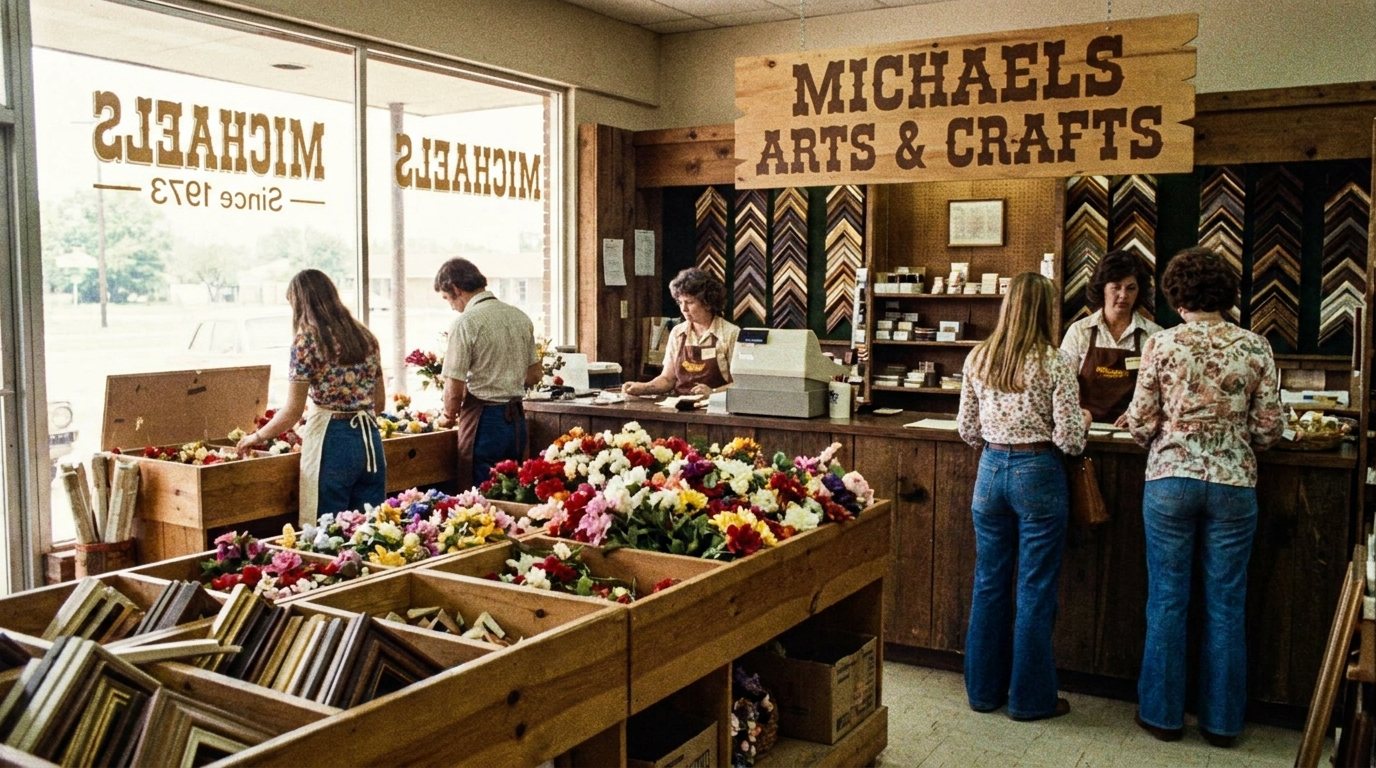
In 1973, Michael J. Dupey took over a money-losing Ben Franklin five-and-dime in Dallas and turned it into an arts-and-crafts store, according to Wikipedia's account of the chain's founding. Dupey's parent company, Dupey Enterprises, had been operating since 1962, but the craft-store conversion was the idea that stuck. Ben Franklin stores were a dying five-and-dime format by the early 1970s, undercut by discounters, and Dupey's insight was that the leftover real estate and foot traffic could support something narrower and more specialized: a store built entirely around hobbyists.
By 1982, the chain had grown to 11 stores and about $10 million in annual revenue when Dallas investor Sam Wyly bought controlling interest, according to FundingUniverse's company history. Dupey exited and started a rival chain, MJ Designs, which Michaels later acquired outright. Wyly and his brother Charles took the company public on NASDAQ in 1984 at $2.50 a share, with just 16 stores on the books.
The land grab
What followed was one of the more aggressive expansion campaigns in specialty retail. The Wylys poured more than $100 million into new stores and acquisitions through the mid-1980s, racing to plant a Michaels in every metro area before a competitor could claim the territory first. The shopping list, per FundingUniverse, included Montiel Corporation's 13 stores in 1984, six more regional chains and Moskatel's 28 California locations between 1985 and 1987, and Helen's Arts & Crafts, bought out of Walmart's hands in 1988. In 1994 and 1995 came the two biggest bolt-ons: Leewards Creative Crafts, adding 101 stores, and Aaron Brothers, the framing and art-supply chain, adding 71 more. By 1996, Michaels was running 450 stores and pulling in $1.24 billion in sales.
The pattern already visible in that stretch, buying someone else's struggling footprint rather than building from scratch, would define the company for the next 30 years.
The buyout that almost broke it
Rapid growth nearly capsized the company once. In 1990, Richard Bass's Arcadia Partners attempted a $225 million leveraged buyout of Michaels that fell apart, leaving the company with a $5 million charge and a balance sheet strained by years of debt-funded expansion. It took a new operating chief to fix what the acquisitions had left behind. R. Michael Rouleau, hired as CEO in 1996, rebuilt Michaels' inventory and distribution systems and tightened store-level operations enough to lift average store profitability by roughly 35 percent a year, according to FundingUniverse. By 2004 the chain had passed 850 stores and $3.39 billion in sales, proof that the Wyly-era land grab could be made to actually earn a return.
Three owners, one business
Michaels has changed hands more times than most retailers its size, and each transition tracked the broader private-equity cycle in retail.
| Year | Event |
|---|---|
| 1984 | IPO on NASDAQ, 16 stores |
| 2006 | Bain Capital and Blackstone buy Michaels for $6 billion, take it private |
| 2008 | 1,000th store opens, mid-financial-crisis |
| 2014 | Returns to NASDAQ as The Michaels Companies, raising about $472 million |
| 2019 | Absorbs roughly 40 former A.C. Moore store leases after its rival's collapse |
| 2021 | Apollo Global Management takes Michaels private again, in a deal valued near $5 billion |
Bain and Blackstone's 2006 buyout, at $6 billion, was itself a bet that a mature specialty retailer could still generate the cash flow to service serious debt. It worked well enough that Michaels opened its 1,000th store in the fall of 2008, of all moments, while much of retail was in freefall. A planned 2012 return to public markets stalled when CEO John Menzer suffered a stroke; Chuck Rubin, recruited from Ulta Beauty, took over in 2013 and shepherded the actual IPO in June 2014, this time under a new holding company, The Michaels Companies, per Wikipedia. Apollo's 2021 take-private, at $22 a share, closed the loop again.
The unwritten strategy: Michaels doesn't open stores, it inherits them
Read the timeline closely and a pattern emerges that Michaels rarely states outright: its store count has grown less from new construction than from being the buyer of last resort for failing craft and fabric retailers. Helen's Arts & Crafts came out of Walmart's divestiture in 1988. Leewards' 101 stores arrived because that chain couldn't make the format work alone. In 2016, Michaels bought Hancock Fabrics' intellectual property after Hancock liquidated in bankruptcy, then in 2019 it moved fast enough to take over roughly 40 A.C. Moore store leases within months of that chain's shutdown, converting them directly into Michaels locations. Around the same time, it folded its own Pat Catan's banner, acquired via the 2016 Lamrite West deal, back into the Michaels nameplate.
That is the throughline from 1973 to today: a five-and-dime became a craft chain because a format was dying, and the craft chain kept growing by being first in line whenever a competitor's format died next. It is a less glamorous strategy than most retail growth stories, but it has proven durable across five decades and three different ownership structures, which is more than most of Michaels' absorbed rivals can say.
Where that leaves Michaels now
Under Ashley Buchanan, who joined as CEO in 2020 from Walmart, Michaels pushed into a broader "maker space" store format aimed at framing, home décor, and DIY projects rather than pure craft supply, according to Wikipedia's summary of the chain's recent history. With NRF and Kantar crediting it with $5.29 billion in 2025 U.S. sales and a footprint that topped 1,250 stores across the U.S. and Canada as it entered the 2020s, Michaels remains the rare specialty retailer that has survived four different economic cycles by never quite looking like the same company twice, while somehow always ending up in the same business.
Every retailer on this list runs on the unglamorous machinery behind the storefront: leases, inventory systems, supplier lists, and the data that describes what is actually on the shelf. Michaels' history is a reminder that sometimes the fastest way to grow that machinery is to inherit someone else's.